Career Transition Tips for HR Professionals in the Age of AI
AI is transforming HR, creating new opportunities and challenges. Discover practical tips to build future-ready skills, embrace AI tools, and successfully transition your HR career with confidence in the evolving workplace.
 Prerana B A
The HR profession is experiencing a major transformation as artificial intelligence reshapes traditional workplace processes. From AI-powered recruitment and workforce analytics to talent management technology, organizations are increasingly using AI to improve efficiency and make smarter people-related decisions.
While automation is changing some HR responsibilities, it is also creating new opportunities for professionals who combine human expertise with digital skills. By embracing AI, investing in continuous learning, and developing strategic capabilities, HR professionals can stay competitive and build successful careers in the evolving world of work.
The Growing Impact of AI on Human Resources
Artificial intelligence is transforming HR by automating routine tasks and enabling more data-driven decision-making. From resume screening and employee onboarding to workforce planning, performance management, and predictive retention analysis, AI is helping organizations improve efficiency and optimize talent management processes.
The adoption of AI in HR continues to grow, creating a greater need for professionals who can combine HR expertise with digital and analytical skills. Leading organizations are already leveraging AI to enhance workforce outcomes. For example, Unilever uses AI-powered assessments and video interview analysis to streamline recruitment, while IBM utilizes AI-driven tools to identify skill gaps and recommend personalized learning opportunities for employees.
While AI improves productivity and supports faster decision-making, human skills remain at the core of effective HR management. Empathy, leadership, ethical judgment, and relationship-building continue to play a critical role in creating positive employee experiences and driving organizational success.
Why HR Professionals Should Embrace AI Rather Than Fear It
One of the biggest misconceptions surrounding AI is that it will eliminate HR jobs entirely. In reality, AI is changing the nature of HR work rather than replacing it.
Organizations increasingly need professionals who can:
- Interpret workforce data
- Manage AI-driven talent management systems
- Develop employee experience strategies
- Guide organizational change initiatives
- Ensure ethical use of AI in HR processes
- Align workforce strategies with business goals
As AI handles repetitive administrative tasks, HR professionals gain more time to focus on strategic decision-making. This shift allows HR departments to become stronger business partners and contribute directly to organizational success.
The rise of AI in human resources creates opportunities for professionals willing to adapt. Those who develop technology skills while maintaining strong people management capabilities are likely to experience accelerated HR career growth in the coming years.
Refer to these articles:
- How an AI Marketing Course helps you stay competitive
- The Future of AI in Healthcare
- Top AI Career Opportunities in Finance for Future Professionals
Key Career Transition Tips for HR Professionals in the Age of AI
As artificial intelligence continues to reshape HR functions, professionals must proactively adapt their skills and career strategies to remain competitive. Rather than viewing AI as a threat, HR professionals should see it as an opportunity to expand their expertise and take on more strategic responsibilities. The following career transition tips can help HR practitioners thrive in an AI-driven workplace.
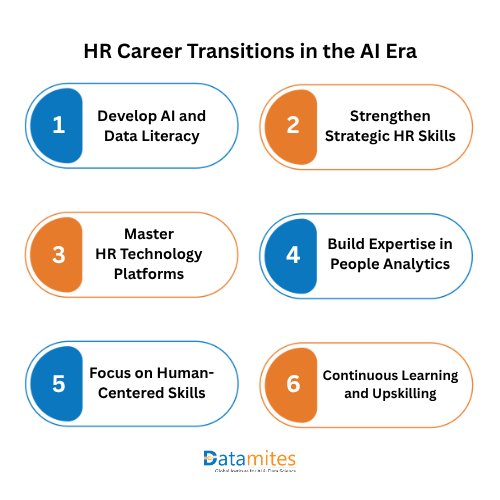
Develop AI and Data Literacy
Understanding AI does not require becoming a software engineer or data scientist. However, HR professionals should develop a working knowledge of how AI systems operate and how they are applied within HR functions.
Key areas to learn include:
- AI fundamentals
- Machine learning in HR
- Predictive analytics
- Workforce analytics
- Data privacy and ethics
- HR performance metrics
Professionals who understand data-driven HR practices can make more informed decisions and communicate more effectively with technology teams.
Learning how to interpret workforce data is becoming just as important as traditional HR expertise. Data literacy enables HR professionals to identify trends, measure outcomes, and contribute valuable insights to leadership discussions.
Strengthen Strategic HR Skills
As technology takes over operational tasks, strategic capabilities become increasingly important.
Modern HR professionals should focus on:
- Business Alignment: Understanding business objectives helps HR teams create workforce strategies that directly support organizational growth.
- Workforce Planning: Organizations increasingly rely on predictive workforce planning to address future talent needs. HR professionals who can forecast skill gaps and workforce requirements add significant value.
- Organizational Development: Managing transformation, improving culture, and supporting business growth remain critical responsibilities that require human expertise.
Strategic thinking allows HR professionals to move beyond transactional responsibilities and become trusted advisors to leadership teams.
Master HR Technology Platforms
Digital transformation in HR is accelerating rapidly. Professionals who understand HR technology platforms gain a significant competitive advantage.
Important technologies include:
- Applicant Tracking Systems (ATS)
- Human Resource Information Systems (HRIS)
- Employee engagement platforms
- Learning management systems
- AI-powered recruitment software
- Talent management technology
- Workforce analytics dashboards
Digital fluency enables HR professionals to maximize technology investments and improve organizational outcomes.
Rather than viewing technology as a threat, successful professionals see it as a tool that enhances productivity and effectiveness.
Build Expertise in People Analytics
People analytics is emerging as one of the most valuable specialties in modern HR.
Organizations increasingly rely on data to answer critical questions such as:
- Why are employees leaving?
- Which candidates are most likely to succeed?
- How effective are training programs?
- What factors influence employee engagement?
- Which teams are at risk of burnout?
Professionals who understand workforce analytics and people analytics can transform raw data into actionable business insights.
This capability helps organizations improve productivity, retention, and employee satisfaction while positioning HR as a strategic business function.
Focus on Human-Centered Skills
While AI can automate processes, it cannot replace essential human skills.
HR professionals should continue strengthening:
- Emotional Intelligence: Understanding emotions, building trust, and managing relationships remain fundamental HR responsibilities.
- Leadership: Organizations need leaders who can inspire teams, navigate uncertainty, and guide change initiatives.
- Communication: Clear communication helps organizations manage transitions, resolve conflicts, and maintain employee engagement.
- Change Management: As technology adoption accelerates, HR professionals often lead transformation efforts. Effective change management skills are becoming increasingly valuable.
Human-centric leadership remains one of the most important differentiators in an AI-driven workplace.
Invest in Continuous Learning and Upskilling
One of the most effective ways to future-proof a career in AI for HR is through continuous learning.
HR upskilling should focus on both technical and strategic competencies.
Recommended learning areas include:
- AI skills for HR professionals
- Data analytics
- HR technology
- Workforce planning
- Employee experience design
- Digital transformation strategies
- Leadership development
Professionals can pursue certifications, online learning platforms, university programs, and industry-recognized credentials to remain competitive.
Reskilling and upskilling are no longer optional. They have become essential components of long-term career success.
Emerging HR Roles in the AI Era
As AI adoption grows, entirely new career paths are emerging within human resources.
- People Analytics Specialist: Focuses on analyzing workforce data to support organizational decision-making and performance improvement.
- HR Technology Consultant: Helps organizations select, implement, and optimize HR technology solutions.
- AI Recruitment Specialist: Manages AI-powered recruitment platforms and develops advanced talent acquisition strategies.
- Workforce Planning Analyst: Uses predictive analytics to forecast workforce needs and support organizational growth.
- Employee Experience Manager: Designs initiatives that improve engagement, productivity, and workplace satisfaction.
- Learning and Development Strategist: Creates personalized learning programs supported by AI-driven recommendations and skills intelligence platforms.
These roles highlight how HR career transformation is creating exciting opportunities for professionals willing to adapt.
Essential Skills HR Professionals Need for Future Career Growth
The future of HR jobs will require a combination of technical expertise and human-centered capabilities.
Key skills include:
- Analytical Thinking: The ability to interpret data, identify patterns, and make evidence-based decisions.
- Digital Skills: Understanding HR technology, automation tools, and AI applications.
- AI Collaboration: Knowing how to work effectively alongside AI systems rather than competing against them.
- Strategic Leadership: Aligning workforce initiatives with broader organizational objectives.
- Adaptability: Remaining flexible in response to changing technologies and business needs.
- Ethical Decision-Making: Ensuring fairness, transparency, and compliance in AI-driven HR practices.
Professionals who cultivate these AI for HR skills will be better prepared for long-term HR career growth.
Common Career Transition Mistakes HR Professionals Should Avoid
While adapting to AI presents many opportunities, certain mistakes can limit career advancement.
- Ignoring Technology Trends: Avoiding AI and digital transformation can quickly make skills outdated.
- Delaying Skill Development: Waiting until new technologies become mandatory often creates unnecessary career challenges.
- Overreliance on Automation: Technology should support human judgment, not replace it entirely.
- Neglecting Interpersonal Skills: Strong relationships, empathy, and communication remain essential despite technological advancements.
- Resisting Organizational Change: Organizations value professionals who embrace innovation and help others adapt successfully.
Avoiding these mistakes can significantly improve long-term career prospects.
Refer to these articles:
- What Are Graph Neural Networks?
- Traditional AI vs Generative AI
- What is Artificial Narrow Intelligence?
How AI and Human Expertise Can Work Together in HR
The future of HR is not about replacing people with AI but combining technology with human expertise to achieve better outcomes. While AI can automate routine tasks and provide valuable insights, HR professionals bring empathy, critical thinking, and relationship-building skills that technology cannot replicate.
Examples of AI-Human Collaboration:
- AI screens resumes, while recruiters conduct meaningful interviews.
- Analytics tools identify engagement trends, while HR leaders create employee support strategies.
- Predictive models forecast turnover risks, while managers address concerns through coaching and communication.
Organizations that balance automation with human judgment often achieve stronger employee experiences, better talent outcomes, and higher workforce productivity. HR professionals who effectively leverage AI while maintaining a people-first approach will be best positioned for future career success.
AI in HR is transforming the way organizations approach talent acquisition, workforce planning, employee experience, and talent management. While automation is reshaping many traditional HR responsibilities, it is also creating new opportunities for professionals to take on more strategic, analytical, and business-focused roles. HR professionals who embrace change and understand how to leverage AI in HR tools can position themselves for long-term career success.
According to the World Economic Forum, AI and automation are expected to transform millions of jobs while simultaneously creating new opportunities that require digital and technology-focused skills. This highlights why continuous learning, AI literacy, and workforce adaptability have become essential for long-term career success.
To succeed in the future of HR, professionals must invest in continuous learning, develop AI and data literacy, strengthen strategic thinking, and maintain strong human-centered leadership skills. By combining technological expertise with empathy, communication, and business acumen, HR professionals can drive organizational growth and remain valuable contributors in an increasingly AI-powered workplace.
DataMites offers an AI for HR course that helps HR professionals develop skills in artificial intelligence, people analytics, and data-driven workforce management. The program covers key areas such as talent acquisition, employee engagement, workforce planning, and performance management, enabling professionals to apply AI effectively across HR functions.
The course is available through online and classroom training, along with hands-on projects and internships. Participants can earn globally recognized certifications, including IABAC accreditation and the Certified AI Professional in People Analytics credential. With over 30 training centers across cities such as Bangalore, Hyderabad, Chennai, Pune, Mumbai, Ahmedabad, Coimbatore, and Delhi, DataMites provides flexible learning opportunities for HR professionals seeking career growth in the AI era.