How Does AI Work? A Simple Explanation for Beginners
Artificial Intelligence works by using data, algorithms, and models to identify patterns, learn from information, and make decisions. This simple explanation explores how AI processes data and performs tasks that typically require human intelligence.
 Farheen Sabha
Artificial Intelligence is transforming the way we interact with technology, making machines smarter and more capable of performing tasks that once required human intelligence. From voice assistants like Siri and Alexa to personalized recommendations on Netflix and Amazon, AI is embedded in our daily lives. But how does AI actually work?
At its core, AI functions by processing vast amounts of data using advanced algorithms and mathematical models to identify patterns, make decisions, and even improve over time. It leverages techniques like machine learning, deep learning, and neural networks to enable computers to "learn" from experience without being explicitly programmed for every task.
In this beginner-friendly guide, we’ll break down the fundamentals of AI, how it processes information, and its real-world applications, making it easy to understand even if you have no prior technical knowledge.
What is Artificial Intelligence?
Artificial Intelligence is the field of computer science that enables machines to simulate human intelligence. It involves developing algorithms and models that allow computers to perform tasks that typically require human cognition, such as problem-solving, learning, decision-making, and natural language understanding.
According to ABI Research, the AI software market, valued at USD 122 billion in 2024, is expected to grow at a 25% Compound Annual Growth Rate (CAGR), reaching an estimated USD 467 billion by 2030. Generative AI is projected to be the fastest-growing AI framework, with a 34.5% CAGR over the forecast period, driven by opportunities in foundation models, optimization software, and model deployment tools.
AI systems can work in different ways depending on their purpose, but most rely on data, computational methods, and trained models to produce predictions, classifications, recommendations, or generated outputs. The quality of an AI system also depends on factors such as the data used, model performance, testing, and how the system is evaluated in its intended application. Organizations such as NIST emphasize testing, evaluation, reliability, security, and responsible AI practices as important parts of developing and deploying trustworthy AI systems.
Refer to these articles:
- The Impact of AI on Various Industries: Current and Future Trends
- AI in Cybersecurity: How Companies Are Fighting AI-Powered Threats
- Small Language Models vs Large Language Models: Which Should You Use?
How Does Artificial Intelligence Works
Artificial Intelligence (AI) is a field of computer science that focuses on creating machines capable of performing tasks that typically require human intelligence. These tasks include problem-solving, decision-making, language understanding, and learning from experience. Here’s a basic breakdown of how AI works:
1. Data Collection
Artificial Intelligence systems thrive on data, which serves as the foundation for learning and decision-making. The data can be collected from various sources such as sensors, websites, social media platforms, customer interactions, or databases. For example, an AI-powered recommendation system might gather user preferences, browsing behavior, and purchase history to suggest products. The quality and quantity of data play a crucial role in determining the model's effectiveness.
2. Data Preprocessing
Raw data often contains errors, inconsistencies, or irrelevant information. Data preprocessing ensures that the dataset is clean, organized, and suitable for analysis. This step may involve:
- Removing duplicate entries and irrelevant data
- Handling missing values through techniques like mean imputation or interpolation
- Normalizing data to maintain consistency
- Encoding categorical data into numerical values for machine learning algorithms
3. Model Selection
Choosing the right algorithm is key to building an efficient Artificial Intelligence course system. Common model types include:
- Neural Networks: Mimic the structure of the human brain for complex pattern recognition tasks like image or speech recognition.
- Decision Trees: Useful for classification and regression tasks by mapping decision paths.
- Support Vector Machines (SVM): Ideal for data with clear margins between classes.
4. Training the AI Model
Training involves feeding the AI system with data so it can identify patterns, relationships, and trends. The model adjusts its internal parameters (weights and biases) to minimize errors and improve accuracy. Techniques like supervised learning, unsupervised learning, and reinforcement learning are used depending on the task.
5. Testing and Validation
After training, the model's performance is evaluated using testing data. This ensures the model can generalize its knowledge to new, unseen data. Metrics like accuracy, precision, recall, and F1 score help assess its effectiveness. Validation techniques such as cross-validation further ensure the model isn’t overfitting (memorizing data instead of learning meaningful patterns).
6. Deployment and Improvement
Once the model proves effective, it’s deployed in real-world applications such as chatbots, recommendation engines, or fraud detection systems. After deployment, AI systems also need to be monitored to evaluate performance, detect errors or unexpected behavior, and identify changes in real-world data. As new data becomes available, the model may need to be retrained, fine-tuned, or otherwise updated to maintain reliable performance.
AI is transforming industries and daily life, making tasks more efficient and intelligent. The more AI advances, the more integrated it will become in various aspects of society. According to the Statista Report, the global Artificial Intelligence market is projected to reach US$617.62 billion in 2026 and grow at a 14.82% CAGR from 2026 to 2032, reaching an estimated US$1.42 trillion by 2032.
Refer to these articles:
- Highest Paying Jobs in India: Career Opportunities and Insights
- Mastering Data Science in India
- Tableau developer salary in India?
Key Components of Artificial Intelligence
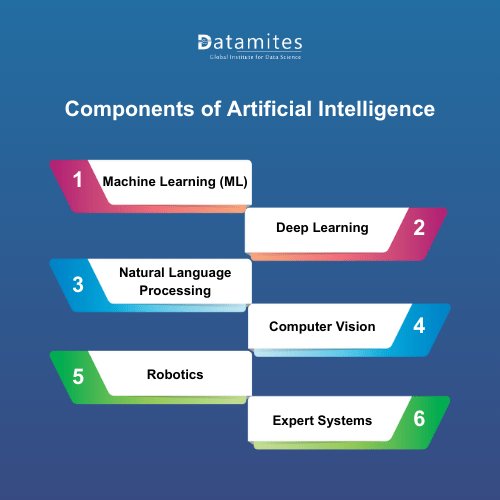
Artificial Intelligence is a broad field that enables machines to perform tasks requiring human-like intelligence. It comprises several key components that work together to process data, make decisions, and improve over time. Here’s a closer look at the fundamental components of AI:
1. Machine Learning (ML): Machine Learning is a subset of AI that enables computers to learn from data without explicit programming it includes:.
- Supervised Learning: The model is trained on labeled data (e.g., spam detection in emails).
- Unsupervised Learning: The model identifies patterns in unlabeled data (e.g., customer segmentation in marketing).
- Reinforcement Learning: The model learns through rewards and punishments (e.g., AI in robotics and gaming).
2. Deep Learning : A specialized form of ML that mimics the human brain’s neural networks. Deep Learning is crucial in image recognition, speech processing, and autonomous systems.
3. Natural Language Processing (NLP) : NLP enables AI to understand, interpret, and respond to human language. Applications include chatbots, translation tools, and voice recognition systems.
4. Computer Vision : Computer Vision allows AI to process and analyze images and videos. It is widely used in facial recognition, medical imaging, and autonomous driving.
5. Robotics: AI-powered robots are designed to perform complex tasks in industries such as manufacturing, healthcare, and space exploration.
6. Expert Systems: AI systems that mimic human decision-making based on predefined rules and logic. These are used in medical diagnosis and financial analysis.
Modern Artificial Intelligence also includes technologies such as generative AI, large language models (LLMs), and AI agents. These systems build on established AI techniques to generate content, understand and process language, and perform multi-step tasks. Their growing use in applications such as content generation, coding, search, customer support, and workflow automation has expanded how Artificial Intelligence is applied in real-world settings.
As AI continues to evolve, it integrates key technologies such as machine learning, deep learning, natural language processing (NLP), computer vision, robotics, and big data processing to drive intelligent decision-making. With ongoing advancements, AI is set to transform industries and redefine the future of technology.
Pros and Cons of Artificial Intelligence: Its Impact on the Present and Future
According to MarketsandMarkets, the global generative AI market is projected to reach USD 185.45 billion in 2026 and grow at a 36.8% CAGR from 2026 to 2033, reaching USD 1,658.97 billion by 2033. Artificial Intelligence Training is revolutionizing industries by automating processes and enhancing human-technology interactions. While AI brings significant advantages, it also introduces notable challenges.
Pros of Artificial Intelligence
- Efficiency and Automation: AI automates repetitive tasks, reducing human effort and increasing productivity.
- Enhanced Decision-Making: AI analyzes large datasets to provide accurate and data-driven insights.
- Personalization: AI tailors user experiences, such as personalized recommendations in e-commerce and streaming services.
- Improved Healthcare: AI assists in early disease detection, medical imaging, and robotic surgeries.
- 24/7 Availability: AI systems do not suffer from fatigue and can operate continuously without breaks.
- Advancements in Autonomous Technology: AI powers self-driving cars, drones, and smart home systems.
Cons of Artificial Intelligence
- Job Displacement: Automation through AI may replace certain jobs, leading to unemployment concerns.
- Bias and Ethical Concerns: AI models may inherit biases present in training data, leading to unfair decision-making.
- High Development Costs: Implementing AI solutions requires significant investment in technology and expertise.
- Security and Privacy Risks: AI-driven systems can be vulnerable to cyber threats and data breaches.
- Limitations in Human-Like Creativity and Emotion: AI can generate creative content and simulate aspects of human-like interaction, but it does not possess human emotions, lived experiences, or consciousness.
Refer to these articles:
Artificial Intelligence is transforming industries and shaping the future of technology. Understanding its fundamentals, key components, and impact helps individuals and businesses leverage AI effectively. While AI offers numerous benefits, addressing its challenges is crucial for responsible and ethical development. As technology evolves, AI will continue to play an integral role in innovation, making our lives smarter and more efficient.
Recognized as one of the Top 20 AI training institutes in India by Analytics India Magazine, DataMites Training Institute offers a comprehensive Offline Artificial Intelligence Course in Bangalore. This program is designed to equip individuals with the skills and expertise needed to thrive in the AI field. Tailored for both beginners and professionals, the course provides an in-depth understanding of AI concepts and applications. Accredited by IABAC and NASSCOM FutureSkills, the program aligns with global AI education standards. DataMites offers internship opportunities and dedicated placement support, ensuring that learners gain practical experience and successfully transition into AI careers.
The Offline Artificial Intelligence course in Chennai is designed to provide learners with a structured learning experience that combines foundational concepts with practical application. DataMites also offers Artificial Intelligence learning options in cities such as Bangalore, Pune, Hyderabad, Mumbai, Ahmedabad, Delhi, and Coimbatore, subject to current course and centre availability. Artificial Intelligence incorporates key features that promote both theoretical learning and practical application, catering to diverse learning preferences while ensuring an industry-relevant education.
Artificial Intelligence Courses operate by processing vast amounts of data using advanced algorithms and mathematical models to mimic human intelligence.While AI continues to evolve, understanding its fundamental principles helps us appreciate its potential and navigate its challenges. As AI becomes more integrated into our world, responsible development and ethical considerations will be key to ensuring its benefits are maximized for society.