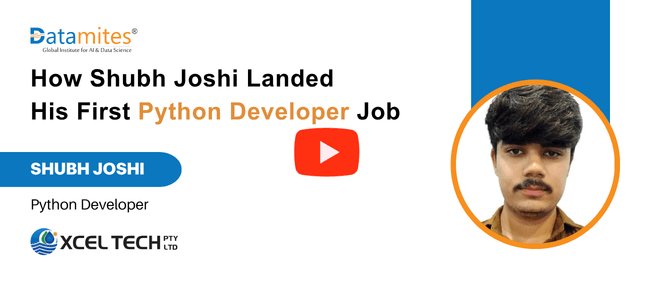
How Shubh Joshi Landed His First Python Developer Job as a Fresher
Learn how Shubh Joshi landed his first Python Developer job as a fresher. Discover his Python learning journey, essential skills, projects, interview preparation, and job search tips for aspiring Python developers.
 Priyanka BR
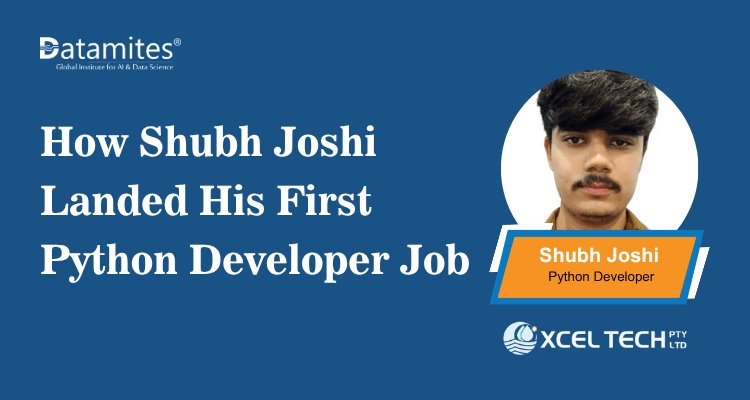
Have you ever wondered how a fresher can build a successful career in Data Science and Python development? Meet Shubh Joshi, a computer engineering graduate from Palanpur, who turned his interest in Data Science, Machine Learning, and Artificial Intelligence into job-ready skills.
His journey focused on understanding concepts, practicing coding, and gaining hands-on experience through real-world projects. He also explored advanced topics like Transformers and Generative AI to strengthen his knowledge.
With structured learning at DataMites Institute, practical experience, and consistent interview preparation, Shubh gained the confidence to begin his professional journey as a Python Developer. His story shows how focused learning and regular practice can help freshers achieve their career goals.
How Shubh Joshi Built His Data Science Career with DataMites
Shubh Joshi's journey from a computer engineering graduate to a Python Developer highlights the value of consistent learning, practical experience, and the right guidance. Through DataMites structured training, hands-on projects, and interview preparation, he strengthened his Data Science and Machine Learning skills and confidently began his professional career.
Q1: Could you please introduce yourself and tell us about your academic background?
My name is Shubh Joshi, and I am from Palanpur. I completed my Bachelor’s degree in Computer Engineering. After that, I joined DataMites Institute, where I learned Python, Machine Learning, Deep Learning, NLP, and Data Science. I also continued learning on my own and explored topics like Transformers and Generative AI. Currently, I am working as a Python Developer at Xcel Tech.
Q2: When and where did you join DataMites?
I joined DataMites in Ahmedabad, where I completed the Data Science course. I wanted to build a stronger foundation in Data Science and learn how Machine Learning and other technologies could be applied practically.
Q3: Did you already know programming before joining DataMites?
Yes, I already had programming knowledge because I was a Computer Engineering student. Programming was not completely new to me. However, I wanted to explore the AI and Data Science field and understand how programming could be applied to data analysis, Machine Learning, and related areas.
Q4: How did you approach your studies during the course?
I focused more on understanding Data Science and Machine Learning concepts than memorizing definitions. Once I understood a concept, I could explain it in my own words. I also spent more time on coding practice and practical learning, which helped me build stronger technical skills and confidence.
Q5: What learning resources did you use apart from the training material?
Apart from the training material, I used YouTube to understand certain concepts in greater depth. I mainly followed Krish Naik and CampusX. Krish Naik helped me understand concepts involving mathematics and technical details, while CampusX explained many topics in a way that was easy for me to understand.
Q6: What projects did you complete during your internship?
During my internship, I completed five projects. These included Parkinson’s disease prediction, salary prediction, bike rental prediction, salary-related analysis, and house price prediction. I worked on these projects from beginning to end. I wanted to understand the complete process instead of simply completing individual parts of a project.
Q7: Were questions about your projects asked during your interview?
Yes, definitely. The interviewers asked questions about the projects on my resume, including model selection, accuracy, dataset management, and data transformation. So, understanding my projects clearly was very important.
Q8: How many rounds did you have to clear during the interview process?
There were six interview rounds in total, covering aptitude, problem-solving, web scraping, technical discussions, HR, and a final management round. I had to prepare for both technical and practical assessments.
Q9: What practical task were you given during the interview?
I was given a web scraping task. I had to scrape the Flipkart website and collect images and text from it. I had around two hours to complete the task. It was challenging because of the time limit, but I managed to complete it successfully.
Q10: What type of questions were asked in the technical round?
Most questions focused on Deep Learning and Machine Learning Algorithms, accuracy, confusion matrix, evaluation metrics, and my projects. I also solved business cases, so practical knowledge was equally important.
Q11: Did you face stage fear during your earlier interviews?
Yes, initially I had stage fear. I overcame it by practicing interview questions on my own and using AI tools for mock interviews. Regular practice helped me become more confident during interviews.
Q12: Did you receive support from the placement team?
Yes, I received support from the placement team. They helped me understand which areas I needed to improve and what additional skills I should develop. Their feedback helped me identify the gaps in my preparation and work on them before appearing for further opportunities.
Q13: What should freshers focus on when starting a Data Science career?
If you are a fresher, first build strong Data Science fundamentals, then learn Deep Learning and model deployment. Building a Machine Learning model is not enough; you should also know how to deploy it in real-world environments.
Q14: Do you think Artificial Intelligence will replace jobs in the future?
I don’t think Artificial Intelligence will replace all jobs. We need to upgrade our skills because AI can generate code, but humans still need to understand client requirements, make decisions, and modify the output when needed.
Q15: What advice would you give to students preparing for Data Science interviews?
My advice is to understand concepts instead of memorizing definitions. Practice coding, work on projects, and prepare for aptitude tests. Also, learn deployment, cloud technologies, and MLOps, and keep practicing interviews to improve with every experience.
Refer to these articles:
- What Is AI? Know Everything About Artificial Intelligence (AI)
- How will Artificial Intelligence Change the Insurance Industry?
- Top 10 Examples Of Artificial Intelligence In Use Today
Shubh Joshi’s Key Takeaways on Building a Data Science and AI Career
Shubh’s journey shows that strong fundamentals, practical learning, and consistent interview preparation can help freshers build a successful career in Data Science and Python development.
Background: Shubh completed his Bachelor of Computer Engineering from GC Gandhinagar and developed a strong interest in Data Science and Machine Learning.
- Skill Development: He strengthened his knowledge of Python, Machine Learning, Deep Learning, NLP, and Data Science while also exploring Transformers and Generative AI.
- Learning Approach: He focused on understanding concepts instead of memorizing definitions and spent more time practicing coding and practical applications.
- Practical Experience: Shubh worked on multiple projects, including Parkinson’s prediction, salary prediction, bike rental, and house price prediction, gaining hands-on experience.
- Interview Preparation: He prepared through mock interviews, aptitude practice, coding, web scraping, and regular revision of Machine Learning and Data Science concepts.
- Technical Skills: His interview preparation covered algorithms, accuracy, confusion matrix, evaluation metrics, Machine Learning, Deep Learning, and real-world business cases.
- Project Knowledge: He understood his projects thoroughly, including model selection, dataset management, data transformation, and the reasons behind choosing specific approaches.
- Interview Experience: His selection process included six rounds covering aptitude, problem-solving, web scraping, technical discussions, HR, and a final management round.
- Career Preparation Strategy: With the growing demand for IT courses, Shubh recommends learning Data Science fundamentals first, followed by Deep Learning, deployment, cloud technologies, and MLOps.
- Key Advice: Focus on concepts, practice coding regularly, build projects, prepare for aptitude tests, and keep improving through every interview experience.
- Outcome Summary: Shubh’s journey demonstrates how structured training, hands-on projects, consistent practice, and continuous learning can help freshers confidently begin their professional career.
Refer to these articles:
- How Rakghitha Started Her AI Developer Career as a Fresher
- How Jayaram Transitioned from Mechanical Engineering to an AI Engineer
- How Abhijeet Started His ML Engineer Career as a Fresher
If Shubh Joshi’s career journey has inspired you to explore opportunities in Artificial Intelligence, the right industry-focused training can help you build strong technical skills. Shubh strengthened his knowledge through DataMites Institute, structured learning, hands-on projects, consistent practice, and interview preparation. If you’re looking to begin a similar journey, you can explore the Artificial Intelligence Course in Ahmedabad offered by DataMites, where learners gain practical experience and industry-relevant AI skills to prepare for their careers.
DataMites Institute offers a structured 9-month Artificial Intelligence program that blends core concepts with practical, industry-focused learning. Learners work on real-world projects, practical assignments, and hands-on exercises to build skills for roles such as AI Engineer, Artificial Intelligence Specialist, and NLP Professional. The program also provides certifications from IABAC and NASSCOM FutureSkills, helping learners strengthen their technical expertise, professional credibility, and readiness for opportunities in the evolving Artificial Intelligence industry.
With 50+ training centers across India, DataMites brings industry-focused Artificial Intelligence learning closer to aspiring professionals in different cities. Learners can explore Artificial Intelligence Courses in Delhi, Chennai, Hyderabad, Bangalore, Mumbai, Coimbatore, Ahmedabad, Nagpur, and Kolkata, with opportunities to work on practical projects, develop hands-on expertise, and learn under the guidance of experienced mentors to become career-ready.