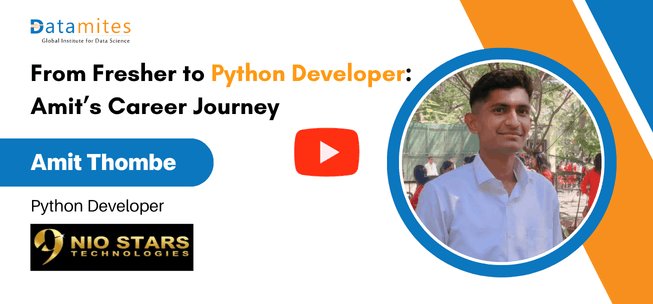
From Fresher to Python Developer: Amit’s Inspiring Career Journey
Amit’s journey shows how a fresher can become a Python developer through consistent learning, practice, and real project experience. It highlights that with focus and training, starting a tech career in Python is achievable.
 Priyanka BR
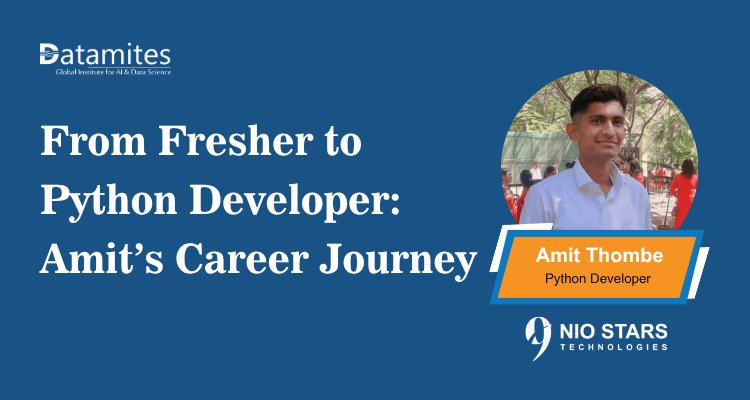
Have you ever wondered how a Computer Science graduate can transform classroom knowledge into a successful career as a Python Developer? Meet Amit, whose determination, consistent learning, and focused preparation helped him take the first step toward a professional career in the technology industry.
While pursuing his Master’s in Computer Science, Amit chose to upskill in Data Science and Artificial Intelligence. Through project work, mock interviews, and daily practice, he gradually built the technical and problem-solving skills needed for industry roles.
A key part of his journey was the guidance he received at DataMites. With hands-on training, practical projects, and interview preparation support, Amit gained the confidence and skills required to successfully begin his professional career.
How DataMites Played a Role in Amit’s Journey to Becoming a Python Developer
This Q&A highlights Amit’s journey from a Master’s in Computer Science to becoming a Python Developer. He shares his experience with DataMites training in Data Science and Artificial Intelligence, along with mock interview practice, project work, and preparation strategies that helped him successfully transition into the industry.
1. Can you briefly introduce yourself?
My name is Amit. I completed my Master’s in Computer Science in 2024. During my master’s, I decided to upskill in the field of Data Science and Artificial Intelligence, and I joined the DataMites certified course in February 2024. I attended both offline sessions in Pune and online lectures conducted by Bangalore trainers as part of my learning journey. Eventually, my efforts helped me get placed as a Python Developer at Nio Stars.
2. Why did you choose AI and data science after your master’s?
During my master’s, I developed an interest in data-related subjects, so I decided to build my career in artificial intelligence and data science and joined the certified course to strengthen my skills.
3. How was your learning experience in the course?
The learning experience at DataMites was very good. The concepts were explained in a simple and easy-to-understand way, which made even difficult topics easy to grasp. The teaching approach helped me build clarity step by step and made the overall learning process smooth and effective.
4. How did you begin getting ready for the interview process?
I attended a total of five mock interviews. In the beginning, the first mock interview was very tough for me, and I was not able to answer properly. After that, I understood my gaps and started preparing more seriously by focusing on concepts step by step. I improved gradually by practicing regularly and strengthening my basics for the next mock interviews.
5. What challenges did you face in later mock interviews?
In the second interview, I had knowledge but I could not explain properly. In the third one, I forgot SQL queries. In the fourth interview, there was miscommunication with the interviewer. These mistakes helped me improve.
6. How did mock interviews help you overall?
Each mock interview helped me identify my weak areas. By the fifth interview, I was much more confident and finally able to perform better and clear it.
7. How was your resume prepared and improved?
My resume was prepared with the support of the placement team. I first received resume templates, which helped me understand the correct format and structure. Based on those templates, I created my resume and shared it for review. After that, it was carefully checked and corrected to make it more professional and aligned with industry requirements.
8. What kind of projects did you include in your resume?
I included a product sales effectiveness project, an employee prediction project, and another predictive analytics project. One was part of the capstone project, while the others were completed independently.
9. Did you work on only institute projects or personal projects too?
I worked on both. One project was part of the capstone, and the other two I built on my own to strengthen my profile.
10. What do you think is more important in data science: Python, statistics, or machine learning?
For me, statistics is the core foundation that supports machine learning. Without it, understanding how algorithms analyze and learn from data becomes challenging.
11. How should a student approach statistics and machine learning?
First, you should focus on statistics and data analysis concepts. You should not directly jump into machine learning. After understanding statistics, you can move to machine learning topics like linear regression and logistic regression.
12. How was your interview experience?
My interview was quite normal. It was conducted by the hiring company and included both technical and managerial discussions.
13. What kind of questions were asked in the interview?
They asked scenario-based questions and questions related to my projects. I had to explain everything from data analysis to model building. There were no coding questions, only theoretical questions.
14. What is your long-term career goal?
My goal is to continue growing in the AI field and strengthen my technical expertise. I believe that continuously improving my skills is the key to long-term success.
15. What advice would you like to give to fresh learners?
Start from basics and don’t try to learn everything at once. Study one topic per day or give two days for one topic. Watch lectures repeatedly if needed and practice regularly. Most importantly, stay consistent and give at least 2 to 4 hours daily for study.
Refer to these articles:
- How AI is Transforming Cybersecurity in 2026
- How AI Engineer Programs Develop Practical Skills for Career Advancement
- Traditional AI vs Generative AI: Key Differences, Examples, and Use Cases
Amit’s Key Takeaways on Becoming a Python Developer
Amit’s journey highlights how consistent learning, structured practice, and mock interview preparation can help graduates build a successful career in the data science and AI field.
- Background: Amit completed his Master’s in Computer Science in 2024 and decided to upskill by joining DataMites training in Data Science and Artificial Intelligence.
- Skill Development: He focused on strengthening core concepts like Python, statistics, and machine learning through guided training and practice sessions in one of the top IT courses, which helped him build a strong technical foundation.
- Learning Experience: The training helped him understand complex topics in a simple and structured way through both offline and online classes.
- Practical Approach: He worked on multiple projects, including capstone and personal projects, to build real-world understanding and improve his technical confidence.
- Mock Interview Preparation: He attended five mock interviews, where initial struggles gradually turned into improved performance and better communication skills.
- Challenges Faced: He faced difficulties in explaining concepts, recalling SQL queries, and handling communication gaps, which helped him identify and improve weak areas.
- Resume Building: With placement support, he prepared a structured resume using templates and feedback to make it industry-ready.
- Interview Experience: His interview focused on projects and scenario-based questions, testing his ability to explain concepts rather than coding directly.
- Job Preparation Strategy: He dedicated more than four hours daily to studying and improving his technical skills.
- Key Advice: Amit believes strong fundamentals in statistics, consistent practice, and regular mock interviews are key to cracking data science interviews.
- Outcome Summary: His journey shows that disciplined learning, practical exposure, and continuous improvement through Python training can successfully lead to a career as a Python Developer in the AI and data science industry.
Refer to these articles:
- How Lakshmi Secured Her First Python Developer Job as a Fresher
- How Hemanth Entered the World of AI and Software Development
- How Vimal Secured His First Research Associate Job as a Fresher
If Amit’s success story has motivated you to explore opportunities in Python development and Artificial Intelligence, gaining industry-focused training can be an excellent first step. Amit began his learning journey with DataMites in Pune, where he developed his Data Science and AI skills through practical training and projects. Learners looking to follow a similar path can explore the Artificial Intelligence Course in Pune offered by DataMites, with training centers in Baner and Kharadi, providing hands-on learning and industry-relevant AI skills.
DataMites Institute offers a 9-month Artificial Intelligence program focused on practical learning, real-world projects, and hands-on skill development. The course prepares learners for careers such as AI Engineer, AI Specialist, and NLP Professional while providing globally recognized certifications from IABAC and NASSCOM FutureSkills. With a strong emphasis on industry-relevant training, the program helps learners build the expertise needed for successful careers in AI and emerging technologies.
With a presence in over 30 training locations across India, DataMites brings professional Artificial Intelligence education closer to aspiring learners. Students can access classroom training at major centers, including DataMites Ahmedabad, along with locations in Bangalore, Chennai, Pune, Mumbai, and Delhi. Each center emphasizes experiential learning through practical projects, industry-focused curriculum, and guided mentorship, helping learners build strong foundations for careers in Artificial Intelligence.