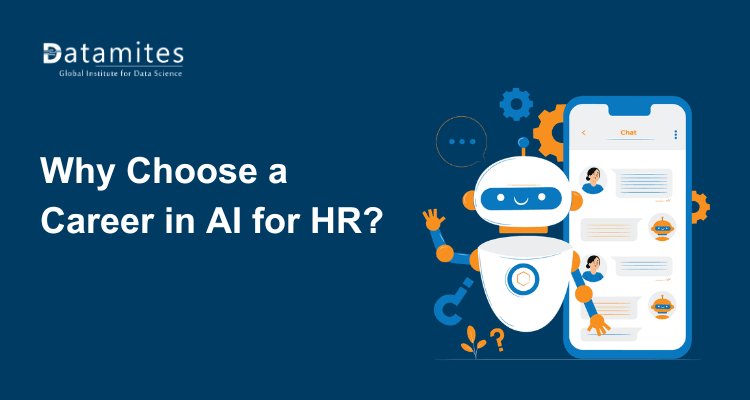
Why Choose a Career in AI for HR?
AI in HR offers high-growth career opportunities by combining technology and people management to improve hiring, employee experience, and smarter workplace decisions.
 Prerana B A
Artificial Intelligence is no longer limited to tech companies or data science labs. It is now transforming industries like healthcare, finance, retail, education, and especially human resources. As organizations invest in automation and intelligent systems, the demand for professionals who understand both HR and technology is rising fast. This is why AI for HR careers is becoming one of the most promising career paths today. Companies are adopting AI recruitment tools, workforce analytics, and employee engagement platforms to improve efficiency, reduce hiring bias, and make smarter workforce deci
According to Grand View Research, the global Artificial Intelligence in HR market was valued at approximately USD 3.25 billion in 2023 and is projected to reach USD 15.24 billion by 2030, growing at a CAGR of 24.8%. This rapid growth highlights the increasing demand for skilled professionals in HR technology and digital transformation. For HR professionals, fresh graduates, recruiters, and career switchers, building a career in AI for HR offers an exciting opportunity to combine people management with cutting-edge technology and future-ready skills.
How AI Is Transforming Human Resources
Here’s how AI is changing traditional HR operations:
- Recruitment: AI screens resumes, matches candidates to job roles, and uses chatbots for interview scheduling and candidate support.
- Training & Onboarding: AI delivers personalized learning paths and guides new employees through onboarding processes step by step.
- Performance Management: AI analyzes employee performance data and feedback to improve productivity, engagement, and goal alignment.
- Workforce Planning: AI predicts hiring needs, identifies skill gaps, and helps forecast employee turnover risks.
- Employee Support: AI-powered assistants handle HR queries related to payroll, leave policies, benefits, and internal processes.
- Automation: Routine HR tasks like payroll processing, attendance tracking, report generation, and documentation are automated for efficiency.
This transformation is creating strong demand for professionals interested in careers in HR technology.
Why AI for HR Is a Promising Career
The rise of automation and workforce intelligence has made AI for HR careers highly attractive for modern professionals.
High Demand for HR Tech Professionals
Companies across industries are investing heavily in HR technology platforms. Businesses need professionals who can manage AI tools, analyze workforce data, and improve hiring strategies.
As digital HR transformation continues, the demand for AI-savvy HR professionals is expected to increase significantly.
This makes a career in AI for HR professionals one of the most future-ready career choices today.
Attractive Salary Opportunities
Professionals with expertise in HR automation, people analytics, and AI recruitment systems often earn higher salaries compared to traditional HR roles.
Some high-paying roles include:
- People Analytics Manager
- HR Technology Consultant
- Talent Intelligence Specialist
- HR Automation Consultant
Since AI skills are still relatively specialized in HR, companies are willing to pay premium salaries for qualified talent.
A Future-Proof Industry
The future of HR jobs is closely connected to technology and automation. Traditional manual HR processes are gradually being replaced by intelligent systems.
However, AI will not replace HR professionals completely. Instead, it will enhance HR decision-making and create new opportunities for strategic roles.
Professionals who understand both human behavior and AI technology will remain highly valuable.
Combination of Technology and Human Interaction
One of the biggest advantages of a career in AI within HR is the balance between technology and people management.
You are not only working with software and analytics but also helping organizations:
- Improve employee experience
- Build inclusive workplaces
- Develop talent strategies
- Support workforce well-being
This makes the field both technically exciting and personally meaningful.
Global and Remote Career Opportunities
Many HR tech companies operate remotely and hire professionals from around the world. Skills in AI recruitment, HR analytics, and automation are highly transferable across industries and countries.
This opens doors to:
- Remote HR tech jobs
- Freelance consulting opportunities
- International HR careers
- Global talent acquisition roles
Refer to these articles:
- How AI Is Changing the Future of Product Development Strategy
- Essential AI Skills for Healthcare Professionals
- Applications of AI in Marketing and Real Use Cases
Top Career Opportunities in AI for HR
The growth of AI in human resources has created several exciting job roles.
HR Data Analyst
HR Data Analysts collect and interpret workforce data to help organizations make informed decisions.
Responsibilities:
- Analyze employee performance data
- Measure hiring effectiveness
- Track retention and turnover trends
- Generate workforce insights
This role is ideal for professionals interested in HR analytics careers.
AI Recruitment Specialist
AI Recruitment Specialists use AI recruitment tools to improve talent acquisition strategies.
Responsibilities:
- Manage AI hiring platforms
- Optimize resume screening systems
- Improve candidate matching
- Reduce recruitment bias
This is one of the fastest-growing areas in AI recruitment and talent acquisition careers.
HR Automation Consultant
HR Automation Consultants help companies automate HR workflows and implement intelligent HR systems.
Responsibilities:
- Deploy HR software
- Automate payroll and onboarding
- Improve HR operations
- Train HR teams on AI tools
Talent Intelligence Analyst
These professionals use predictive analytics and machine learning in HR to identify future talent needs.
Responsibilities:
- Workforce forecasting
- Skill gap analysis
- Talent market research
- Succession planning
People Analytics Manager
People Analytics Managers combine HR strategy with data science to improve workforce performance.
Responsibilities:
- Employee engagement analysis
- Productivity measurement
- Organizational planning
- Leadership reporting
HR Tech Product Specialist
This role focuses on HR software products and platforms.
Responsibilities:
- Product implementation
- User training
- Customer support
- Feature optimization
Professionals in this field often work with SaaS companies specializing in AI-powered HR solutions.
Skills Required for a Career in AI for HR
A successful AI for HR career requires a mix of HR knowledge, technical skills, and analytical thinking. Since this field combines people management with technology, professionals need a well-rounded skill set.
- HR Fundamentals: Understanding recruitment, performance management, employee relations, and workforce planning.
- Data Analytics Skills: Ability to analyze HR data using tools like Excel, Power BI, or Tableau.
- AI & HR Tech Knowledge: Familiarity with AI recruitment tools, HR automation systems, and AI-powered HR platforms.
- Basic Machine Learning Understanding: Knowledge of predictive analytics and how AI supports hiring and workforce decisions.
- HRIS Platforms: Experience with systems like Workday, SAP SuccessFactors, or Oracle HCM.
- Communication Skills: Ability to present insights clearly and collaborate with teams and leadership.
- Adaptability: Willingness to learn new HR technologies and keep up with digital transformation trends.
These skills help build strong opportunities in HR analytics, HR tech careers, and AI recruitment roles, shaping the future of HR jobs.
Benefits of Working in AI-Powered HR
Working in AI-powered HR isn’t just about using new tools. It changes how HR professionals think, decide, and create value inside an organization. Here are the key benefits:
More strategic and less repetitive work
AI takes over routine tasks like resume screening, scheduling, payroll processing, and report generation. This frees up HR professionals to focus on strategy, culture, and decision-making instead of admin-heavy work.
Faster and better decision-making
With AI-driven analytics, HR teams can work with real-time data instead of guesswork. Hiring decisions, retention strategies, and performance reviews become more accurate and data-backed.
Strong career growth opportunities
This field is still evolving, which means early professionals can grow quickly. Roles in HR tech, people analytics, and HR automation are expanding across industries.
Better employee experience
AI tools help personalize onboarding, training, and engagement. Employees get faster support, clearer communication, and more tailored learning paths, which improves satisfaction.
Higher earning potential
Because AI in HR requires a mix of HR knowledge and technical skills, professionals with this expertise are often paid more than traditional HR roles.
Cross-functional exposure
You don’t stay limited to HR alone. You work with data teams, product teams, and leadership, which builds stronger business understanding and leadership skills.
Global opportunities
AI-powered HR skills are transferable across industries and countries. That opens doors to remote roles, international companies, and consulting opportunities.
AI is changing HR into a more data-driven and strategic field. It improves decision-making, reduces routine work, and creates new career opportunities. Professionals who build AI and HR skills will be well positioned for the future.
Refer to these articles:
- Will AI Agents Replace Your Next Coworker? Exploring the Future of Work
- How AI is Transforming Customer Analytics in 2026
- Why Agentic AI Is the Most In-Demand Skill for Data Scientists in 2026
Future of AI in Human Resources
The future of AI in human resources is growing quickly, supported by major investments in HR technology and automation. Reports show AI is already reducing hiring time by up to 40% and automating many repetitive HR tasks. As organizations move toward digital HR transformation, demand is rising for professionals in AI for HR careers, HR analytics, and workforce intelligence.
HR is becoming more data-driven and automated as AI reshapes how companies manage talent and decision-making.
- Predictive hiring: AI will forecast candidate fit and retention.
- Employee engagement: AI will track sentiment and improve satisfaction in real time.
- Workforce planning: AI will predict hiring needs and skill gaps.
- Personalized learning: Training paths will be tailored using AI insights.
- Generative AI in HR: Job descriptions and communication will be automated.
- HR automation: Routine tasks like payroll and onboarding will be streamlined.
Overall, the future of AI in human resources will focus on empowering HR professionals with smarter tools, creating more strategic and high-value roles in HR technology and analytics.
The rapid growth of automation, workforce analytics, and intelligent recruitment systems has made AI for HR careers one of the most promising career paths today. It combines people management with technology, and as organizations invest in digital HR transformation, demand for skills in AI-powered HR, analytics, and recruitment technology continues to rise.
The future of HR jobs is not about replacing humans, but using AI to build smarter, faster, and more employee-focused workplaces. Now is the right time to learn HR tech skills, explore an AI in HR course, and prepare for future opportunities in AI and human resources.
DataMites Institute offers a structured AI for HR course aimed at helping HR professionals use artificial intelligence to make smarter, data-driven decisions. The course combines foundational AI concepts with people analytics and practical use cases across areas like talent acquisition, employee engagement, workforce planning, and performance management. It is part of a wider set of AI programs designed for professionals such as product managers, healthcare specialists, risk analysts, marketers, and business leaders.
Learners can select from flexible learning modes, including online training, classroom sessions, and hands-on internships with real-world projects. The program also provides globally recognized certifications, including IABAC accreditation and the Certified AI Professional in People Analytics. With more than 30+ offline centers across cities like Bangalore, Chennai, Hyderabad, Pune, Mumbai, Ahmedabad, Coimbatore, and Delhi, DataMites supports both in-person and virtual learning with a strong focus on career advancement.