The Role of AI in Financial Reporting and Financial Analysis
Explore the role of AI in financial reporting and financial analysis, including automated reporting, fraud detection, predictive analytics, financial forecasting, and risk assessment. Discover the benefits, challenges, and future of artificial intelligence in finance for smarter, data-driven business decisions.
 Kriti Maurya
Artificial intelligence has huge impact on how organizations prepare financial reports, analyze business performance, manage financial risks, and make strategic decisions. By combining machine learning, natural language processing, predictive analytics, and intelligent automation, finance teams can process large volumes of financial data more efficiently and identify patterns that may be difficult to detect through manual analysis alone.
AI in financial reporting can support tasks such as transaction classification, account reconciliation, financial document processing, and report preparation. Similarly, AI in financial analysis can help organizations forecast cash flow, evaluate financial performance, identify unusual transactions, and assess potential business scenarios.
For example, a finance team can use AI-enabled tools to compare bank transactions with general ledger entries, flag unexplained differences, and prioritize items for investigation. Financial analysts can also use Predictive and Prescriptive Analytics to evaluate how changes in operating expenses, sales, or customer payment patterns might affect future cash flow.
However, AI does not guarantee accurate financial results. Its effectiveness depends on the quality of the underlying data, the suitability of the models, the controls surrounding their use, and the expertise of the professionals reviewing their outputs.
Understanding the applications, benefits, limitations, and future potential of AI in finance can help organizations adopt these technologies responsibly.
What Is AI in Financial Reporting and Financial Analysis?
AI in financial reporting and financial analysis refers to the use of artificial intelligence technologies to process financial information, recognize patterns, automate selected workflows, and support financial decision-making. According to a KPMG report, while approximately 30% to 41% of organizations currently use AI extensively in financial reporting, adoption is expected to grow substantially, with nearly 83% projected to adopt AI extensively within the next three years.
Although the two functions are closely related, they serve different purposes.
AI in financial reporting focuses on organizing financial data, supporting accounting processes, preparing reports, and identifying inconsistencies before information is finalized.
Guide to AI in Finance explains AI in financial analysis which focuses on interpreting financial results, identifying performance trends, forecasting potential outcomes, and supporting business planning.
Several technologies contribute to these applications.
1. Machine Learning
Machine learning models identify patterns in historical financial data and use them to classify transactions, flag anomalies, or estimate future outcomes. For example, a model may identify expense transactions that differ significantly from an established spending pattern.
2. Natural Language Processing
Natural language processing enables AI systems to extract and interpret information from documents such as invoices, contracts, financial disclosures, and management reports. This can reduce the effort required to locate relevant information across large document collections.
3. Predictive Analytics
Predictive analytics uses historical data and relevant variables to estimate potential future outcomes. Finance teams can apply it to cash flow forecasting, revenue projections, expense planning, and scenario analysis.
4. Generative AI
Generative AI can help summarize financial reports, draft management commentary, explain changes in financial indicators, and assist with financial research. Its outputs must be checked against verified financial data before being used in formal reports or business decisions.
Together, these technologies can improve the speed and consistency of financial workflows while allowing professionals to concentrate on interpretation, judgment, and strategic planning.
Refer to the articles below:
- The Role of AI in Investment and Portfolio Analysis
- Key Challenges and Opportunities in AI Product Management
- How to Use AI for Customer Segmentation: Types, Methods, Benefits & Guide
Key Applications of AI in Financial Reporting and Financial Analysis
AI supports a range of financial activities, from routine accounting processes to more advanced analytical tasks.
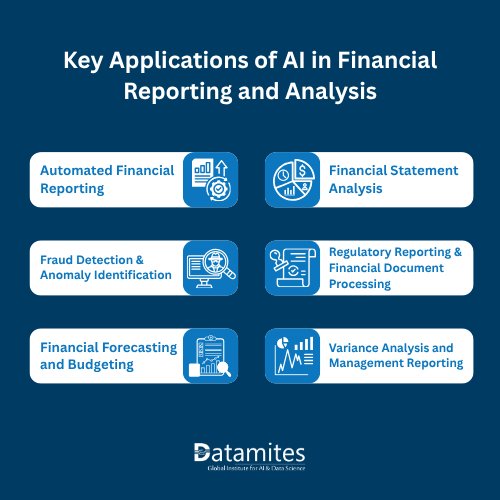
1. Automated Financial Reporting
Preparing financial reports often involves collecting information from accounting systems, spreadsheets, banking platforms, and enterprise resource planning (ERP) systems. AI-enabled automation can assist with data extraction, transaction categorization, account reconciliation, and report preparation.
For example, during a month-end close, an automated system may compare bank statement entries with ledger transactions and flag unmatched amounts for review. This helps accountants prioritize discrepancies instead of checking every transaction manually.
However, automated reconciliation does not eliminate the need to investigate differences, verify journal entries, or approve financial statements.
2. Fraud Detection and Anomaly Identification
AI models can examine transaction amounts, payment frequencies, vendor details, and historical spending patterns to identify potentially unusual activity.
Consider a company that normally processes one invoice per supplier for a particular service. An AI system may flag two invoices with similar amounts, dates, and invoice numbers for investigation.
Such alerts can help finance teams identify duplicate payments, unusual expense claims, and potentially unauthorized transactions. Nevertheless, an anomaly is not proof of fraud. Investigators must examine supporting documentation, authorization records, and transaction context before drawing conclusions.
3. Financial Forecasting and Budgeting
AI-powered financial forecasting can help organizations estimate future revenue, expenses, working capital requirements, and cash flow.
Models may incorporate historical financial performance, seasonal patterns, customer payment behavior, sales pipelines, and other relevant variables. Finance teams can use these estimates to compare budgets with actual results and evaluate alternative business scenarios.
For instance, a business can assess how a delay in customer payments or an increase in supplier costs might affect its projected cash position over the next quarter.
Forecasts should be reviewed regularly because unexpected market changes, incomplete data, and shifts in customer behavior can reduce predictive accuracy.
4. Financial Statement Analysis
AI can help analysts examine income statements, balance sheets, and cash flow statements to identify AI trends for finance, unusual movements, and relationships between financial indicators.
For example, an AI-assisted analysis may flag rising operating expenses alongside slowing revenue growth. An analyst can then investigate whether the change reflects higher input costs, lower operational efficiency, or a temporary business event.
AI can also help compare financial ratios across reporting periods. However, meaningful comparisons require consistent accounting definitions, appropriate industry context, and an understanding of significant changes in accounting policies.
5. Regulatory Reporting and Financial Document Processing
Financial organizations must process large volumes of documents while complying with applicable accounting, tax, and regulatory requirements.
AI-based document processing can extract information from invoices, contracts, receipts, and supporting schedules. It can also help organize records, identify missing information, and support the preparation of compliance documentation.
For example, an AI system may extract supplier details, invoice dates, tax amounts, and payment terms from invoices before transferring the information into an accounting workflow.
Organizations must validate extracted data and ensure that the resulting reports meet the applicable requirements of their jurisdiction and reporting framework.
6. Variance Analysis and Management Reporting
Variance analysis compares actual financial results with budgets, forecasts, or previous reporting periods. AI can help identify significant differences and highlight the factors that may require further investigation.
For instance, if actual operating expenses exceed the budget, an AI-assisted workflow may group the differences by department, expense category, or reporting period.
Finance professionals can use these findings to investigate the underlying causes, communicate performance changes, and recommend corrective action. AI-generated explanations should always be checked against the underlying accounting records.
What Are the Benefits of AI in Financial Reporting?
When implemented appropriately, AI can improve the efficiency, consistency, and analytical capabilities of finance teams.
1. Improved Operational Efficiency
Automating repetitive tasks such as data extraction, transaction classification, and reconciliation can reduce manual processing effort. Finance professionals can spend more time reviewing exceptions, investigating discrepancies, and interpreting results.
2. Greater Data Consistency
AI-enabled validation and standardized workflows can help identify missing fields, duplicate records, inconsistent classifications, and unexpected values. These checks support data quality but do not replace formal accounting controls.
3. Faster Reporting Cycles
Automated data collection and document processing can help teams prepare financial information more efficiently, particularly during recurring reporting periods. The overall time saved depends on system integration, data quality, workflow complexity, and the level of human review required.
4. Better Financial Decision-Making
AI-assisted analysis can help management understand performance trends, evaluate alternative scenarios, and identify areas that deserve further attention.
For example, a company can compare projected cash flow under different sales assumptions before making decisions about hiring, investment, or inventory purchases.
5. Proactive Risk Identification
AI can monitor transaction patterns and financial indicators to flag unusual activity or emerging risks. Earlier identification gives finance teams more time to investigate potential problems and determine appropriate responses.
6. Improved Access to Financial Insights
Natural language interfaces and generative AI tools can help users explore financial information and summarize complex reports. These capabilities can make analysis more accessible to managers who are not financial specialists, provided the results are accurate and appropriately contextualized.
The benefits are not automatic. Organizations should establish measurable objectives, evaluate the performance of their AI systems, and compare expected improvements with implementation and maintenance costs.
Refer to the articles below:
- Popular AI Tools in Healthcare for 2026
- Leveraging AI for HR and People Analytics: Tools and Techniques
- Who is an AI Product Manager? Key Roles and Responsibility
What Are the Challenges and Limitations of AI in Finance?
Despite its potential, AI adoption in financial reporting and analysis introduces technical, operational, and governance challenges.
1. Data Quality and Integration
AI systems depend on reliable input data. Incomplete transaction records, inconsistent account classifications, duplicate entries, and outdated information can lead to misleading outputs.
Organizations may also need to integrate data from multiple accounting and business systems, which can introduce compatibility issues and additional implementation costs.
Recommended approach: Establish data validation procedures, consistent definitions, reconciliation controls, and clear ownership of financial data.
2. Explainability and Transparency
Some complex AI models are difficult to interpret. Finance professionals may need to understand why a system flagged a transaction, produced a forecast, or recommended a particular action.
This is especially important when outputs influence financial statements, audit procedures, regulatory reporting, or significant business decisions.
Recommended approach: Document model assumptions, retain supporting evidence, use appropriate explanation methods, and ensure that important outputs can be independently reviewed.
3. Privacy and Cybersecurity
Financial records may contain confidential business information, employee details, customer data, and commercially sensitive transactions. Sending this information to external AI services without appropriate safeguards can create privacy and security risks.
Recommended approach: Apply role-based access controls, encryption, data minimization, vendor assessments, and approved policies for using AI with confidential information.
4. Bias and Model Reliability
AI models can reflect limitations in their training data or become less reliable when business conditions change. Historical patterns may no longer be representative of current economic conditions.
Recommended approach: Test models against relevant data, monitor performance over time, investigate unexpected outputs, and reassess assumptions when circumstances change.
5. Errors in Generative AI Outputs
Generative AI can produce convincing explanations that contain incorrect figures, unsupported assumptions, or fabricated references. It may also misinterpret accounting terminology or overlook important qualifications in financial disclosures.
Recommended approach: Verify calculations against authoritative records, check cited sources, and prevent unreviewed AI-generated content from entering official financial reports.
6. Implementation Costs and Skills Gaps
AI adoption may require new software, system integration, employee training, data infrastructure, and ongoing monitoring. Smaller organizations may find these requirements difficult to manage.
Recommended approach: Begin with a clearly defined, low-risk use case, measure the results, and focusing on AI Skills for Finance and expand only when the benefits justify the cost and operational complexity.
7. Accountability and Human Oversight
AI can assist with financial analysis, but organizations remain responsible for their financial reporting, internal controls, and business decisions. Automated recommendations should not replace professional judgment or established approval procedures.
Recommended approach: Assign clear responsibility for reviewing AI outputs, approving adjustments, investigating exceptions, and maintaining an auditable record of significant decisions.
Best Practices for Implementing AI in Financial Reporting and Analysis
Organizations can improve the likelihood of successful adoption by following a structured implementation process.
- Identify a specific business problem. Choose a task such as invoice data extraction, reconciliation support, or cash flow forecasting rather than adopting AI without a clear objective and work on real world use cases of finance.
- Assess data readiness. Check whether the required data is accurate, sufficiently complete, accessible, and consistently defined.
- Select an appropriate solution. Compare functionality, integration requirements, security controls, explainability, and total cost.
- Establish governance procedures. Define permitted uses, access permissions, review responsibilities, escalation procedures, and documentation requirements.
- Test before deployment. Evaluate performance using representative historical data and realistic scenarios, including exceptions and unusual cases.
- Maintain human review. Require qualified professionals to validate material outputs and approve significant accounting or reporting decisions.
- Monitor ongoing performance. Track error rates, processing time, exception volumes, forecast accuracy, and other relevant indicators.
- Review and improve continuously. Update workflows as regulations, business processes, data sources, and technology change.
These practices help organizations balance automation with financial accuracy, accountability, and appropriate risk management.
How AI Improves Financial Reporting?
Consider a company that processes hundreds of supplier invoices each month. During the accounts payable process, finance professionals must verify invoice details, identify duplicate payments, reconcile transactions, and ensure that expenses are recorded in the appropriate accounts.
An AI-assisted workflow can support these activities through several steps:
- Invoice data extraction: Document-processing technology extracts supplier names, invoice numbers, dates, amounts, and payment terms.
- Duplicate detection: The system identifies invoices with matching or similar details and flags potential duplicates for review.
- Transaction reconciliation: Automated rules compare invoice records with purchase orders, payment records, and accounting entries.
- Exception investigation: Finance professionals review mismatches, missing documentation, and unusual transactions before making corrections.
- Reporting and documentation: Approved results are incorporated into the accounting workflow, with supporting evidence retained for audit and review.
This example illustrates how AI can support financial reporting without replacing accounting controls. A potential duplicate invoice is not necessarily fraudulent, and extracted information may contain errors. Human review and appropriate approval procedures remain essential.
Organizations evaluating such a workflow should measure its effectiveness using indicators such as processing time, exception rates, data extraction accuracy, and the number of confirmed duplicate payments identified. Any claimed improvement should be based on documented results rather than assumed benefits.
How to Evaluate the Accuracy of AI in Financial Analysis?
AI-generated financial insights should be assessed before they are used for reporting or business decisions. The evaluation process should reflect the intended use of the system.
For financial forecasting, organizations can compare predictions with actual results over appropriate historical periods. Measures such as mean absolute error (MAE) or mean absolute percentage error (MAPE) may help assess forecast performance when their assumptions and limitations are understood.
For anomaly detection, finance teams can examine how many flagged transactions require investigation, how many represent genuine issues, and whether important exceptions are being missed. A high number of alerts does not necessarily indicate effective fraud detection.
For document processing, organizations can sample extracted fields and compare them against original invoices, contracts, and supporting records. Critical information, such as financial amounts and tax details, may require stricter validation.
Testing should include unusual transactions and changing business conditions. Results should be documented, reviewed periodically, and used to determine whether the AI system remains suitable for its intended purpose.
What Is the Future of AI in Financial Reporting and Financial Analysis?
The future of AI in finance is likely to involve more integrated automation, increasingly accessible AI tools for finance, and improved support for continuous financial monitoring.
1. More Continuous Financial Monitoring
Instead of relying exclusively on periodic reviews, organizations may increasingly use automated workflows to monitor transactions, reconcile selected accounts, and flag exceptions throughout the reporting cycle.
Continuous monitoring can help identify issues earlier, although the effectiveness of these systems depends on data availability, control design, and timely investigation.
2. Greater Use of Generative AI
Generative AI may become more common in drafting management commentary, summarizing financial disclosures, answering questions about approved financial datasets, and explaining movements in key performance indicators.
Its most useful role is likely to be assisting professionals with research and communication while preserving verification and approval processes.
3. More Sophisticated Predictive Analysis
Advances in predictive analytics may help finance teams evaluate different economic conditions, model cash flow risks, and compare possible business strategies.
These models can support planning, but forecasts will continue to involve uncertainty and should not be treated as guaranteed outcomes.
4. AI-Assisted Auditing and Internal Controls
AI may increasingly support the examination of large transaction populations, the identification of unusual patterns, and the prioritization of audit procedures.
Auditors and control owners will still need to assess evidence, determine the significance of findings, and apply professional judgment.
5. Stronger Governance and Regulatory Attention
As organizations expand their use of AI, expectations around documentation, data protection, security, accountability, and model oversight are likely to remain important.
Finance teams will need to understand both the capabilities of AI systems and the risks associated with using them in regulated or high-impact processes.
6. Changing Skills Requirements for Finance Professionals
The increasing use of AI may place greater emphasis on data literacy, analytical reasoning, technology evaluation, and governance skills alongside accounting knowledge.
Professionals who can interpret AI-generated insights, challenge assumptions, validate outputs, and communicate financial implications will be better equipped to use these tools responsibly.
AI is changing financial reporting and financial analysis by helping organizations automate repetitive workflows, identify unusual transactions, interpret financial information, and evaluate future business scenarios.
Its most valuable applications include automated reconciliation support, anomaly detection, financial forecasting, financial statement analysis, and document processing. When supported by reliable data, suitable technology, and effective controls, these applications can improve operational efficiency and provide finance teams with additional insights for decision-making.
Refer to the articles below:
- AI Browsers Explained: How Agentic Browsing is Changing the Internet
- How Does AI Work? A Simple Explanation for Beginners
- The Impact of AI on Various Industries: Current and Future Trends
However, AI also introduces challenges involving data quality, model transparency, privacy, cybersecurity, implementation costs, and the reliability of generated outputs. Human oversight, professional judgment, and clear accountability therefore remain essential.
Organizations should approach AI adoption as a structured business and governance initiative rather than simply a technology upgrade. By starting with measurable use cases and validating results carefully, they can capture potential benefits while maintaining the accuracy and integrity of financial information.
For finance professionals interested in developing relevant technology skills, learning opportunities in artificial intelligence, data analytics, and financial analysis can help build the knowledge needed to work effectively in an increasingly data-driven environment. Before choosing a training program, readers should evaluate its curriculum, practical projects, instructor expertise, and relevance to their career goals.
DataMites Institute offers an industry-oriented AI Finance Courses designed to help finance professionals apply artificial intelligence for data-driven insights and informed decision-making. The curriculum covers AI fundamentals, financial analytics, risk management, fraud detection, investment analysis, and financial forecasting, with an emphasis on practical applications. In addition to finance, DataMites provides specialized programs in AI for HR, AI Marketing, AI in Healthcare, and AI for Business Leaders to support professionals in developing AI skills relevant to their respective fields. With globally recognized IABAC certifications, DataMites operates over 30+ centers across key Indian cities such as Hyderabad, Pune, Chennai, Ahmedabad, Bangalore, Mumbai, Coimbatore, Delhi, Nagpur, and Kochi, offering career-oriented training.