Data Science Career Opportunities in Johannesburg
Explore data science career opportunities in Johannesburg, including key industries, in-demand roles, skills, salary expectations, career paths and future opportunities for aspiring data professionals.
 Swagatam Sinha
Johannesburg is more than South Africa's financial and business centre. It is also home to organisations across banking, retail, telecommunications, technology, consulting and other industries where data plays an important role in everyday decisions. From detecting financial fraud to understanding customer behaviour and forecasting demand, businesses increasingly need professionals who can turn data into practical insights.
This creates opportunities across a range of data-related careers in Johannesburg. While data scientist is one of the most recognised roles, the local market also includes opportunities for data analysts, business intelligence analysts, data engineers, machine learning engineers, and quantitative professionals.
For graduates, working professionals and career changers, understanding where these opportunities exist, which skills employers look for and how different data careers can progress is an important first step. This guide explores the data science career opportunities in Johannesburg, including key industries, job roles, salary expectations, skills, career paths and areas where data professionals can build their careers.
Why Johannesburg Is Becoming an Important Data Science Hub
Johannesburg's concentration of financial, technology and professional services businesses creates a wide range of applications for data skills. The 2026 Cities Economic Outlook identifies ICT, finance and insurance, and real estate among the city's areas of economic specialization.
The financial services sector is particularly relevant to data careers. Banks, insurers and other financial organisations work with large volumes of customer and transaction data, creating applications for risk analysis, fraud detection, forecasting, customer analytics and quantitative modelling. The BANKSETA Sector Skills Plan 2026-2027 also identifies technology, digitisation and analytics as one of its strategic focus areas for the banking and micro-finance sector.
Technology-related opportunities extend across the wider Gauteng economy. According to MICT SETA, Gauteng accounted for approximately 57% of registered MICT employers and 74% of the sector's workforce in 2025. Its Sector Skills Plan 2025-2030 identifies data scientists as one of the top 10 priority occupations in the MICT sector and highlights Big Data analytics, cloud computing and AI as important technology change drivers.
Public-sector digitalisation is another part of the wider Gauteng technology ecosystem. The Gauteng Department of e-Government received R1.9 billion for 2026/27, with funding directed toward ICT infrastructure, digital government services, cybersecurity, ICT skills development and an AI Office.
For people considering data careers in Johannesburg, this means opportunities can be connected to several industries rather than a single technology market. Financial services, retail, telecommunications, professional services, technology and government can all require different combinations of data analysis, statistics, programming, business intelligence and data engineering skills.
Refer to these articles:
- PyTorch vs TensorFlow
- How Data Scientists Can Build AI Agents Using Python
- How to Become a Data Scientist With No Experience
Where Are Data Science Professionals Finding Opportunities in Johannesburg?
The demand for data skills is connected to the types of industries that dominate Johannesburg's economy.
Banking and financial services offer significant opportunities for data professionals. Banks use analytics and machine learning for fraud detection, customer segmentation, credit assessment, risk management and financial forecasting.
Insurance companies rely on data to assess risk, analyze claims, develop pricing models and detect unusual patterns.
Retail and e-commerce businesses can use customer and sales data to understand purchasing behaviour, forecast demand, optimize inventory, and improve marketing decisions.
Telecommunications companies work with large datasets involving customers, network usage and service performance. Data professionals can contribute to churn analysis, customer analytics, forecasting and network-related projects.
Technology and professional services companies also provide opportunities through software development, consulting, analytics and data projects for clients. Johannesburg's technology ecosystem is also supported by growing digital infrastructure. A 2026 South Africa Data Center Colocation Market report forecasts the country's colocation market to reach approximately US$1.33 billion by 2030, with Johannesburg remaining the country's leading data center hub. The growth is being driven by AI workloads, hyperscale development and enterprise adoption of hybrid cloud infrastructure.
Logistics and supply chain organisations can use data to improve demand forecasting, optimise routes, monitor delivery performance and manage inventory more effectively.
This variety means that a data science career in Johannesburg does not necessarily require working for a company whose primary business is technology.
What Data Science Roles Can You Explore in Johannesburg?
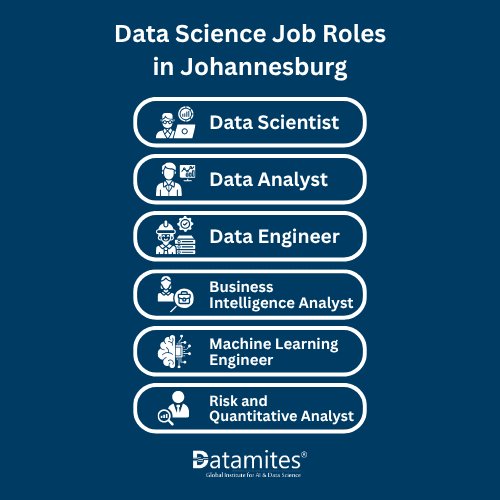
Data science is a broad field, and different roles require different combinations of technical and business skills.
Data Scientist
Data scientists apply statistics, programming and machine learning techniques to solve complex problems and build predictive or analytical models. Commonly used tools include Python and SQL, supported by statistics and machine learning frameworks. In Johannesburg, applications can include fraud detection, customer behaviour analysis, financial modelling and forecasting.
Data Analyst
Data analysts use data to identify insights and address business questions. Their responsibilities may include data cleaning, SQL analysis, reporting, dashboard development, and identifying trends. Knowledge of SQL, Excel, Power BI and Tableau can be useful for professionals pursuing this career path.
Business Intelligence Analyst
Business intelligence analysts focus on turning organisational data into reports and dashboards that support business decisions. This role can be a good fit for those who enjoy combining data analysis with clear business communication.
Data Engineer
Data engineers build and manage systems that collect, store, organise and process data. Their work can involve databases, data pipelines, cloud platforms and distributed data technologies.
Machine Learning Engineer
Machine learning engineers focus on implementing machine learning models and integrating them into software or business systems. This path generally requires stronger programming and software engineering skills alongside machine learning knowledge.
Risk and Quantitative Analyst
These roles can be relevant to Johannesburg's financial sector. Professionals may use mathematics, statistics, financial data and modelling techniques to analyse risk, markets or business performance.
Refer to these articles:
- How LLMs Are Transforming Data Science Careers
- Data Mesh vs Data Fabric in 2026: Choosing the Right Data Architecture
- Data Science vs Cyber Security: Which Has a Better Future?
What Does a Data Science Career Path Look Like in Johannesburg?
There is no single route through the data profession. Career progression depends on an individual's education, technical skills, industry experience and chosen specialisation.
An analytics-focused path could develop from:
- Entry Level: Data Analyst
- Mid Level: Senior Data Analyst
- Advanced Level: Analytics Lead
- Management: Analytics Manager
A more technical path could develop through:
A typical progression can move from junior data scientist to data scientist, followed by senior data scientist, and later into lead or principal data scientist roles.
Another pathway could be:
A typical data engineering career can progress from data engineer to senior data engineer and then to lead data engineer.
Professionals can also move between related roles. Existing technical skills can provide a foundation for moving into other data careers. Someone experienced in SQL and business intelligence can add Python and machine learning to their skill set and work toward data science. A software developer, meanwhile, can build on their programming background to pursue opportunities in data engineering or machine learning engineering.
The important point is that job titles and progression structures vary between employers.
What Skills Do Johannesburg Employers Look For?
A practical data science skill set usually combines technical knowledge with the ability to understand business problems.
Python is widely used for data analysis, machine learning and automation. SQL is important for working with relational databases and extracting information for analysis.
A foundation in statistics helps professionals understand distributions, relationships between variables, probability and model evaluation. Candidates targeting data scientist positions should also understand machine learning concepts such as regression, classification, clustering and model validation.
Data visualization is another important skill. Analysts and data scientists need to communicate findings through charts, dashboards and clear explanations.
Depending on the role, knowledge of Power BI, Tableau, cloud platforms, databases, PySpark or other data technologies can also be useful. Learners who need a flexible way to develop these skills can also consider online data science courses in South Africa, particularly when they want to combine structured learning with their existing work or study commitments.
Technical ability alone is not enough. Employers also need professionals who can understand a business problem, communicate findings and explain what the results mean to people who may not have a technical background.
Learners who need a flexible way to develop these skills can also consider an online artificial intelligence course in Johannesburg, particularly when they want to build AI-related knowledge alongside their existing work or study commitments.
Refer to these articles:
- LLMs vs. SLMs: Key Differences and How to Choose the Right Model
- Databricks vs Snowflake: Which Is Better for Data Science?
- Why Synthetic Data Is the Future of GDPR Compliance
What Can You Earn in a Data Science Career in Johannesburg?
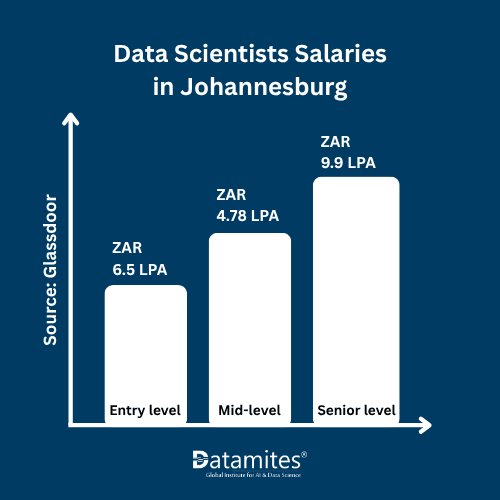
The average base pay of data scientists in Johannesburg varies depending on experience, skills, responsibilities and employer. Glassdoor salary data for 2026 provides separate figures for base pay and total pay, so these figures should be considered as different salary measures.
At the junior or entry level, data scientists earn approximately ZAR 4 lakh per year in base pay. Glassdoor reports a median total pay of about ZAR 4.78 lakh per year for junior data scientists in Johannesburg. Total pay can include additional compensation beyond base salary.
At the mid level, Glassdoor does not provide a separate salary category specifically for mid-level data scientists in Johannesburg. Its overall Johannesburg Data Scientist data shows a median total pay of approximately ZAR 6.5 lakh per year. This figure should therefore be treated as an overall market benchmark rather than a specific mid-level salary.
At the senior level, Glassdoor reports a median total pay of around ZAR 9.9 lakh per year for senior data scientists in Johannesburg. The reported base-pay range is approximately ZAR 7.25 lakh to ZAR 10 lakh per year. The base-pay range should not be directly compared with the median total-pay figure because they represent different compensation measures.
Overall, salary levels can vary based on experience, technical expertise, industry, company size, role responsibilities and additional compensation. The figures provide market benchmarks rather than fixed salary expectations for every data scientist in Johannesburg.
Source: Glassdoor salary data for data scientists, junior data scientists, and senior data scientists in Johannesburg, 2026.
Which Johannesburg Business Hubs Have Data-Related Opportunities?
Johannesburg's data-related opportunities are connected to its broader business geography.
Sandton is particularly associated with corporate headquarters and financial services, making it relevant to finance, analytics, risk and business intelligence roles.
Rosebank has developed as a business and commercial district with activity across corporate and professional services.
Midrand sits between Johannesburg and Pretoria and has a significant concentration of business, technology and corporate activity.
Other areas across the Johannesburg metropolitan region also contribute to the wider technology and business ecosystem.
The 2026 Cities Economic Outlook ranks Johannesburg first in South Africa by the size of its formal employment base, with 1.82 million formal jobs, while employment in the city grew by 11.5% between 2014 and 2024. Finance and insurance added more than 252,000 jobs during this period, highlighting the importance of the sector to Johannesburg's employment market.
Refer to these articles:
- Data Science Job Roles, Salary Structure and Course Fees in South Africa
- How to Become a Data Scientist in South Africa?
- Is Data Science & Artificial Intelligence in Demand in South Africa?
What Kind of Data Science Projects Reflect Johannesburg's Business Needs?
A practical portfolio can help demonstrate how technical knowledge applies to real business problems.
- A candidate interested in financial services could create a fraud detection or credit-risk project using an appropriate public dataset.
- Someone interested in retail could build a customer segmentation model or sales forecasting project.
- For telecommunications, a customer churn analysis could demonstrate data preparation, exploratory analysis, feature engineering and predictive modelling.
- A logistics project could examine delivery times, demand patterns or route performance.
- A business intelligence project could combine SQL with Power BI to create a dashboard showing sales, customer or operational performance.
The strongest projects should explain the problem, data source, preparation process, analytical approach, results and possible business application. A portfolio that demonstrates this complete process can communicate practical ability more effectively than a collection of disconnected tutorials.
What Should You Consider Before Choosing Data Science in Johannesburg?
Data science can involve a substantial technical learning curve. Programming, statistics, databases and machine learning require consistent practice, particularly for people entering the field without a technical background.
The market is also broader than the data scientist title alone. Someone interested in data should understand the differences between data analytics, business intelligence, data engineering, machine learning, and data science before choosing a specialisation.
Practical experience is another important consideration. Employers may look for evidence that candidates can work with real datasets, solve analytical problems and communicate findings. For learners who prefer structured study, online data science courses in Johannesburg can be one way to develop foundational knowledge while continuing with work or other commitments.
The technology landscape also changes over time. MICT SETA's sector planning work is specifically designed to identify current and future skills needs across South Africa's information, communications and technology sector. For this reason, building a career in data requires continued learning rather than treating a single qualification or tool as the end of the learning process.
For learners who prefer structured study, an online data analyst course in Johannesburg can be one way to develop foundational skills in data analysis while continuing with work or other commitments.
Refer to these articles:
- Data Science and Artificial Intelligence in Demand in Johannesburg
- Data Science Jobs, Salaries, and Course fees in Cape Town
- Data Science And Artificial Intelligence Demand in Cape Town
What Does the Future Hold for Data Careers in Johannesburg?
Johannesburg's financial, commercial and technology ecosystem provides several settings where data can support business decisions. The wider South African technology market is also moving toward greater use of AI and advanced digital technologies. MarketsandMarkets 2026 The South Africa AI Platform Market report projects the country's AI platform market to grow from US$40.1 million in 2025 to US$211.8 million by 2030, representing a 39.5% CAGR.
This growth does not mean that every new technology investment will create a data scientist position. However, it indicates expanding use of AI and data technologies across enterprise and public-sector environments. Data analytics, business intelligence, data engineering, machine learning, AI and quantitative roles can therefore form part of the broader data career landscape.
For people researching data science career opportunities in Johannesburg, the most useful approach is therefore to look beyond a single job title. Understanding the local industries, developing relevant technical and business skills, building practical projects and choosing a suitable specialisation can help candidates understand where their skills may fit within Johannesburg's data-driven economy.
Johannesburg's combination of financial services, corporate activity, technology and professional services gives data professionals multiple areas in which to apply their expertise. The career path ultimately depends on the individual's skills, experience, interests and chosen area of specialization. For those looking to build these skills through structured learning, online data science courses can provide another option alongside self-study, practical projects and other forms of professional development.
For learners looking to build skills for data-related roles, DataMites is a globally recognized institute offering professional training in data and technology fields, with more than 12 years of experience and trust in the learning industry and 200,000+ learners globally. Its course offerings include Data Science, Data Analyst, Artificial Intelligence, and Data Engineer programs, along with related learning areas such as Python, statistics, machine learning, databases, Big Data and business intelligence.
These programs cover different areas of the data ecosystem, allowing learners to choose a learning path based on the skills and career direction they want to develop.