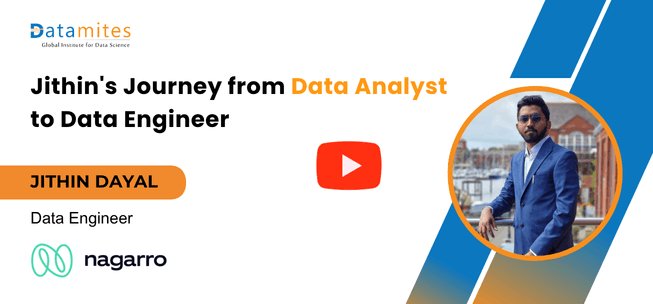
Jithin's Journey from Data Analyst to Data Engineer
Explore Jithin's inspiring transition from Data Analyst to Data Engineer with expert tips on Python, SQL, cloud technologies, and career growth.
 Prerana B A
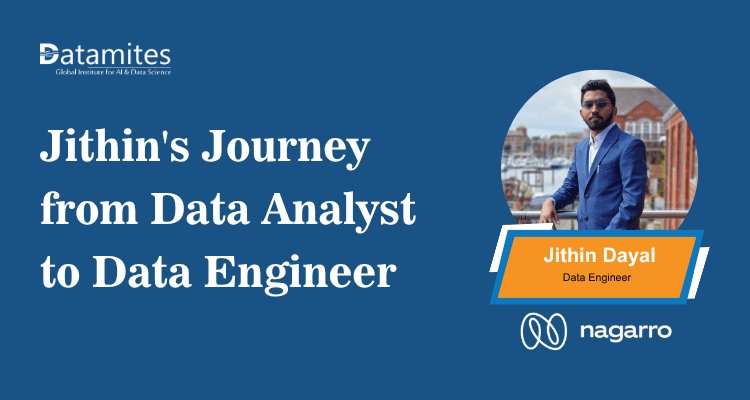
Jithin's journey from a Mechanical Engineering graduate to a Data Engineer at Nagarro showcases how determination, continuous learning, and practical experience can lead to a successful career transition into the data industry. Starting with a strong foundation in Python and data analytics through structured training, he gradually built expertise in SQL, ETL processes, cloud technologies, PySpark, Databricks, and Data Governance while progressing from a Data Analyst role to Data Engineering.
Throughout his career, Jithin worked on real-world data transformation, reporting, and cloud-based data pipeline projects, gaining valuable industry experience across global organizations. His insights on mastering technical fundamentals, building practical projects, preparing for interviews, and staying updated with emerging technologies offer valuable guidance for aspiring Data Analysts and Data Engineers. DataMites success story is an inspiring example of how continuous learning, hands-on experience, and perseverance can help students and professionals build a rewarding career in the rapidly evolving field of Data Engineering.
Jithin's Journey from Mechanical Engineering to Data Engineering
Career transitions are possible with the right mindset, continuous learning, and practical experience. In this exclusive alumni interview, Jithin shares how he transformed his career from Mechanical Engineering to Data Engineering, highlighting the skills, challenges, and milestones that shaped his journey.
Q1. Can you share your background and how you started your data journey?
I finished my graduation in mechanical engineering. In the early years, like most graduates, I took up internships with manufacturing companies like Bosch and Yamaha in India. The experience was good, but I felt something was missing. I realized I was more interested in working with computers, fixing websites, and finding patterns in data. During the pandemic, I decided to make the shift into computer science and data. At that point, I knew what data was, but I didn't know how to work with it, so I joined DataMites to take my first steps in Python.
Q2. How was your Python and data science learning experience?
It was a strong foundation. I learned Python from the basics the core libraries, how to work with datasets like those on Kaggle, and how to connect and explore data. This happened during the pandemic, and those early lessons in Python fundamentals became the base for everything I did later.
Q3. What did you do after completing your training at DataMites?
I moved into a six-month internship with Rubixe, working alongside DataMites. That internship gave me my first real hands-on experience applying what I had learned.
Q4. What was the next step in your career after the internship?
I decided to pursue further studies and moved to the UK for a master's degree in computer science. After completing my degree, I got placed in a company where I started in an entry-level data role, handling data entry before moving into implementing reporting software, working with large data dumps across multiple clients, generating insights, building visualizations, and reporting data errors.
Q5. How did you transition into a data analyst role at Deloitte?
Towards the end of 2023, I joined Deloitte as a data analyst. This was a much deeper role involving the full data process extraction, transformation, loading, data mapping, and complex SQL transformations, while collaborating with global teams. It was a strong learning experience, but I noticed that as an analyst, my scope was limited. I was working only with data that was already prepared for me, without visibility into the pipeline processes happening before or after my part of the workflow.
Q6. How did you expand your skill set while at Deloitte?
I got trained in PySpark, Azure Databricks, and AWS Lambda functions, among other tools. This training helped me understand the broader data engineering ecosystem beyond just analysis.
Q7. How Did You Return to India and Become a Data Engineer?
Earlier this year, a change in the UK's immigration system affected my visa status, since the salary I was earning didn't meet the new threshold. Deloitte offered me a role back in India, which I accepted, continuing in an analyst capacity. Shortly after, I joined Nagarro as a Data Engineer, working with Databricks SQL.
Q8. Why did you choose to specialize in data governance specifically?
I noticed that while everyone focuses on working with data, the bigger picture data governance often gets overlooked. Data governance covers who has access to data, who is working on it, what has been done to it, and ultimately who is answerable for it. That gap in the industry is what drew me to build my expertise in this area, and it directly helped me land the data engineer role at Nagarro.
Q9. For students aiming to become data analysts, what tools should they focus on?
I'd split this into two parts tools and projects. On the tools side, focus on Power BI, Tableau, and especially Excel. A lot of people underestimate Excel, but most of the corporate world still runs on it. Day-to-day tasks, reporting, and even automation are often built around Excel functions and pivot tables. Even tools like Power BI are fundamentally built on the same logic as Excel, so mastering Excel functions and pivot tables first has more value than people realize.
Q10. What kind of projects would strengthen a data analyst's resume?
Portfolio projects matter a lot for example, a Power BI dashboard comparing bicycle sales data across a few years. But the key mistake many people make, myself included, is building the dashboard first and figuring out the questions later. The right approach is to define your questions first, then build visualizations to answer them. Most effective dashboards only need five or six well-chosen visuals to answer the core questions clearly.
Q11. Data Engineering offers many tools. Which ones should beginners prioritize?
The data engineering world is genuinely vast. My own focus is on data governance and metadata management, which most people overlook while working directly with data. As a general starting point, I'd say the cloud ecosystem, whether Azure or AWS, can feel like a jungle of tools. Understanding how components connect, for example, how Databricks integrates with Azure Data Lake is just as important as knowing the tools individually, since two connected services on the same platform don't always communicate with each other automatically.
Q12. How Important Are Data Science Fundamentals in the AI Era
Extremely important. AI tools can point out that a line has an error, but they won't explain why it happened. If you don't understand the underlying logic, you'll repeat the same mistake on a larger pipeline, and that error compounds. My advice is to set aside the AI assistance for a moment and focus on strong Python fundamentals proper object-oriented programming, well-defined classes and functions. Many people know how to prompt AI to generate code, but they don't understand the basics well enough to catch mistakes or adapt the code correctly.
Q13. What's your recommended learning path for someone starting in data engineering?
Start with core Python, then move to a notebook environment like Google Colab, then progress to Databricks, and then to Azure. It's also worth keeping an eye on emerging trends like Microsoft Fabric, since the field is evolving quickly. Based on conversations with global teams, current AI tools like Copilot and Gemini are only showing a fraction of their real capability, and companies are still investing heavily to unlock more. The field will keep evolving, but strong fundamentals will always keep you relevant.
Q14. Walk us through what the data engineering interview process at Nagarro looked like.
It started with a proctored aptitude test strict screen, audio, and video monitoring with around 30 questions to complete in 15 to 30 minutes, testing speed and accuracy. Clearing that led to a technical round with an SQL-focused interviewer covering joins, window functions, unions, and clauses like HAVING.
Q15. What kind of Python questions came up in the interview?
The Python round focused on logic rather than syntax, since the interviewers assumed candidates would use AI tools for actual coding in real work. One example question involved reversing the case of every letter in a string capital letters becoming lowercase and vice versa. The evaluation focused on how I reasoned through the logic, not just the final answer.
Q16. Did the Interview Cover Projects and Data Governance?
Yes, there was a detailed discussion about my project work, including why I used specific libraries like PySpark over standard pandas libraries. The conversation moved into data governance concepts as well tools like Collibra versus Azure Unity Catalog, and how businesses apply data governance principles to their business intelligence processes, especially around validating and cleaning data earlier in the pipeline to avoid wasting storage and processing power on irrelevant data.
Q17. Were there scenario-based questions about optimizing workflows?
Yes, quite a few. One example was about creating checkpoints in a data pipeline instead of duplicating data at every step of a notebook workflow (which becomes very costly with terabytes of data), you create a checkpoint, save your progress to storage, and continue from there rather than rerunning the entire pipeline. These scenario questions were less about reciting a textbook answer and more about explaining your thought process and how you'd approach optimizing time and resources.
Q18. What Advice Would You Give for Data Engineering Interviews?
Take your time to answer. Interviewers aren't necessarily looking for the fastest answer they want to see your step-by-step thought process. Walking through your reasoning clearly is often more valuable than jumping straight to a solution.
Q19. Should Non-Tech Freshers Choose Data Analytics or Data Engineering?
It really depends on your comfort level with programming. If you're confident with Python and enjoy working through logic, data engineering could be a good fit you can build toward Azure, AWS, or GCP certifications. If you're more comfortable with SQL, Excel, and Power BI, which has a more approachable interface, data analytics might suit you better. It's not strictly about your background either. I've seen companies hire people from non-tech fields, like nurses, specifically for their subject-matter expertise combined with data skills. The key is to position your resume to highlight your domain knowledge alongside your technical skills.
Q20.What Skills Are Essential for a Data Engineer Role?
Focus on data governance, since it's becoming a major part of the industry as companies become more accountable for how data is used, where it originates, and how long it's retained. Learning tools like Collibra and Azure Unity Catalog can open up strong career opportunities, since these are still relatively niche skills that fewer professionals have mastered and that expertise tends to be well compensated.
Refer these articles :
- Devadarsan’s Journey from Fresher to Data Scientist
- Subramani’s Journey from Data Enthusiast to Data Engineer
- How Milind Kumar Built a Career in Data Engineering
Key Takeaways from Jithin's Data Engineering Career Journey
Jithin's career journey demonstrates that success in the data industry is built on continuous learning, practical experience, and a willingness to embrace new technologies. From transitioning out of Mechanical Engineering to becoming a Data Engineer, his story highlights the importance of mastering programming fundamentals, gaining hands-on project experience, and staying adaptable in a rapidly evolving field.
- Jithin successfully transitioned from a Mechanical Engineering background to a Data Engineer, proving that career changes into the data field are achievable with the right skills and dedication.
- Learning Python provided the foundation for his journey into Data Science, Data Analytics, and eventually Data Engineering.
- Practical training, internships, and hands-on projects played a significant role in developing industry-ready technical skills.
- Pursuing a Master's in Computer Science helped him strengthen his technical knowledge and gain international work experience.
- His career progression from Data Entry to Data Analyst and finally to Data Engineer highlights the value of continuous learning and professional growth.
- Working as a Data Analyst helped him build expertise in SQL, ETL processes, data transformation, reporting, visualization, and collaboration with global teams.
- He transitioned to Data Engineering to gain experience in building and managing data pipelines rather than only analyzing processed data.
- Microsoft Excel remains one of the most important tools for aspiring Data Analysts despite the popularity of modern BI platforms.
- Strong knowledge of SQL, Power BI, Tableau, and Excel is essential for beginners aiming for Data Analyst roles.
- A successful data portfolio should focus on solving real business problems instead of simply creating dashboards.
Refer these articles :
- How to Become a Data Scientist in Hyderabad?
- How to Choose the Best Institute for Data Science in Hyderabad
- Why a Data Scientist Career in Hyderabad in 2026?
Jithin's journey shows that success in Data Engineering comes from continuous learning, hands-on experience, and adapting to new technologies. By mastering Python, SQL, cloud platforms, and data governance, he built a successful career from the ground up. His experience inspires students and professionals to strengthen their fundamentals, work on real-world projects, and embrace lifelong learning to thrive in the evolving data industry.
If you're planning to build a career in Data Engineering or Data Science, Jithin's journey shows that continuous learning, hands-on projects, and strong programming fundamentals can help anyone transition into the data industry, even from a Mechanical Engineering background. According to the U.S. Bureau of Labor Statistics (BLS), employment for Data Scientists is projected to grow 36% from 2023 to 2033, with around 20,800 job openings annually. As demand for data professionals continues to rise, Data Science, Data Engineering, Artificial Intelligence, Machine Learning, and Python have emerged as some of the top IT courses, offering excellent career opportunities across industries.
Jithin's successful transition from Mechanical Engineering to Data Engineering was driven by structured learning at DataMites. Through hands-on projects, internships, and expert guidance, he built strong skills in Python, SQL, Data Analytics, and Data Engineering. With globally recognized IABAC® and NASSCOM FutureSkills® certifications, DataMites prepares learners for successful data careers. If you're exploring Data Science courses in Dehradun, a structured Data Science program can help you build the skills needed for one of today's top IT courses and high-demand careers.
Whether you're a fresher, a working professional, or someone planning a career transition like Jithin, DataMites makes quality Data Science education accessible. With online and offline training centers, DataMites offers Data Science courses in Gurgaon along with programs across major cities in India. Through structured learning, hands-on projects, expert mentorship, internship opportunities, and globally recognized IABAC® and NASSCOM FutureSkills® certifications, learners gain the practical skills needed for successful careers. Jithin's DataMites success story proves that with the right guidance and continuous learning, building a rewarding career in Data Science and Data Engineering is within reach.