What are the ethical consideration in AI finance
Explore the key ethical considerations in AI finance, including data privacy, algorithmic bias, transparency, accountability, and regulatory compliance. Learn how financial institutions can use artificial intelligence responsibly to improve decision-making, manage risks, protect customers, and build trust in AI-driven financial services.
 Kriti Maurya
From AI-powered budgeting applications to automated credit assessments and personalized financial recommendations, these technologies can make financial information more accessible and everyday money management more efficient. An incorrect AI recommendation can lead to poor financial decisions, while an unfair automated assessment can affect a person's access to credit or other financial opportunities.
Understanding the ethical considerations in AI finance is essential for consumers, technology developers, researchers, and anyone who uses AI-powered financial tools. Responsible AI should help people make informed decisions without compromising their privacy, fairness, or ability to exercise independent judgment.
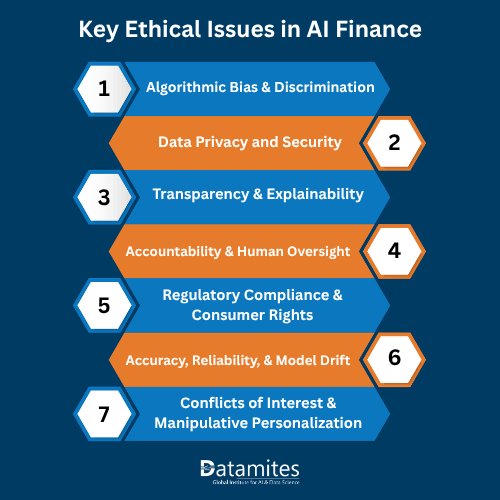
This article explores seven major AI ethics and responsible AI risk , explains how they affect everyday financial decisions, and provides practical solutions for using AI more responsibly.
Why Are Ethical Considerations Important in AI Finance?
AI can analyze large amounts of financial information, identify unusual transactions, categorize spending, and generate personalized insights. These capabilities can help people understand their spending habits, compare AI in Financial Reporting, and organize their financial goals.
Nevertheless, AI systems are not always accurate, impartial, or transparent. Their outputs depend on the data they receive, how they are designed, and the context in which they are used.
For example, an AI budgeting assistant might incorrectly categorize a transaction, while an automated credit assessment could produce an unfavorable result because of inaccurate information or biased historical data.
AI ethics and responsible AI practices matter because financial decisions can have long-term consequences for people's savings, borrowing opportunities, investments, and financial security.
The National Institute of Standards and Technology (NIST) identifies several characteristics associated with trustworthy AI, including reliability, security, privacy, fairness, transparency, and accountability. (Source: NIST — Artificial Intelligence Risk Management Framework)
Understanding these principles helps people evaluate AI tools for finance more carefully and recognize situations in which human judgment or independent verification is necessary.
Refer to the articles below:
- AI Product Innovation: Strategy, Process & Business Impact
- Essential AI Skills for Marketing Professionals
- How AI Is Creating New Roles in Human Resources
Key Issues for Ethical AI in finance
Understanding the key ethical issues in AI Strategies Transforming Traditional Finance is essential to ensuring fair, transparent, secure, and accountable financial decision-making while protecting consumer rights and privacy.
1. Algorithmic Bias and Discrimination
Algorithmic bias occurs when an AI system produces systematically unfair outcomes for particular individuals or groups. In finance, this may affect credit assessments, loan eligibility, fraud detection, and personalized financial recommendations.
Bias can develop when training data reflects historical discrimination, when certain groups are underrepresented, or when an algorithm relies on variables that indirectly reproduce existing inequalities.
For example, imagine an automated credit assessment that uses historical lending data. If that data reflects unequal treatment of certain communities, the model may reproduce those patterns when evaluating new applicants. Even if the system does not explicitly use sensitive characteristics, other variables may act as indirect proxies.
This can result in people receiving different assessments despite having similar relevant financial circumstances.
How to reduce AI bias
- Question automated assessments that appear inconsistent with the available facts.
- Check whether personal information used by a system is accurate and up to date.
- Look for explanations of how an automated assessment was produced.
- Avoid assuming that a computer-generated decision is automatically objective.
- Support the availability of appropriate review and correction mechanisms.
Fairness cannot always be measured by a single number. Evaluating an AI system requires considering the context, the people affected, and whether differences in outcomes are justified.
2. Data Privacy and Security
AI-powered financial applications may process sensitive information such as transaction histories, income, spending habits, account balances, financial goals, and credit records.
Although this information can help generate personalized insights, sharing too much of it can create unnecessary privacy risks. Poorly protected data may be exposed through unauthorized access, security breaches, or inappropriate use.
Generative AI introduces additional concerns when people enter personal financial records into tools without understanding how the information may be processed or retained.
For example, someone might upload a bank statement to an unfamiliar AI application to create a monthly budget. If the application does not adequately protect the information, the person's transaction history and other sensitive details could be exposed.
How to protect financial information?
- Share only the personal information necessary for the task.
- Avoid entering passwords, PINs, security codes, or complete account credentials into AI chatbots.
- Review privacy policies and data-sharing permissions before using financial applications.
- Use strong passwords and multifactor authentication where available.
- Remove unnecessary identifying information before uploading documents.
- Be cautious about connecting financial accounts to unfamiliar applications.
- Delete stored information when appropriate and understand the limits of deletion.
Privacy protection should be considered before sharing data, not only after a problem occurs.
3. Transparency and Explainability
AI systems sometimes generate recommendations or decisions without clearly explaining the factors behind them. This can make it difficult for people to understand why a particular result was produced or determine whether it is reasonable.
For example, an automated credit assessment might produce an unfavorable result without making it clear whether the outcome was influenced by debt obligations, inaccurate records, or other factors.
Transparency means making relevant information about an AI system's purpose, limitations, and outputs understandable to the people affected by it.
The US Consumer Financial Protection Bureau (CFPB) addressed this issue in its guidance on adverse credit decisions. The guidance explains that applicable requirements to provide specific reasons for adverse decisions still apply when complex algorithms are used. (Source: CFPB- Adverse Action Notification Requirements for Credit Decisions Based on Complex Algorithms)
This example illustrates why the complexity of AI trends for finanace should not prevent people from receiving explanations when they are legally entitled to them.
How to improve transparency
- Look for clear explanations of AI-generated recommendations.
- Check whether the system identifies its limitations and uncertainties.
- Distinguish verified financial information from estimates or predictions.
- Ask for clarification when an important recommendation is difficult to understand.
- Review the information behind significant financial decisions.
- Seek correction when an automated result appears to rely on inaccurate information.
Explainability gives people a better opportunity to question errors instead of accepting every automated result without scrutiny.
4. Accountability and Human Oversight
AI systems can misinterpret information, generate inaccurate predictions, or recommend actions that do not fit an individual's circumstances.
For example, an AI budgeting tool might classify a necessary medical expense as discretionary spending. An AI investment assistant might recommend an asset without adequately considering the user's time horizon or tolerance for risk.
These examples highlight the importance of human judgment in financial decision-making.
Accountability means that there should be a meaningful way to investigate errors, correct inaccurate information, and challenge consequential automated decisions.
How to maintain human control
- Verify important recommendations before acting on them.
- Review the assumptions behind financial calculations and projections.
- Correct inaccurate information when possible.
- Seek human assistance when an automated result has significant consequences.
- Avoid allowing AI to make consequential decisions without appropriate safeguards.
- Keep records of important recommendations and the reasons for acting on them.
Human oversight is most valuable when the potential consequences are serious. AI can assist with analysis, but people should retain appropriate control over decisions affecting their financial well-being.
5. Regulatory Compliance and Consumer Rights
AI Ethics and Responsible AI use also involves respecting privacy rights, consumer protections, and applicable rules governing automated decisions.
The relevant requirements vary by country and by the purpose for which AI is used. Understanding these differences is important because a tool's availability does not necessarily mean every use of that tool is lawful or appropriate.
For example, the Digital Personal Data Protection Act, 2023, is an important reference for understanding India's personal-data protection framework. Its practical application should be considered alongside the relevant rules, commencement notifications, and applicable legal requirements.
(Source: India Code — Digital Personal Data Protection Act, 2023)
Consumers should also understand that legal rights differ across jurisdictions. Some laws provide specific protections relating to credit decisions, personal information, or automated processing, while others may offer different forms of protection.
How to protect your rights
- Read the privacy terms of financial applications before sharing personal data.
- Understand what information an application collects and why.
- Review the explanations provided for consequential automated decisions.
- Correct inaccurate personal information where possible.
- Use appropriate complaint or appeal channels when a decision appears incorrect.
- Consult qualified legal guidance when a significant decision raises questions about your rights.
Knowing the relevant rules helps people make better-informed choices about how their financial information is collected and used.
6. Accuracy, Reliability, and Model Drift
AI-generated financial information is not always correct. A system may miscalculate figures, misunderstand a financial product, rely on outdated information, or generate a convincing explanation that contains factual errors.
For example, an AI assistant might compare two investment options but overlook fees, liquidity restrictions, or differences in risk. A budgeting application could also produce an inaccurate spending summary if it misclassifies transactions.
AI models can become less reliable over time when financial conditions, user behavior, or the information available to them changes. This is commonly associated with model drift or performance degradation.
Generative AI adds another risk: it can present incorrect information confidently, making errors difficult to recognize without verification.
How to evaluate AI accuracy
- Verify calculations using a calculator or reliable financial tool.
- Check product terms, fees, and interest rates against current documentation.
- Use up-to-date and authoritative sources for tax or regulatory questions.
- Treat forecasts as estimates rather than guaranteed outcomes.
- Compare important recommendations with independent sources.
- Seek qualified professional advice when a decision is complex or consequential.
AI can accelerate financial research, but independent verification remains essential when mistakes could affect money, savings, or investments.
7. Conflicts of Interest and Manipulative Personalization
AI can personalize financial recommendations using information about a person's spending patterns, preferences, financial goals, and risk tolerance.
Personalization can be useful, but it can also be misused to influence people toward choices that benefit a provider more than the individual.
For example, an AI-powered investment application might promote an option with higher fees without clearly explaining that less expensive alternatives exist. A personalized marketing system could also target people experiencing financial difficulties with costly borrowing options.
These situations raise ethical questions about manipulation, fairness, and the responsible use of personal data.
How to recognize and reduce these risks
- Compare alternatives rather than relying on a single recommendation.
- Check fees, commissions, risks, and other material conditions.
- Be cautious when an AI tool creates unnecessary urgency.
- Look for disclosures about sponsored recommendations or commercial relationships.
- Avoid making financial decisions based solely on personalized advertising.
- Consider whether a recommendation genuinely matches your needs and circumstances.
Personalization should help people understand their options, not exploit their behavior or financial vulnerabilities.
Refer to the articles below:
- Key Challenges and Opportunities in AI Product Management
- AI in Marketing Funnel Analysis for Effective Decision-Making
- Popular AI Tools in Healthcare for 2026
Real-World Example: Explainability in AI-Based Credit Decisions
A useful example of ethical AI in finance comes from the CFPB's 2022 guidance on adverse credit decisions involving complex algorithms.
The guidance explains that applicable US credit-law requirements to provide specific reasons for adverse decisions continue to apply even when complex algorithms make those decisions difficult to interpret.
Consider the following hypothetical example.
A person applies for a loan and receives an unfavorable automated credit assessment. The person believes the assessment is incorrect because some of the information used in the evaluation is outdated.
If the decision cannot be adequately explained or challenged, the person may have difficulty identifying the error or understanding what to do next.
A more responsible process would provide the explanation required by applicable law, allow inaccurate information to be challenged, and provide an appropriate way to request review.
This Use Case of finance illustrates three important AI Ethics and Responsible AI principles:
- Transparency: People should receive understandable explanations when appropriate.
- Accuracy: Decisions should not rely on incorrect or misleading information.
- Accountability: There should be a suitable way to investigate and correct errors.
The broader lesson is that automated decisions should not become unquestionable simply because AI is involved.
How to Use AI in Finance Responsibly
People can reduce many of the risks associated with AI-powered financial tools by adopting a few practical habits.
Step 1: Understand the Purpose of the Tool
Before using an AI application, identify what it is designed to do. A tool that categorizes spending may be suitable for budgeting but unsuitable for making complex investment decisions.
Do not assume that a tool designed for one purpose is reliable for every financial task.
Step 2: Protect Your Personal Data
Review the information requested by the application and avoid sharing unnecessary sensitive details.
Be particularly cautious when uploading bank statements, tax documents, identity records, or transaction histories to unfamiliar services.
Step 3: Verify Important Information
Check AI-generated calculations, financial claims, and recommendations against dependable sources.
For consequential decisions, use current product documentation and relevant official guidance rather than relying exclusively on an AI-generated answer.
Step 4: Question Unclear Recommendations
Ask the tool to explain the assumptions, evidence, and limitations behind a recommendation. If the explanation remains vague or contradictory, treat the result cautiously.
An explanation should help you evaluate the recommendation, not merely make it sound convincing.
Step 5: Compare Different Options
Use independent sources to compare costs, risks, features, and alternatives.
Avoid making major financial decisions based on one AI-generated recommendation, particularly when the tool's commercial incentives or data sources are unclear.
Step 6: Maintain Independent Judgment
AI can help organize information and explore possibilities, but it cannot fully understand every aspect of a person's financial circumstances.
Consider your own goals, obligations, risk tolerance, and time horizon before acting on a recommendation.
Step 7: Report Errors and Protect Your Rights
If an AI-powered service produces a harmful or inaccurate result, use the available complaint or correction process. Keep relevant records and seek appropriate assistance when necessary.
These habits cannot eliminate every risk, but they can help people use AI more thoughtfully and protect their financial interests.
The Future of Ethical AI in Finance
AI is likely to play an increasingly important role in financial education, budgeting, fraud detection, credit assessment, investment research, and personalized financial planning.
Advances in explainable AI may help people understand automated recommendations more clearly. Privacy-enhancing technologies may also support more controlled use of sensitive information, while improved evaluation methods may help identify inaccurate or unfair outputs.
Nevertheless, technological progress alone cannot resolve every ethical challenge. Fairness requires attention to social context, privacy requires responsible data practices, and accountability requires AI Career Opportunities in Finance to question decisions.
The NIST AI Risk Management Framework offers a useful reference for understanding trustworthy AI principles, including reliability, fairness, privacy, transparency, and accountability. It is a voluntary framework for managing AI risks, not a certification that any particular application is safe. (Source: NIST)
As AI capabilities evolve, people will need to remain informed about both the benefits and limitations of the tools they use. Responsible adoption depends on combining technological innovation with independent judgment, clear explanations, and appropriate protections.
Refer to the articles below:
- AI Copilots vs AI Agents: How Are They Different
- How Artificial Intelligence is Transforming Digital Marketing
- What is Semantic Networks in Artificial Intelligence
Ethical considerations in AI finance include bias, data privacy, transparency, accountability, reliability, and consumer rights. AI can help people manage finances, understand information, compare options, and make informed decisions. However, users should verify important claims, protect personal data, question unclear recommendations, and maintain independent judgment. Ultimately, ethical AI in finance must be fair, reliable, transparent, and privacy-conscious, supporting better financial decisions without compromising trust or individual independence.
DataMites offers an industry-focused AI Finance Courses that equips finance professionals with the knowledge to apply artificial intelligence in financial analysis and data-driven decision-making. The curriculum covers AI fundamentals, financial analytics, and practical applications, including risk management, fraud detection, investment analysis, and financial forecasting.
In addition to finance-focused training, DataMites Institute provides specialized programs in AI for Product Managers, AI for HR Analytics, AI in Healthcare, AI for Business Leaders, and AI in Marketing. Learners can choose flexible online or on demand classroom training options and gain practical exposure through case study. With IABAC-associated certifications and an emphasis on industry-relevant skills, DataMites offers learning opportunities across major Indian cities, including Bangalore, Hyderabad, Pune, Chennai, Ahmedabad, Mumbai, Coimbatore, Delhi, Nagpur, and Kochi.