AI Copilots vs AI Agents: How Are They Different?
Explore the key differences between AI Copilots and AI Agents, including their capabilities, workflows, and level of automation. Understand how each approach supports smarter decision-making and task execution across modern applications.
 Priyanka BR
Artificial intelligence is evolving from tools that simply generate responses into systems that can support workflows, interact with software, and complete defined tasks. AI copilots and AI agents represent two important approaches, but they differ in autonomy, task execution, human oversight, and decision-making. Understanding these distinctions is essential for evaluating where each technology can provide practical value.
This article examines AI Copilots vs AI Agents from a practical perspective, covering how they work, their core capabilities, level of autonomy, limitations, and real-world business applications. Rather than treating the technologies as interchangeable, we will explore what each is designed to do and how their roles differ within AI-powered workflows. Let’s see where AI copilots and AI agents fit in modern business operations.
What Are AI Copilots and How Do They Work?
An AI copilot is an intelligent assistant that works alongside a user to support tasks such as writing, coding, research, analysis, and content creation. Unlike a standalone chatbot, a copilot is often integrated into the software where work already happens, allowing it to use relevant context and provide assistance within that workflow.
How AI Copilots Work
A typical copilot follows this process:
User Input → Context → AI Model → Suggested Output → Human Review
The system combines the user's request with relevant context and sends it to an LLM (large language model). Depending on the implementation, it may also access permitted documents, application data, APIs, or software features before generating an output. The user can then review, edit, accept, or refine the result. This human-in-the-loop approach is a defining characteristic of many AI copilot capabilities, where AI accelerates a task while the user remains responsible for directing and validating the outcome.
Research supports the value of this collaborative model. A study published in The Quarterly Journal of Economics examined 5,172 customer-support agents using a generative AI conversational assistant and found a 15% average increase in productivity, measured by issues resolved per hour. The researchers also found that productivity gains varied across workers, with less-experienced agents benefiting substantially from AI assistance.
AI Copilots in Everyday Work
AI copilots are increasingly becoming practical workplace assistants, supporting professionals across technical, creative, and communication tasks:
- GitHub Copilot: Assists developers inside coding environments by suggesting code, completing functions, and explaining programming logic.
- Microsoft Copilot: Helps users draft emails, summarize meetings or documents, create presentations, and work with information across Microsoft 365 applications.
- Adobe Firefly: Supports creative workflows by generating images, modifying visual elements, and helping users explore design concepts.
- Grammarly: Assists with writing by suggesting grammar corrections, improving clarity, and adapting text for different communication needs.
These examples show why AI copilot capabilities depend heavily on their integration with the user's workflow. Instead of moving work to a separate AI tool, users can receive assistance within the application they already use. The user remains involved in reviewing and directing the output, making collaboration a central feature of the copilot model.
Refer to these articles:
- AI in Cybersecurity: How Companies Are Fighting AI-Powered Threats
- AI Answer Engines vs Traditional Search: How Google Rankings Are Changing
- AI Browsers Explained: How Agentic Browsing is Changing the Internet
What Are AI Agents, and How Do They Work?
An AI agent is a software system that can work toward a defined goal by planning tasks, using tools, making decisions, and taking actions with limited human intervention. Unlike a copilot, which mainly assists a user, an agent can manage multiple steps in a workflow and respond to changing information.
How AI Agents Work
A typical agent follows this process:
Goal → Plan → Tool Use → Action → Observe → Adjust → Result
The agent interprets the goal, breaks it into tasks, selects the required tools or data sources, and performs actions. It then evaluates the results and decides what to do next. Depending on the system, an agent may access APIs, databases, documents, business applications, or code execution tools while maintaining context across multiple steps.
The growing adoption of agentic AI is reflected in recent industry research. McKinsey’s 2026 global survey found that 40% of respondents from large organizations were scaling AI agents, up from 27% the previous year. This highlights the increasing interest in AI systems capable of handling more complex, multi-step workflows.
AI Agents in Everyday Work
AI agents can take on multi-step tasks by interpreting information, making decisions within defined rules, and carrying out actions across workplace systems:
- Customer Support: Handles a customer request, checks account details, and initiates approved actions before escalating complex cases.
- Finance: Matches invoices with purchase orders, identifies discrepancies, and routes exceptions for review.
- IT Operations: Investigates system alerts, checks logs, performs approved diagnostic actions, and updates service tickets.
- Recruitment: Screens applications, retrieves candidate information, coordinates interviews, and updates recruitment systems.
These examples highlight AI agent capabilities, where the system can coordinate several actions instead of simply generating a response. The level of AI agent autonomy can vary, with businesses defining permissions, approval steps, and human oversight for sensitive tasks.
AI Copilots vs AI Agents: Key Differences in Capabilities and Autonomy
The difference between AI copilots and AI agents becomes clearer when they are compared by control, execution, decision-making, and autonomy. Both can use large language models, access context, and interact with connected tools, but they take different roles within a workflow.
| Capability | AI Copilot | AI Agent |
| Primary role | Assists the user | Works toward a defined goal |
| Workflow control | Primarily human-directed | Can be system-directed within defined boundaries |
| Task execution | Supports or performs specific actions | Coordinates multiple actions |
| Decision-making | Recommends or supports decisions | Can make intermediate decisions |
| Tool use | May use integrated tools | Can orchestrate multiple tools and systems |
| Autonomy | Generally lower | Generally higher |
| Human oversight | Usually frequent | Can be based on approvals, exceptions, or checkpoints |
| Typical use | Writing, coding, analysis, research | Automation, orchestration, multi-step workflows |
Four Dimensions That Separate AI Copilots and AI Agents
The key differences between AI copilots and AI agents can be understood by looking at how they manage workflows, tasks, decisions, and autonomy:
1. Who drives the workflow?
An AI copilot follows user direction and provides assistance, while an AI agent can pursue a defined goal and determine the steps needed to achieve it.
2. Who performs the work?
A copilot helps with specific tasks such as drafting or analysis. An agent can coordinate multiple steps, use connected tools, and execute approved actions.
3. How are decisions handled?
A copilot mainly supports human decision-making with suggestions and recommendations. An agent can make intermediate decisions within defined instructions, permissions, and constraints.
4. How much autonomy is involved?
AI agent autonomy is generally higher because agents can plan, act, evaluate results, and continue a workflow without a new prompt at every step. Copilots remain more user-driven.
Refer to these articles:
- Explainable AI: Why Black‑Box Models Are Losing Trust
- LLM Fine-Tuning vs Prompt Engineering: Which Is Better?
- What Are Graph Neural Networks? A Simple Guide for Beginners
Where AI Copilots and AI Agents Overlap
The distinction is not absolute. Both AI copilots and AI agents can use LLMs, retrieve information, summarize content, generate text or code, call tools, and work with business data. The same underlying Artificial Intelligence model may even support both types of systems.
The key difference is how those capabilities are orchestrated. A copilot typically uses them to assist a person during a workflow, whereas an agent can combine them into a sequence of actions aimed at completing a defined objective. As a result, the boundary between the two can vary depending on the system's tools, permissions, workflow design, and level of human oversight.
One Workflow, Two Approaches
Consider a customer-support workflow.
AI Copilot:
Customer complaint → Analyze issue → Suggest response → Human reviews → Human sends response
AI Agent:
Customer complaint → Analyze issue → Check customer record → Review policy → Determine permitted action → Update system → Escalate when required
The distinction is therefore not simply whether AI can generate content or use tools. It is the extent to which the system can independently coordinate and execute the workflow.
The Practical Distinction
A useful way to summarize AI Copilots vs AI Agents is:
Copilot: Human-led work + AI assistance
Agent: Goal-driven work + AI-directed execution
This is a simplified distinction rather than a rigid technical boundary. A business may use a copilot for tasks requiring frequent human judgment while using an agent for repeatable, multi-step workflows with clearly defined boundaries. The appropriate level of autonomy depends on the complexity of the task, the consequences of errors, the available artificial intelligence tools, and the amount of human oversight required.
AI Copilots vs AI Agents: Use Cases, Benefits and Real-World Applications
The practical value of AI Copilots vs AI Agents becomes clearer through their business applications. Copilots primarily support employees within existing workflows, while agents can coordinate multiple steps and execute defined processes with greater autonomy. As organizations adopt these systems, considerations such as data control, security, and AI sovereignty also become increasingly important.
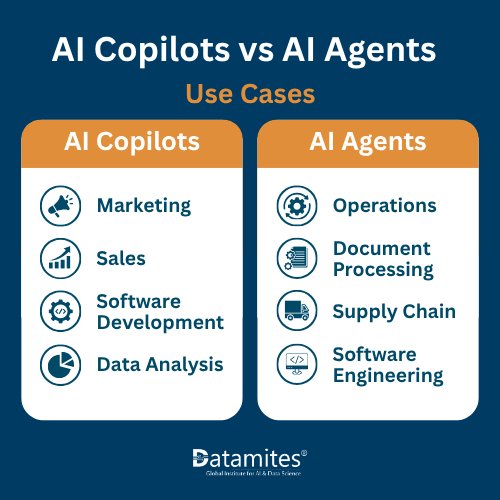
AI Copilot Use Cases
- Marketing: Helps create campaign content, summarize research, and refine messaging.
- Sales: Summarizes customer interactions, prepares meeting briefs, and suggests follow-up messages.
- Software Development: Supports code generation, debugging, documentation, and testing.
- Data Analysis: Helps summarize reports, explore information, and identify relevant patterns.
AI Agent Use Cases
- Operations: Monitors defined conditions, gathers information, performs approved actions, and escalates exceptions.
- Document Processing: Extracts information, validates records, updates systems, and routes incomplete cases.
- Supply Chain: Monitors inventory or supplier data and initiates predefined workflow actions when required.
- Software Engineering: Can analyze an issue, modify code, run tests, and return results for developer review.
Business Benefits
AI copilot use cases can improve employee productivity, reduce repetitive knowledge work, and support faster analysis and content creation. AI Agents in the Workplace can reduce manual handoffs, coordinate multi-step processes, and support AI-powered automation across connected systems.
Recent Deloitte research found that 66% of surveyed organizations reported productivity and efficiency gains from AI, while 53% reported improved decision-making and data-driven insights.
Real-World Application
Consider a sales workflow. A copilot can help a salesperson analyze an opportunity and prepare a customer response. After approval, an AI agent could update the CRM, retrieve relevant information, schedule approved follow-ups, and coordinate related workflow steps.
This shows how AI copilots and AI agents can work together: copilots support human judgment, while agents handle suitable, repeatable processes within defined boundaries.
AI Copilots vs AI Agents: Which Technology Should Businesses Choose?
Choosing between AI copilots and AI agents depends on the workflow, level of human involvement, and business objective. Copilots are suitable when employees need continuous assistance and control, while agents are better suited to repeatable, multi-step processes with clear rules, permissions, and system access.
Before adopting either approach, businesses should consider workflow complexity, integration requirements, data security, governance, exception handling, and expected business value. Greater autonomy should be introduced only when the process is structured enough to support appropriate monitoring and human intervention.
In many cases, a hybrid approach can be effective. Copilots can support employees with analysis, preparation, and decision-making, while agents can execute approved operational tasks. This enables businesses to combine human judgment with targeted automation while keeping accountability within the workflow.
Refer to these articles:
- What’s the Difference Between Gen AI, Agentic AI and AI Agents
- Understanding Foundation Models in AI: A Beginner’s Guide
- What Is AI Governance and Why It's Becoming Essential
Understanding technologies such as AI copilots and AI agents requires more than knowing how they are used. Professionals also need a strong foundation in Artificial Intelligence, Machine Learning, Python, and real-world AI applications. DataMites Institute offers career-focused training designed to help learners develop these skills through structured learning, expert-led sessions, hands-on projects, and practical case studies.
DataMites Institute offers a 9-month Artificial Intelligence course designed to build practical skills in TensorFlow, Keras, Computer Vision, neural networks, AI automation, and Generative AI through hands-on projects and real-world applications. The program includes IABAC and NASSCOM FutureSkills certifications, along with placement support and mock interview preparation to help learners prepare for Artificial Intelligence careers. With 2,00,000+ learners trained and 50+ offline centres across India, learners can explore our Artificial Intelligence courses in Delhi, Pune, Bangalore, Hyderabad, Chennai, Coimbatore, Ahmedabad, Mumbai, and other locations.
Learners in Coimbatore can strengthen their practical capabilities through the Artificial Intelligence course in Coimbatore, which combines guided instruction with practical projects and industry-oriented learning. The program helps participants strengthen their understanding of Artificial Intelligence concepts while developing applicable skills for evolving roles across the technology landscape.