What Are the Job Opportunities in AI for Healthcare?
Explore job opportunities in AI for healthcare, including roles in medical data science, machine learning engineering, clinical AI research, and health informatics. Learn key skills, career paths, and future demand shaping healthcare innovation.
 Prerana B A
The healthcare industry is changing faster than ever, and artificial intelligence (AI) is at the center of this transformation. From AI-powered diagnostics to virtual healthcare assistants, hospitals and healthcare companies are increasingly using advanced technologies to improve patient care, reduce costs, and streamline operations.
As a result, AI jobs in healthcare are becoming some of the most in-demand careers worldwide. Whether you are a healthcare professional, software engineer, data scientist, or recent graduate, there are now exciting opportunities to build a future in this rapidly growing field.
According to industry reports, the global AI healthcare market is expected to exceed $180 billion by 2030, growing at a remarkable rate due to increasing investments in healthcare automation, medical analytics, and predictive diagnostics. This explosive growth is creating thousands of new AI healthcare jobs across hospitals, pharmaceutical companies, research labs, insurance providers, and HealthTech startups.
How AI Is Revolutionizing Healthcare in 2026
Artificial intelligence is no longer a futuristic idea in medicine. In 2026, AI is already helping doctors diagnose diseases faster, assisting researchers in drug discovery, and improving patient experiences through automation.
Some major applications of AI-powered healthcare include:
- Medical image analysis
- Predictive healthcare analytics
- AI-assisted surgeries
- Personalized treatment plans
- Virtual health assistants
- Remote patient monitoring
- Drug development automation
- Clinical decision support systems
For example:
- AI systems can detect early signs of cancer in medical scans.
- Machine learning models can predict patient risks before symptoms worsen.
- NLP-powered healthcare chatbots can assist patients 24/7.
- Wearable devices use AI to monitor heart health in real time.
Major healthcare organizations and companies investing heavily in AI include:
- Google Health
- Microsoft
- IBM
- NVIDIA
- Tempus
- PathAI
This rapid digital transformation is fueling demand for professionals with expertise in healthcare technology careers and artificial intelligence.
Refer to these articles:
- Top AI Tools in HR Transforming Tech Companies
- How AI Help Business in Marketing and Customer Behavior Analysis
- AI Trends That Will Transform Banking and Finance by 2030
Why AI Careers in Healthcare Are Growing
AI is changing healthcare faster than almost any other industry, and that shift is creating a huge wave of new careers. Here’s what’s driving the growth.
Rising Demand for Smart Healthcare Solutions
Healthcare providers are overwhelmed with growing patient volumes and administrative work. AI helps automate repetitive tasks and improves efficiency.
Hospitals are now hiring experts for:
- Healthcare automation jobs
- AI healthcare engineer roles
- Healthcare analytics careers
- Clinical AI specialist positions
Explosion of Healthcare Data
Modern healthcare generates massive amounts of data from:
- Electronic health records (EHRs)
- Wearables
- Medical imaging
- Genomics
- Insurance systems
Organizations need skilled professionals who can analyze this data using AI and machine learning.
This has created strong demand for:
- Healthcare data scientist jobs
- Machine learning healthcare jobs
- AI medical industry jobs
Growth of HealthTech Startups
Thousands of HealthTech startups are building AI solutions for:
- Telemedicine
- Medical diagnostics
- Remote monitoring
- Mental health support
- Predictive healthcare
These startups are creating flexible, remote, and high-paying AI healthcare job opportunities globally.
Top AI Job Opportunities in Healthcare
The healthcare AI market is expanding across hospitals, biotech, pharma, insurance, and digital health startups. The strongest opportunities right now sit at the intersection of medicine, data, and automation. Here are the top AI job paths gaining momentum.
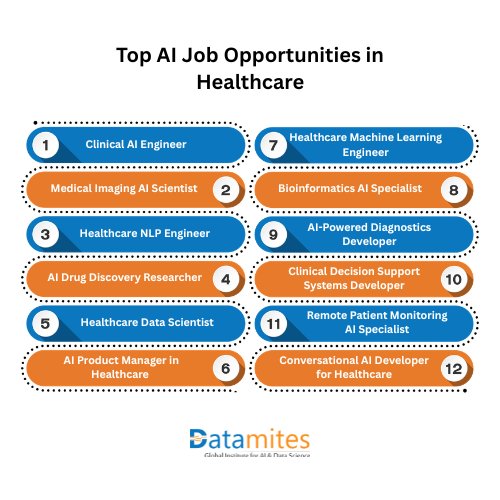
1. Clinical AI Engineer
A Clinical AI Engineer develops AI systems used in hospitals and clinical environments.
Responsibilities
- Build predictive healthcare models
- Develop clinical decision tools
- Integrate AI into hospital systems
- Improve patient workflow automation
Skills Needed
- Python
- TensorFlow
- Healthcare data systems
- Cloud computing
- Machine learning
Average Salary
$110,000–$160,000 annually (varies by country and experience)
This is one of the fastest-growing AI healthcare jobs in modern hospitals.
2. Medical Imaging AI Scientist
Medical imaging is one of the biggest areas for AI in healthcare job opportunities.
These specialists create AI models that analyze:
- X-rays
- CT scans
- MRIs
- Ultrasounds
Key Technologies
- Deep learning
- Computer vision
- Neural networks
Real-World Example
AI tools now help radiologists detect diseases like lung cancer and stroke faster and with greater accuracy.
Salary Insight
$120,000–$180,000 per year
This role is ideal for professionals interested in AI in medical diagnosis.
3. Healthcare NLP Engineer
Natural Language Processing (NLP) helps AI understand medical language.
Healthcare NLP Engineers build systems that process:
- Clinical notes
- Medical records
- Voice-based patient interactions
- Healthcare chatbots
Common Tools
- Python
- NLP libraries
- Large language models
- Speech recognition systems
Career Demand
With the rise of conversational AI in hospitals, this role is becoming a major part of healthcare innovation jobs.
4. AI Drug Discovery Researcher
Drug discovery traditionally takes years and billions of dollars. AI is dramatically speeding up the process.
Responsibilities
- Analyze biological data
- Predict drug interactions
- Use machine learning to identify treatment candidates
Industries Hiring
- Pharmaceutical companies
- Biotech firms
- Research institutions
Salary Range
$130,000–$200,000+
This is one of the most advanced medical AI careers today.
5. Healthcare Data Scientist
Healthcare Data Scientists analyze large datasets to improve patient outcomes and healthcare operations.
Daily Tasks
- Build predictive models
- Analyze patient trends
- Detect healthcare risks
- Optimize treatment strategies
Required Skills
- SQL
- Python
- Data visualization
- Statistics
- Machine learning
Why It Matters
Healthcare organizations rely heavily on data-driven decisions, making healthcare data scientist jobs highly valuable.
6. AI Product Manager in Healthcare
AI Product Managers bridge the gap between technical teams and healthcare providers.
Responsibilities
- Lead AI healthcare product development
- Coordinate engineers and clinicians
- Ensure regulatory compliance
- Improve patient-focused solutions
Important Skills
- Leadership
- Product strategy
- Healthcare workflows
- AI fundamentals
This role is perfect for professionals who enjoy both technology and business strategy.
7. Healthcare Machine Learning Engineer
Machine Learning Engineers build intelligent healthcare systems that continuously learn from data.
Examples of Projects
- Predictive patient monitoring
- Disease risk prediction
- Personalized treatment recommendations
- Technical Stack
- Python
- TensorFlow
- PyTorch
- Cloud AI platforms
Salary
$115,000–$170,000
These machine learning healthcare jobs are expected to grow rapidly over the next decade.
8. Bioinformatics AI Specialist
Bioinformatics combines biology, genetics, and AI.
Key Responsibilities
- Analyze DNA and genomic data
- Support precision medicine
- Build AI-powered research tools
Industries
- Genomics companies
- Cancer research labs
- Pharmaceutical research
This field is becoming increasingly important in personalized healthcare.
9. AI-Powered Diagnostics Developer
AI-powered diagnostics are helping doctors detect diseases earlier than ever before.
Responsibilities
- Build diagnostic AI systems
- Improve diagnostic accuracy
- Develop real-time healthcare monitoring tools
Industry Trend
AI diagnostic tools are now used in cardiology, dermatology, oncology, and ophthalmology.
This role is central to the future of AI-powered healthcare.
10. Clinical Decision Support Systems Developer
Clinical Decision Support Systems (CDSS) help healthcare professionals make informed medical decisions.
Key Tasks
- Develop recommendation systems
- Integrate medical guidelines into AI tools
- Improve treatment planning
Technologies Used
- Predictive analytics
- Healthcare databases
- AI algorithms
Hospitals worldwide are investing heavily in these systems.
11. Remote Patient Monitoring AI Specialist
Remote healthcare is growing rapidly after the expansion of telemedicine services.
Responsibilities
- Develop AI monitoring systems
- Analyze wearable device data
- Detect health anomalies in real time
Why This Role Matters
Remote AI healthcare jobs allow patients to receive care from home while reducing hospital workloads.
12. Conversational AI Developer for Healthcare
Conversational AI systems are becoming essential in patient communication.
Examples
- Virtual health assistants
- AI symptom checkers
- Appointment scheduling bots
Required Skills
- NLP
- Voice AI
- Chatbot development
- Healthcare compliance
This role is especially popular among digital healthcare careers.
Refer to these articles:
- LLM Fine-Tuning vs Prompt Engineering: Which Is Better?
- Top AI Trends That Will Shape 2026
- PyTorch vs TensorFlow: Which is Better?
Future Scope of AI in Healthcare Careers
AI in healthcare is growing rapidly and is expected to expand significantly over the next decade. Industry reports suggest the global market could rise from around $20–30 billion in the early 2020s to over $200 billion by 2030, driven by strong adoption across hospitals, research, and HealthTech.
This growth is fueled by applications such as personalized medicine, predictive healthcare, robotics-assisted surgery, mental health AI tools, cybersecurity, and genomic research. AI is also expected to improve efficiency by reducing healthcare costs and supporting faster, more accurate clinical decisions.
Rather than replacing jobs, AI is creating new opportunities in areas like healthcare AI ethics, governance, medical robotics, safety auditing, and digital health consulting. Professionals with combined expertise in healthcare and AI will remain in the highest demand.
AI jobs in healthcare are growing fast, especially in hospitals, pharma, and healthtech startups. Key areas include diagnosis, drug discovery, personalized medicine, predictive healthcare, and hospital automation, all driven by AI and data technologies. This is creating strong demand for skilled professionals worldwide.
The future of healthcare careers will depend on AI, and people with skills in machine learning, data analytics, and healthcare systems will have the best opportunities. AI healthcare jobs will continue to expand and become one of the most important career paths in modern medicine.
DataMites offers an AI for healthcare courses designed to help professionals apply artificial intelligence in real clinical and operational environments. The program covers core AI concepts, data-driven healthcare insights, and practical applications in areas such as patient care, hospital management, and medical research. It is also part of broader AI learning tracks that include domains like product management, HR and people analytics, finance, risk, marketing, and business leadership.
The course includes flexible learning options such as online training, classroom sessions, and project-based internships for hands-on experience. It also provides industry-recognized certifications, including affiliations such as IABAC and credentials aligned with healthcare and clinical AI roles. With access to training across multiple locations in India, it supports both in-person and online learning formats based on learner needs.