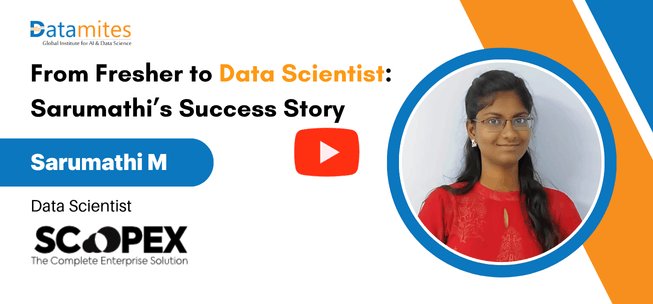
From Fresher to Data Scientist: Sarumathi’s Success Story
Discover Sarumathi’s inspiring journey from fresher to Data Scientist, exploring her learning experience, career growth, and success in the field of data science.
 Prerana B A
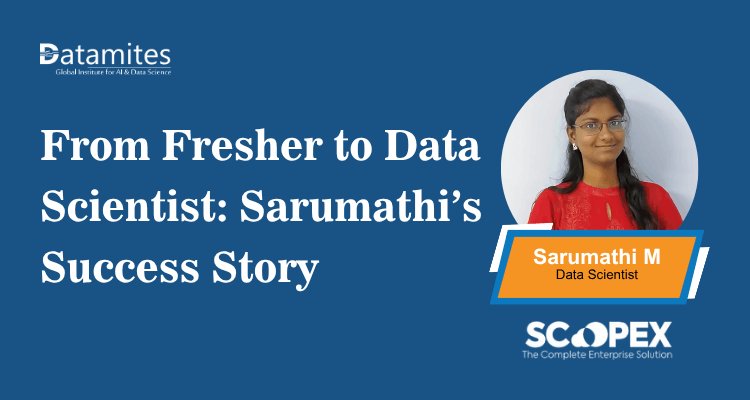
Switching careers into Data Science can be challenging, especially for graduates and professionals coming from a non-IT background. Sarumathi’s journey shows how structured learning, hands-on projects, internship experience, mock interviews, and consistent preparation can help a learner move toward a Data Science career. After completing her B.E. in 2024, Sarumathi initially worked as a Production Engineer in a manufacturing company. Driven by her interest in Data Science, she decided to transition into the field and joined DataMites in Chennai.
During her six-month training, she learned essential concepts including Python, SQL, Statistics, Machine Learning, Pandas, and NumPy, starting from the basics. She then completed an internship involving five projects, including one client project. After completing the learning and project phases, she participated in mock interviews and multiple client interviews before being selected for a Data Scientist role at Scopex Apps Pvt. Ltd in Chennai. This DataMites success story highlights the importance of practical learning and understanding the reasoning behind technical concepts rather than simply memorizing definitions.
Sarumathi’s Career Journey: From Engineering Graduate to Data Scientist
Sarumathi’s journey from an engineering graduate and Production Engineer to a Data Scientist shows how focused learning, practical experience, and consistent interview preparation can help freshers build a career in Data Science. Her experience offers valuable lessons for students from both technical and non-IT backgrounds.
1.What was your educational and professional background before joining DataMites?
I am a 2024 B.E. graduate from an ECE background. After graduation, I worked as a production engineer in a manufacturing company before deciding to switch into data science.
2. What motivated you to transition from a production engineering role into data science?
I developed a genuine interest in the data science field, and that interest is what pushed me to make the career switch. I decided to join DataMites to build the right foundation for this transition.
3.How long was your DataMites training program, and what did it cover?
The training lasted six months. It started from the basics and covered Python, SQL, Statistics, Machine Learning, Pandas, and NumPy, helping me build a strong foundation through data science courses in Chennai.
4. How challenging was it to learn IT skills with an ECE background?
It was tough initially since I came from an ECE background and IT subjects were new to me. However, I found Python easier to learn because it is close to English-based coding, and the trainers taught everything starting from the basics, which made the learning curve much smoother.
5. What helped you retain and understand the concepts taught in class?
Whatever was taught in class, I would go home and practice the same day. This habit helped me remember concepts instead of forgetting them, and it made the learning process much easier for me over time.
6 . Were the DataMites study materials sufficient for your learning?
The class notes and materials shared by my mentor after every session were sufficient for my learning. My mentor would send notes over email, and I also created my own written notes to strengthen my understanding. Whenever I had doubts, I would refer to tools like ChatGPT and Google for additional clarification.
7. How was your transition from theory to hands-on projects during the internship?
Initially, we only understood the theory, not the actual project flow. But during the internship, my mentors guided us on how to structure a project, from loading and analyzing data to generating results. Working on my own project helped me understand the complete process and how outputs are derived, which was a very valuable learning experience.
8. How many internship projects did you complete, and were they team-based?
I worked in a team and completed four projects along with one client project during my internship. Every project gave us the opportunity to analyze results and even achieve high accuracy scores, which made the experience genuinely enjoyable and rewarding.
9. Did the projects you worked on help you during your job interviews?
Yes, the projects were extremely important. In fact, the very first question in most of my interviews was to explain the projects I had worked on.
10. How many mock interviews did you attend, and what was that experience like?
I attended two mock interviews. In the first one, I was asked basic questions on Python, SQL, and statistics, along with some coding tasks. I realized I needed to improve my coding and machine learning skills after that round. I worked on those gaps and successfully cleared my second mock interview.
11. How did DataMites support you with interview preparation?
After clearing the mock interview, DataMites shared nearly 9 to 10 files containing commonly asked interview questions across technical and HR rounds, along with reference answers. I supplemented this with additional research on YouTube and used tools like ChatGPT to strengthen my answers. I also made sure to be thorough with explaining my project workflow, since that came up frequently in interviews.
12. How many company interviews did you attend before finally getting selected?
I attended around four interviews in total. I had actually cleared one interview earlier and received an offer, but I was unable to join due to a health condition at the time. DataMites then gave me another opportunity to interview through their placement network, which eventually led to my current offer.
13. Can you walk us through the interview rounds for the role you were finally selected for?
There were three rounds in total. The first round focused on machine learning concepts and a detailed walkthrough of my projects. The second round covered Python and SQL fundamentals. The third round was the HR round.
14. What kind of questions were asked in the machine learning and project round?
I was asked to explain my project step by step, including the reasoning behind each choice, such as why I used a particular model or technique. I was also asked about the machine learning pipeline I used and whether I was familiar with newer AI concepts like LLMs. The interviewer also shared how machine learning processes work within their own company.
15. What do interviewers really look for in candidates?
From my experience, interviewers are not just checking whether you know definitions. They want to know whether you understand the actual workflow, why a particular approach was used, and how you would troubleshoot a model that isn't performing well. It's less about memorized theory and more about applied, real-world understanding.
16. What advice would you give to freshers starting a career in Data Science?
My advice would be to avoid memorizing definitions and instead understand concepts in depth. Always ask yourself why something works the way it does. This habit of questioning and exploring solutions makes the learning process more meaningful and prepares you much better for real-world work in the industry.
Refer these articles :
- How Varun Built a Successful Career in Data Science
- Devadarsan’s Journey from Fresher to Data Scientist
- How Rakshitha Successfully Transitioned Into Data Science
Key Takeaways from Sarumathi's Success Story
Sarumathi’s journey offers several valuable lessons for students, freshers, and career switchers who are planning to enter the Data Science field:
- Sarumathi has been placed as a Data Scientist at Scopex Apps Pvt. Ltd., marking a successful transition from her earlier role as a production engineer.
- A non-IT engineering background is not a barrier to building a career in Data Science with structured learning and consistent effort.
- Daily practice after each class can improve concept retention and make technical topics easier to understand.
- Hands-on projects and internship experience help learners connect theoretical knowledge with real-world Data Science workflows.
- Working on client-based projects can provide practical exposure and prepare candidates to discuss projects confidently during interviews.
- Mock interviews help identify technical weaknesses and give learners an opportunity to improve before attending actual interviews.
- Combining structured interview preparation materials with self-research can strengthen preparation for technical and HR rounds.
- Interviewers often look beyond definitions and evaluate practical understanding, problem-solving ability, and the reasoning behind technical decisions.
- Consistent practice and persistence are important because every interview can provide valuable experience and help candidates perform better in future opportunities.
Refer these articles :
- What Is Data Science And Why Now?
- Essential Skills That You Need To Become A Data Scientist
- Difference Between Data Science And Machine Learning
Sarumathi’s journey from Production Engineer to Data Scientist shows that a career switch into Data Science is achievable with the right guidance, consistent practice, and hands-on experience. She completed her training at the DataMites center in Chennai, where structured learning, practical projects, and focused interview preparation helped her build the skills and confidence needed to achieve her career goals.
Starting a career in the data industry requires strong fundamentals, practical experience, and continuous learning. Sarumathi’s journey shows how structured training, hands-on projects, and regular practice helped her transition from a Production Engineer to a Data Scientist. According to IMARC Group, India’s Data Science Platform market was valued at USD 592.3 million in 2025 and is projected to reach USD 2.62 billion by 2034, growing at a 17.42% CAGR. Building skills through top IT courses such as Data Science, Artificial Intelligence, Machine Learning, and Data Analytics can help aspiring professionals prepare for this growing industry.
Whether you're a fresher, a working professional, or someone planning a career transition like Sarumathi, DataMites makes quality Data Science education accessible. With online and offline learning options, DataMites provides a Data Science institute in Chennai and training programs across major cities in India. Through structured learning, real-world projects, expert mentorship, mock interviews, and globally recognized IABAC® and NASSCOM FutureSkills® certifications, learners gain the practical skills and confidence needed to succeed in the industry. Sarumathi's journey demonstrates that with the right guidance, hands-on learning, and consistent effort, aspiring professionals can successfully transition into a career in the data industry.
DataMites has a strong presence across India, with 30+ offline training centers providing learners with convenient access to quality Data Science education. DataMites offers Data Science courses in Delhi, along with training options in Chennai, Pune, Hyderabad, Mumbai, Coimbatore, Ahmedabad, Kolkata, Noida, Indore, Jaipur, Chandigarh, Kochi, Nagpur, and Bhubaneswar, allowing learners to choose a location that best suits their training needs. These centers provide structured learning, hands-on projects, practical training, and industry-focused guidance, helping learners develop the skills needed to build successful careers in Data Science.