AI Engineer vs. Data Scientist in South Africa
Explore the key differences between AI engineers and data scientists in South Africa, including their skills, salaries, career paths, and job opportunities to help you choose the right career.
 Swagatam Sinha
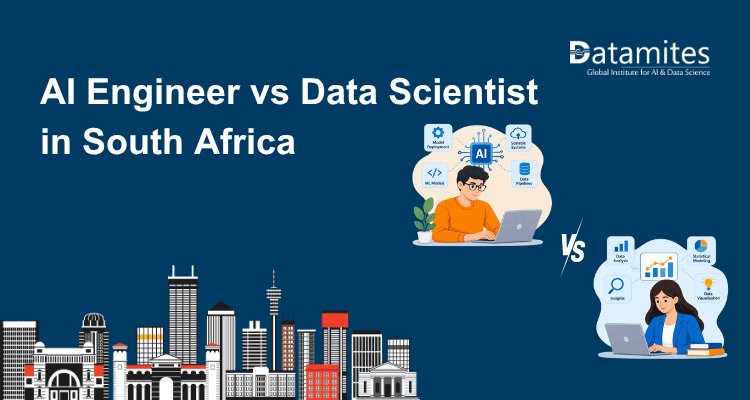
Choosing between artificial intelligence and data science can be difficult when both fields involve programming, machine learning, and problem-solving. However, the work behind each career is different. AI engineers develop applications that use AI technologies, while data scientists analyze information to identify patterns and support business decisions.
Consider a South African retailer that wants to predict product demand and automate customer inquiries. A data scientist could develop a forecasting model using historical sales data. An AI engineer could integrate an AI assistant into the retailer's website or connect the forecast to its inventory system.
Both roles contribute to business outcomes, but they require different technical strengths. Understanding their responsibilities, salary expectations, qualifications, and career paths can help graduates and working professionals decide which direction to pursue in South Africa.
AI Engineer vs Data Scientist: Key Differences
| Factor | AI Engineer | Data Scientist |
| Primary responsibility | Develop and deploy AI applications | Analyze data and develop predictive models |
| Main skills | Programming, software engineering, model integration | Statistics, data analysis, machine learning |
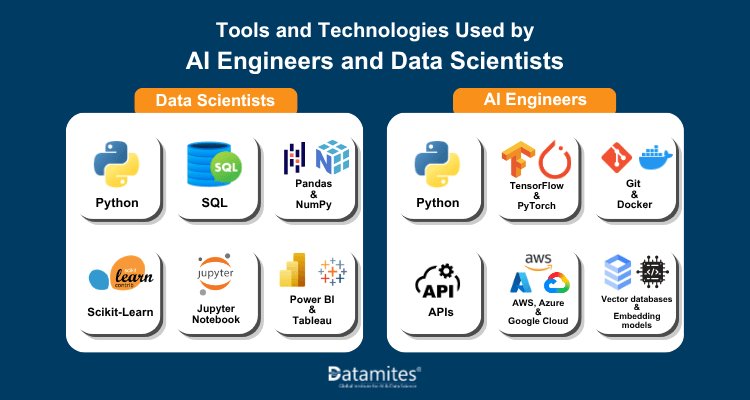
| Common tools | Python, APIs, PyTorch, TensorFlow, Docker | Python, SQL, pandas, scikit-learn |
| Typical deliverables | AI applications and automated workflows | Forecasts, models, analytical reports |
| Main objective | Build reliable AI solutions | Generate evidence for better decisions |
What Does an AI Engineer Do?
An AI engineer develops software applications that use machine learning models, language models, and other AI technologies. The work can involve integrating models into existing systems, creating document-processing applications, building recommendation engines, and testing applications before deployment.
For example, an engineer working for a financial services company might develop a chatbot that retrieves approved information to answer customer questions. The engineer must also test the application, manage access to information, and monitor its performance after release.
What Does a Data Scientist Do?
A data scientist investigates datasets to answer business questions and estimate future outcomes. Responsibilities include data cleaning, exploratory analysis, statistical testing, model development, and communicating findings.
At a South African bank, a data scientist might study customer transactions to identify patterns associated with loan defaults or account closures. The findings could help the bank improve its risk assessment or customer retention strategies.
Refer to these articles:
- Small Language Models vs Large Language Models
- AI Answer Engines vs Traditional Search
- What Is AI Governance and Why Is It Becoming Essential
AI Engineer vs Data Scientist: Skills and Tools
Both careers benefit from Python, SQL, and machine learning knowledge. The main difference is how these skills are applied. Data scientists concentrate on analyzing data and evaluating predictions, whereas AI engineers often need additional software development and deployment capabilities.
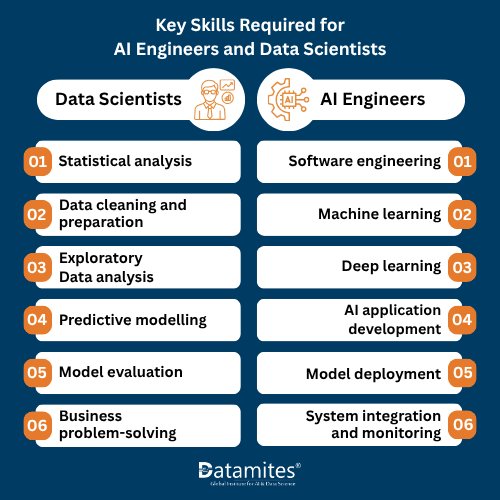
Programming, Databases and Statistics
Python is widely used in both professions. Data scientists use it to explore datasets and build models, while AI engineers use it to develop applications and connect AI components.
SQL is important for retrieving information from relational databases. Knowledge of statistics and probability is particularly useful for data scientists who need to test hypotheses, interpret results, and measure uncertainty. AI engineers also need mathematical knowledge to understand model behavior and performance.
Machine Learning and Generative AI
Data scientists may use scikit-learn, TensorFlow or PyTorch to develop models for fraud detection, demand forecasting, and customer churn prediction. Their work includes selecting suitable algorithms and evaluating model performance.
AI engineers use machine learning models within applications. Depending on the role, they may work with natural language processing, computer vision, large language models, or retrieval-augmented generation (RAG). RAG allows an application to retrieve relevant information from a document collection before generating an answer.
An online artificial intelligence course in South Africa can be one option for beginners who want structured learning in machine learning, generative AI, and related technologies.
Software Development and Data Visualization
AI engineering often involves APIs, Git, Docker, cloud services, testing, and application monitoring. These skills help developers move applications from experimentation into production.
Data science requires tools for preparing datasets, analyzing results, and communicating findings. Python libraries, Jupyter Notebook, Power BI, Tableau, and Matplotlib can support these tasks.
Beginners can start with Python and SQL before choosing specialized tools. Reviewing local job advertisements can help identify which technologies employers expect for particular positions.
AI Engineer vs Data Scientist Salary in South Africa: 2026
Salary estimates differ according to experience, employer, location, industry, and technical specialization. Figures from different platforms may also represent different measures of compensation, so they should not be treated as a direct comparison without checking their definitions.
AI Engineer Salary in South Africa
SalaryScope's 2026 The AI Engineer salary guide provides the following estimated monthly figures:
- Entry-level AI engineers: around R35,000.
- Mid-level AI engineers: approximately R85,000.
- Senior AI engineers: around R140,000.
- Lead and specialist positions: potentially above R220,000.
These are estimates reported by SalaryScope, not official national salary averages. Actual earnings can vary substantially according to the responsibilities and experience required.
Data Scientist Salary in South Africa
PayScale's South African data scientist salary data reported an average base salary of approximately R460,138 per year, based on 341 salary profiles updated on 7 July 2026.
The reported annual base salary range was approximately R207,000 to R809,000. The average equates to around R38,345 per month before tax.
An online data science course in South Africa may help learners develop foundational skills in Python, SQL, statistics, and predictive modelling. Training alone, however, does not determine an individual's salary or guarantee employment.
Salary Differences in Johannesburg and Cape Town
City-level estimates offer additional context, although job titles and reporting methods can differ between sources.
Johannesburg
- AI engineers: Glassdoor reports median total pay of approximately R925,000 per year, equivalent to R77,083 per month. The reported base salary range is R700,000 to R978,000 annually, with additional pay reported separately.
- Data scientists: Glassdoor reports median total pay of approximately R650,000 per year, equivalent to R54,167 per month. The reported total-pay range is R490,000 to R830,000 annually.
Cape Town
- AI developers: Indeed reports an average base salary of approximately R362,092 per year, or R30,174 per month. The estimate was updated on 17 September 2026 and is based on five reported salaries. AI developer and AI engineer roles can overlap, but they are not necessarily identical.
- Data scientists: Glassdoor reports average base pay of approximately R45,000 per month, with additional pay averaging around R3,000. The reported base-pay range is R35,000 to R58,000 per month.
People comparing training options can explore an online artificial intelligence course in Cape Town, depending on their location and preferred learning format.
These figures are published estimates, not guaranteed earnings. Before making career or financial decisions, compare current vacancies and check whether the advertised compensation represents base salary or total pay.
Refer to these articles:
- How to Become a Data Scientist in South Africa?
- How to Become an Artificial Intelligence Engineer in South Africa?
- How Much is the Artificial Intelligence Course Fee in South Africa?
AI and Data Science Opportunities Across South African Industries
The demand for particular skills depends on how organizations use technology and whether they are hiring for relevant positions. The following industries provide examples of potential applications rather than a guarantee of available vacancies.
Banking and Financial Services
Banks, insurers, and fintech companies use data analytics and AI in areas such as fraud detection, transaction monitoring, customer service, and risk assessment.
The Fintech Association of South Africa's March 2026 pulse survey received 44 responses from industry participants, with 20 organizations identifying fraud, anti-money laundering, or transaction monitoring as an AI use case.
AI engineers may integrate models into secure financial applications, while data scientists can investigate transaction patterns and evaluate predictive models. Both roles require attention to data quality, security, and regulatory requirements.
Technology and Software Development
Software businesses can incorporate intelligent search, language models, recommendation systems, and automated workflows into their products.
According to MarketsandMarkets, South Africa’s artificial intelligence (AI) market is projected to grow from USD 1.34 billion in 2026 to USD 6.77 billion by 2031. This forecast reflects expected market expansion and should not be interpreted as a direct measure of job vacancies.
AI engineers may develop software that uses these technologies, while data scientists can analyze product usage and assess the performance of predictive models.
Retail and E-commerce
Retailers can use historical sales and customer data to forecast demand, understand purchasing patterns, and evaluate promotions. Data scientists may develop forecasting models, while AI engineers can integrate recommendations and automated customer support into retail platforms.
Telecommunications, Healthcare and Logistics
Telecommunications companies can analyze network performance and customer behavior. Healthcare organizations may use properly governed datasets to investigate patient trends, while logistics businesses can apply predictive analytics to demand planning and route optimization.
Data scientists in these sectors need analytical and statistical skills. AI engineers may need additional knowledge of system integration, deployment, and operational reliability.
Across these industries, useful skills include Python, SQL, machine learning, data preparation, software testing, and model evaluation. The combination required depends on the specific position.
Career Options for AI Engineers and Data Scientists in South Africa
The skills discussed above can lead to different specializations. The following roles illustrate possible directions, although availability and entry requirements vary between employers.
AI Engineering Roles
- AI Engineer: Develops and deploys applications that use AI technologies.
- Machine Learning Engineer: Builds and improves machine learning systems.
- Generative AI Engineer: Develops applications using large language models, RAG, and related technologies.
- NLP Engineer: Creates systems for processing human language, including chatbots and document analysis tools.
- Computer Vision Engineer: Develops systems that interpret images and video.
- MLOps Engineer: Manages the deployment, monitoring, and maintenance of models in production.
These roles are relevant to software development, financial services, telecommunications, and other industries adopting AI. Some employers combine several responsibilities into a single position.
Data Science and Analytics Roles
- Data Scientist: Develops models and analyses complex datasets.
- Machine Learning Scientist: Researches algorithms and methods to improve model performance.
- Business Intelligence Analyst: Creates reports and dashboards to explain business performance.
- Risk Analyst: Applies quantitative methods to assess financial or operational risks.
- Customer Analytics Specialist: Investigates customer behavior, retention, and purchasing patterns.
- Quantitative Analyst: Uses mathematics, statistics, and programming for financial modeling.
Data scientists may work in banking, insurance, retail, healthcare, telecommunications, and consulting. Some positions focus on business reporting, while others involve advanced statistical modelling or machine learning.
People researching data science jobs in South Africa should compare employers requirements for programming, statistics, data visualization, and machine learning.
Refer to these articles:
- Is Data Science & Artificial Intelligence in Demand in South Africa?
- Data Science And Artificial Intelligence Demand in Cape Town
- Data Science and Artificial Intelligence in Demand in Johannesburg
AI Engineer or Data Scientist: Which Career Suits You?
Your preferred working style is a useful starting point when choosing between these careers.
Choose AI engineering if you enjoy building software. You may prefer developing applications, connecting APIs, testing systems, and making AI tools work reliably for users. Programming and software development should be central to your learning plan.
If you want to build practical AI skills before applying for relevant roles, an online artificial intelligence course in Johannesburg can help you develop knowledge of machine learning, deep learning and AI application development.
Consider data science if you enjoy investigating problems. You may prefer exploring datasets, testing hypotheses, interpreting statistical results, and explaining what the evidence means for a business.
If you are a graduate, build a foundation in programming and databases before attempting a small project in each field. Compare the activities involved rather than choosing a path solely because of its job title.
If you are changing careers, use your existing experience where possible. A finance professional could begin with financial data analysis, while a software developer might explore AI application development.
Graduates in Johannesburg who prefer analytical work can compare an online data science course in Johannesburg with the skills listed in entry-level vacancies. Relevant training should support practical learning rather than replace project experience.
Neither profession is automatically easier to enter. Entry-level software development, data analysis, or business intelligence work may provide useful experience, depending on the skills required for a future position.
Portfolio Projects for AI Engineering and Data Science Beginners
A portfolio demonstrates how you approach a problem, select tools, and evaluate results. Two well-documented projects can provide useful evidence of your skills.
Data Science Project: Retail Sales Forecasting
Use a public retail sales dataset to identify seasonal trends and forecast future demand. Document how you cleaned the data, selected a forecasting method, and measured prediction accuracy. Include charts and explain limitations, such as missing observations or changes in customer behavior.
AI Engineering Project: Document Question-Answering Application
Build an application that answers questions using public documents. Connect a language model to a retrieval system and test whether its responses are supported by the source material. Document how the application handles missing information and questions it cannot answer confidently.
For each project, explain the problem, dataset, tools, method, results, and possible improvements. Include instructions for running the code and provide evaluation metrics where appropriate. Use properly licensed data and avoid publishing confidential information or credentials.
Choose projects that reflect the requirements of the positions you want to pursue. Learners seeking additional analytical practice may also explore an online data science course in Cape Town as part of their learning plan.
Refer to these articles:
- Understanding Foundation Models in AI: A Beginner’s Guide
- What’s the Difference Between Gen AI, Agentic AI and AI Agents
- What is Artificial Narrow Intelligence?
Career Growth and Future Opportunities: AI Engineer vs. Data Scientist
Career progression depends on experience, technical ability, project ownership, and the responsibilities available within an organization.
AI Engineering Progression
A typical progression may include:
- Junior AI Engineer: Assists with application development and testing.
- AI Engineer: Integrates models into applications and manages deployments.
- Senior AI Engineer: Leads complex implementations and addresses reliability issues.
- AI Architect or Technical Lead: Designs system architecture and guides technical decisions.
Data Science Progression
A possible route in data science includes:
- Junior Data Scientist: Prepares data and supports exploratory analysis.
- Data Scientist: Develops models and investigates business problems.
- Senior Data Scientist: Leads modelling projects and evaluates complex results.
- Data Science Manager or Specialist: Leads analytical teams or develops expertise in areas such as forecasting, risk, or machine learning.
Generative AI is creating additional technical challenges in both fields. Professionals may need to evaluate model reliability, manage data quality, assess bias, and understand responsible AI practices.
South Africa's draft National AI Policy identifies skills development and responsible AI adoption as priorities. Keeping technical knowledge current can help professionals respond to changing requirements, although progression ultimately depends on practical ability and employer needs.
Choosing between an AI engineer and a data scientist depends on your interests, technical skills, and career goals. AI engineering focuses on building and deploying AI applications, while data science centers on analyzing data, developing models, and supporting business decisions. Comparing South African job requirements and working on practical projects can help you decide which path suits you.
For those looking to develop relevant skills, DataMites Institute is a globally recognized training institute with more than 12 years of experience and over 200,000 learners worldwide. Its AI Engineer program covers Python, machine learning, deep learning, generative AI, and cloud technologies, along with live instructor-led training, an internship, and real-time projects. Prospective learners can review the course details, fees, and available learning formats to determine whether the program aligns with their learning goals.