154,000
94,809*
NO COST EMI : 15,802 p.m for 6 Months
*Offer valid till 31st July 2026
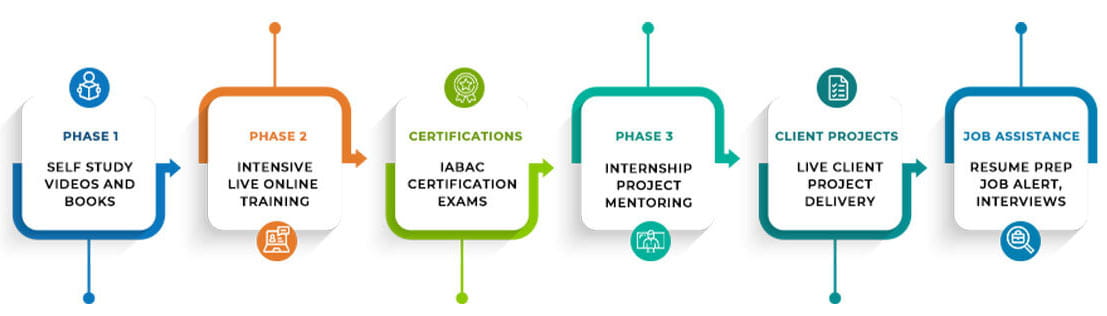
Instructor Led Live Online
Self Learning + Live Mentoring
In - Person Classroom Training



MODULE 1 : ARTIFICIAL INTELLIGENCE OVERVIEW
• Evolution Of Human Intelligence
• What Is Artificial Intelligence?
• History Of Artificial Intelligence
• Why Artificial Intelligence Now?
• Areas Of Artificial Intelligence
• AI Vs Data Science Vs Machine Learning
MODULE 2 : DEEP LEARNING INTRODUCTION
• Deep Neural Network
• Machine Learning vs Deep Learning
• Feature Learning in Deep Networks
• Applications of Deep Learning Networks
MODULE3 : TENSORFLOW FOUNDATION
• TensorFlow Structure and Modules
• Hands-On:ML modeling with TensorFlow
MODULE 4 : COMPUTER VISION INTRODUCTION
• Image Basics
• Convolution Neural Network (CNN)
• Image Classification with CNN
• Hands-On: Cat vs Dogs Classification with CNN Network
MODULE 5 : NATURAL LANGUAGE PROCESSING (NLP)
• NLP Introduction
• Bag of Words Models
• Word Embedding
• Hands-On:BERT Algorithm
MODULE 6 : AI ETHICAL ISSUES AND CONCERNS
• Issues And Concerns Around Ai
• Ai And Ethical Concerns
• Ai And Bias
• Ai:Ethics, Bias, And Trust
MODULE 1 : PYTHON BASICS
• Introduction of python
• Installation of Python and IDE
• Python Variables
• Python basic data types
• Number & Booleans, strings
• Arithmetic Operators
• Comparison Operators
• Assignment Operators
MODULE 2 : PYTHON CONTROL STATEMENTS
• IF Conditional statement
• IF-ELSE
• NESTED IF
• Python Loops basics
• WHILE Statement
• FOR statements
• BREAK and CONTINUE statements
MODULE 3 : PYTHON DATA STRUCTURES
• Basic data structure in python
• Basics of List
• List: Object, methods
• Tuple: Object, methods
• Sets: Object, methods
• Dictionary: Object, methods
MODULE 4 : PYTHON FUNCTIONS
• Functions basics
• Function Parameter passing
• Lambda functions
• Map, reduce, filter functions
MODULE 1 : OVERVIEW OF STATISTICS
• Introduction to Statistics
• Descriptive And Inferential Statistics
• Basic Terms Of Statistics
• Types Of Data
MODULE 2 : HARNESSING DATA
• Random Sampling
• Sampling With Replacement And Without Replacement
• Cochran's Minimum Sample Size
• Types of Sampling
• Simple Random Sampling
• Stratified Random Sampling
• Cluster Random Sampling
• Systematic Random Sampling
• Multi stage Sampling
• Sampling Error
• Methods Of Collecting Data
MODULE 3 : EXPLORATORY DATA ANALYSIS
• Exploratory Data Analysis Introduction
• Measures Of Central Tendencies: Mean,Median And Mode
• Measures Of Central Tendencies: Range, Variance And Standard Deviation
• Data Distribution Plot: Histogram
• Normal Distribution & Properties
• Z Value / Standard Value
• Empherical Rule and Outliers
• Central Limit Theorem
• Normality Testing
• Skewness & Kurtosis
• Measures Of Distance: Euclidean, Manhattan And Minkowski Distance
• Covariance & Correlation
MODULE 4 : HYPOTHESIS TESTING
• Hypothesis Testing Introduction
• P- Value, Critical Region
• Types of Hypothesis Testing
• Hypothesis Testing Errors : Type I And Type II
• Two Sample Independent T-test
• Two Sample Relation T-test
• One Way Anova Test
• Application of Hypothesis testing
MODULE 1: MACHINE LEARNING INTRODUCTION
• What Is ML? ML Vs AI
• Clustering, Classification And Regression
• Supervised Vs Unsupervised
MODULE 2: PYTHON NUMPY PACKAGE
• Introduction to Numpy Package
• Array as Data Structure
• Core Numpy functions
• Matrix Operations, Broadcasting in Arrays
MODULE 3: PYTHON PANDAS PACKAGE
• Introduction to Pandas package
• Series in Pandas
• Data Frame in Pandas
• File Reading in Pandas
• Data munging with Pandas
MODULE 4: VISUALIZATION WITH PYTHON - Matplotlib
• Visualization Packages (Matplotlib)
• Components Of A Plot, Sub-Plots
• Basic Plots: Line, Bar, Pie, Scatter
MODULE 5: PYTHON VISUALIZATION PACKAGE - SEABORN
• Seaborn: Basic Plot
• Advanced Python Data Visualizations
MODULE 6: ML ALGO: LINEAR REGRESSION
• Introduction to Linear Regression
• How it works: Regression and Best Fit Line
• Modeling and Evaluation in Python
MODULE 7: ML ALGO: LOGISTIC REGRESSION
• Introduction to Logistic Regression
• How it works: Classification & Sigmoid Curve
• Modeling and Evaluation in Python
MODULE 8: ML ALGO: K MEANS CLUSTERING
• Understanding Clustering (Unsupervised)
• K Means Algorithm
• How it works : K Means theory
• Modeling in Python
MODULE 9: ML ALGO: KNN
• Introduction to KNN
• How It Works: Nearest Neighbor Concept
• Modeling and Evaluation in Python
MODULE 1: FEATURE ENGINEERING
• Introduction to Feature Engineering
• Feature Engineering Techniques: Encoding, Scaling, Data Transformation
• Handling Missing values, handling outliers
• Creation of Pipeline
• Use case for feature engineering
MODULE 2: ML ALGO: SUPPORT VECTOR MACHINE (SVM)
• Introduction to SVM
• How It Works: SVM Concept, Kernel Trick
• Modeling and Evaluation of SVM in Python
MODULE 3: PRINCIPAL COMPONENT ANALYSIS (PCA)
• Building Blocks Of PCA
• How it works: Finding Principal Components
• Modeling PCA in Python
MODULE 4: ML ALGO: DECISION TREE
• Introduction to Decision Tree & Random Forest
• How it works
• Modeling and Evaluation in Python
MODULE 5: ENSEMBLE TECHNIQUES - BAGGING
• Introduction to Ensemble technique
• Bagging and How it works
• Modeling and Evaluation in Python
MODULE 6: ML ALGO: NAÏVE BAYES
• Introduction to Naive Bayes
• How it works: Bayes' Theorem
• Naive Bayes For Text Classification
• Modeling and Evaluation in Python
MODULE 7: GRADIENT BOOSTING, XGBOOST
• Introduction to Boosting and XGBoost
• How it works?
• Modeling and Evaluation of in Python
MODULE 1: TIME SERIES FORECASTING - ARIMA
• What is Time Series?
• Trend, Seasonality, cyclical and random
• Stationarity of Time Series
• Autoregressive Model (AR)
• Moving Average Model (MA)
• ARIMA Model
• Autocorrelation and AIC
• Time Series Analysis in Python
MODULE 2: SENTIMENT ANALYSIS
• Introduction to Sentiment Analysis
• NLTK Package
• Case study: Sentiment Analysis on Movie Reviews
MODULE 3: REGULAR EXPRESSIONS WITH PYTHON
• Regex Introduction
• Regex codes
• Text extraction with Python Regex
MODULE 4: ML MODEL DEPLOYMENT WITH FLASK
• Introduction to Flask
• URL and App routing
• Flask application – ML Model deployment
MODULE 5: ADVANCED DATA ANALYSIS WITH MS EXCEL
• MS Excel core Functions
• Advanced Functions (VLOOKUP, INDIRECT..)
• Linear Regression with EXCEL
• Data Table
• Goal Seek Analysis
• Pivot Table
• Solving Data Equation with EXCEL
MODULE 6: AWS CLOUD FOR DATA SCIENCE
• Introduction of cloud
• Difference between GCC, Azure,AWS
• AWS Service ( EC2 instance)
MODULE 7: AZURE FOR DATA SCIENCE
• Introduction to AZURE ML studio
• Data Pipeline
• ML modeling with Azure
MODULE 8: INTRODUCTION TO DEEP LEARNING
• Introduction to Artificial Neural Network, Architecture
• Artificial Neural Network in Python
• Introduction to Convolutional Neural Network, Architecture
• Convolutional Neural Network in Python
MODULE 1: DATABASE INTRODUCTION
• DATABASE Overview
• Key concepts of database management
• Relational Database Management System
• CRUD operations
MODULE 2: SQL BASICS
• Introduction to Databases
• Introduction to SQL
• SQL Commands
• MY SQL workbench installation
MODULE 3: DATA TYPES AND CONSTRAINTS
• Numeric, Character, date time data type
• Primary key, Foreign key, Not null
• Unique, Check, default, Auto increment
MODULE 4: DATABASES AND TABLES (MySQL)
• Create database
• Delete database
• Show and use databases
• Create table, Rename table
• Delete table, Delete table records
• Create new table from existing data types
• Insert into, Update records
• Alter table
MODULE 5: SQL JOINS
• Inner join
• Outer join
• Left join
• Right join
• Cross join
• Self join
• Windows functions: Over, Partition , Rank
MODULE 6: SQL COMMANDS AND CLAUSES
• Select, Select distinct
• Aliases, Where clause
• Relational operators, Logical
• Between, Order by, In
• Like, Limit, null/not null, group by
• Having, Sub queries
MODULE 7: DOCUMENT DB/NO-SQL DB
• Introduction of Document DB
• Document DB vs SQL DB
• Popular Document DBs
• MongoDB basics
• Data format and Key methods
MODULE 1: GIT INTRODUCTION
• Purpose of Version Control
• Popular Version control tools
• Git Distribution Version Control
• Terminologies
• Git Workflow
• Git Architecture
MODULE 2: GIT REPOSITORY and GitHub
• Git Repo Introduction
• Create New Repo with Init command
• Git Essentials: Copy & User Setup
• Mastering Git and GitHub
MODULE 3: COMMITS, PULL, FETCH AND PUSH
• Code commits
• Pull, Fetch and conflicts resolution
• Pushing to Remote Repo
MODULE 4: TAGGING, BRANCHING AND MERGING
• Organize code with branches
• Checkout branch
• Merge branches
• Editing Commits
• Commit command Amend flag
• Git reset and revert
MODULE 5: GIT WITH GITHUB AND BITBUCKET
• Creating GitHub Account
• Local and Remote Repo
• Collaborating with other developers
MODULE 1: BIG DATA INTRODUCTION
MODULE 2: HDFS AND MAP REDUCE
MODULE 3: PYSPARK FOUNDATION
MODULE 4: SPARK SQL and HADOOP HIVE
MODULE 1: TABLEAU FUNDAMENTALS
• Introduction to Business Intelligence & Introduction to Tableau
• Interface Tour, Data visualization: Pie chart, Column chart, Bar chart.
• Bar chart, Tree Map, Line Chart
• Area chart, Combination Charts, Map
• Dashboards creation, Quick Filters
• Create Table Calculations
• Create Calculated Fields
• Create Custom Hierarchies
MODULE 2: POWER-BI BASICS
• Power BI Introduction
• Basics Visualizations
• Dashboard Creation
• Basic Data Cleaning
• Basic DAX FUNCTION
MODULE 3 : DATA TRANSFORMATION TECHNIQUES
• Exploring Query Editor
• Data Cleansing and Manipulation:
• Creating Our Initial Project File
• Connecting to Our Data Source
• Editing Rows
• Changing Data Types
• Replacing Values
MODULE 4 : CONNECTING TO VARIOUS DATA SOURCES
• Connecting to a CSV File
• Connecting to a Webpage
• Extracting Characters
• Splitting and Merging Columns
• Creating Conditional Columns
• Creating Columns from Examples
• Create Data Model
MODULE 1: NEURAL NETWORKS
• Structure of neural networks
• Neural network - core concepts(Weight initialization)
• Neural network - core concepts(Optimizer)
• Neural network - core concepts(Need of activation)
• Neural network - core concepts(MSE & RMSE)
• Feed forward algorithm
• Backpropagation
MODULE 2: IMPLEMENTING DEEP NEURAL NETWORKS
• Introduction to neural networks with tf2.X
• Simple deep learning model in Keras (tf2.X)
• Building neural network model in TF2.0 for MNIST dataset
MODULE 3: DEEP COMPUTER VISION - IMAGE RECOGNITION
• Convolutional neural networks (CNNs)
• CNNs with Keras-part1
• CNNs with Keras-part2
• Transfer learning in CNN
• Flowers dataset with tf2.X(part-1)
• Flowers dataset with tf2.X(part-2)
• Examining x-ray with CNN model
MODULE 4 : DEEP COMPUTER VISION - OBJECT DETECTION
• What is Object detection
• Methods of Object Detections
• Metrics of Object detection
• Bounding Box regression
• labelimg
• RCNN
• Fast RCNN
• Faster RCNN
• SSD
• YOLO Implementation
• Object detection using cv2
MODULE 5: RECURRENT NEURAL NETWORK
• RNN introduction
• Sequences with RNNs
• Long short-term memory networks(part 1)
• Long short-term memory networks(part 2)
• Bi-directional RNN and LSTM
• Examples of RNN applications
MODULE 6: NATURAL LANGUAGE PROCESSING (NLP)
• Introduction to Natural language processing
• Working with Text file
• Working with pdf file
• Introduction to regex
• Regex part 1
• Regex part 2
• Word Embedding
• RNN model creation
• Transformers and BERT
• Introduction to GPT (Generative Pre-trained Transformer)
• State of art NLP and projects
MODULE 7: PROMPT ENGINEERING
• Introduction to Prompt Engineering
• Understanding the Role of Prompts in AI Systems
• Design Principles for Effective Prompts
• Techniques for Generating and Optimizing Prompts
• Applications of Prompt Engineering in Natural Language Processing
MODULE 8: REINFORCEMENT LEARNING
• Markov decision process
• Fundamental equations in RL
• Model-based method
• Dynamic programming model free methods
MODULE 9: DEEP REINFORCEMENT LEARNING
• Architectures of deep Q learning
• Deep Q learning
• Reinforcement Learning Projects with OpenAI Gym
MODULE 10: Gen AI
• Gan introduction, Core Concepts, and Applications
• Core concepts of GAN
• GAN applications
• Building GAN model with TensorFlow 2.X
• Introduction to GPT (Generative Pre-trained Transformer)
• Building a Question answer bot with the models on Hugging Face
MODULE 11: Gen AI
• Introduction to Autoencoder
• Basic Structure and Components of Autoencoders
• Types of Autoencoders: Vanilla, Denoising, Variational, Sparse, and Convolutional Autoencoders
• Training Autoencoders: Loss Functions, Optimization Techniques
• Applications of Autoencoders: Dimensionality Reduction, Anomaly Detection, Image
AI is the future, and DataMites helped me step into it! The online Data Science course was easy to follow, and the tutors explained everything clearly. Even after completing my course, the team supported me with placements and I successfully cracked a job! Grateful to DataMites for shaping my career.
I joined DataMites to learn Data Science and gained strong skills in ML, DL, and Statistics. Through my internship at Rubixe AI Solutions, I worked on real-world projects, which helped me land job interviews and an offer. The trainers were very supportive and explained every concept clearly. Thanks to DataMites, my data science journey was smooth and successful.
My mentor, a DataMites alumnus, suggested I join the Data Science course, and it was one of my best decisions! The offline classes were interactive and full of guidance, and I got the chance to intern at Rubixe AI Solutions. The placement team was very supportive and helped me perfect my resume. Truly thankful to DataMites for this amazing learning journey.
I joined DataMites after completing my engineering in Computer Science and became a Certified Data Scientist. With their support, I completed an internship at Rubix AI Solutions and now work as an AI intern at Inventor Hub. DataMites made learning statistics and data science easy with clear guidance and great materials. I’m truly thankful for their support.
I joined DataMites for the Certified Data Scientist online course, and it was a great experience! The real-time projects helped me apply my learning practically, and the placement support added real value to my career restart after 8 years. DataMites is the perfect platform to learn, grow, and begin your data science journey.
I joined DataMites for the Data Science course and learned Python, SQL, Machine Learning, and Deep Learning through hands-on projects. The trainers are excellent at explaining concepts clearly. The placement team is very supportive and provides great opportunities thanks to DataMites for helping me start my data science journey.
I joined DataMites after my B.Tech when I developed an interest in Data Science and Machine Learning. The training was well-structured, and I even got an internship opportunity that helped me gain real experience. The placement team was super supportive and guided me through every step. Thanks to DataMites, I’m now placed at Horizon Broadband Pvt. Ltd.
I joined DataMites after completing my BCA, and it was the best decision for my data science career! I learned Python, SQL, Machine Learning, Deep Learning, and NLP, and worked on several capstone and client projects that gave me real-world experience. The trainers and team were always friendly and supportive, patiently clearing all my doubts. Thanks to DataMites, I’m confident and job-ready in data science
I started my data science journey with DataMites, and it’s been an amazing experience! The Certified Data Scientist Program helped me learn everything from scratch through hands-on projects and an internship. The placement team was incredibly supportive, always ready to clarify my doubts. Thanks to their guidance, I successfully got placed. Highly recommend DataMites to anyone starting their data science career
Enrolling at DataMites was one of the best decisions I made for my career. Coming from a freelance writing background with no prior technical experience, I was initially unsure about stepping into the field of data analytics. But DataMites made the transition smooth and achievable. I’d highly recommend them to anyone looking for a guided, industry-ready data analytics course. A true DataMites success story!
Artificial intelligence is rapidly expanding in MG Road, Kochi. Industries such as IT, healthcare, education, finance, and retail are adopting AI-based solutions, creating strong career opportunities for AI engineers, machine learning specialists, and data scientists.
Essential skills include programming (Python, R, Java), mathematics, statistics, machine learning, deep learning, and natural language processing (NLP). Knowledge of frameworks like TensorFlow and PyTorch, along with analytical and problem-solving skills, is highly valued.
Yes. The demand for AI professionals is steadily increasing in Kochi, including MG Road. Companies are actively hiring AI engineers, ML developers, and data analysts to drive innovation and automation.
Artificial intelligence courses usually last 3–6 months for certifications and 9–12 months for advanced diploma or postgraduate programs.
The artificial intelligence course fees in MG Road typically range between INR 40,000 and INR 2,00,000, depending on the institute, course depth, and program type.
Entry-level AI professionals usually earn around INR 4–6 LPA, while experienced experts can make INR 10–20 LPA or more depending on their specialization.
Yes. Many artificial intelligence courses are designed for beginners, starting with fundamentals and progressing toward advanced topics, supported by hands-on projects.
Popular tools include TensorFlow, PyTorch, Scikit-learn, Keras, IBM Watson, Google AI Platform, Microsoft Azure AI, and OpenAI APIs.
The best way is to join a structured AI training course that combines theory with real-world projects. Additionally, practicing on platforms like Kaggle and GitHub helps strengthen practical skills.
Common subjects covered in an artificial intelligence course include the fundamentals of artificial intelligence and machine learning, Python programming, data handling and analytics, deep learning methods, natural language processing (NLP), computer vision, and concepts of AI deployment along with ethics. These areas together provide learners with both technical knowledge and practical skills to apply artificial intelligence in real-world scenarios.
Students, graduates, engineers, IT professionals, data analysts, and career changers can enroll. Some beginner programs are open even without a strong technical background.
Yes. Coding, especially in Python, is necessary to build and train AI systems effectively.
Advanced programs usually require a bachelor’s degree in computer science, engineering, mathematics, or related fields. However, beginner-level courses are often open to learners from diverse academic backgrounds.
You can build artificial intelligence skills through structured online or offline courses, hands-on coding practice, real-world projects, and active participation in artificial intelligence communities.
An artificial intelligence engineer designs systems that replicate human-like intelligence, while a machine learning engineer develops and improves algorithms that enable systems to learn from data.
Most artificial intelligence courses do not impose strict age restrictions. Anyone with the interest and eligibility can enroll, although some advanced programs may require a technical background.
Begin with programming and math fundamentals, then pursue artificial intelligence and machine learning courses. Strengthen your expertise with real projects and gain industry experience through internships.
Artificial intelligence is widely adopted in IT, healthcare, finance, e-commerce, and manufacturing, where it supports automation, predictive analytics, customer service, and strategic decision-making.
Yes, mathematics, especially statistics, probability, and linear algebra is essential in artificial intelligence roles. However, modern programming tools simplify complex calculations.
Learning artificial intelligence can be demanding, but with guided training, steady practice, and project-based exposure, it becomes achievable for motivated learners.
Yes, careers in artificial intelligence are typically well-compensated due to the specialized skills required and the rising demand, with salaries growing alongside experience and expertise.
You can register for the DataMites artificial intelligence course either online or by visiting the MG Road center. The training blends theoretical knowledge with practical projects and case studies to ensure complete learning.
At DataMites MG Road, the AI course duration ranges from 3 to 9 months, depending on the level chosen (beginner, advanced, or expert) and the learning mode (classroom, online, or self-paced).
The DataMites artificial intelligence course fees in MG Road typically range from INR 40,000 to INR 1,50,000, based on the chosen program. Learners can take advantage of discounts, EMI facilities, and flexible payment options, making the training more accessible and affordable.
DataMites provides an industry-relevant curriculum, international certifications, expert trainers, real-world projects, and comprehensive career support services, making it one of the top choices for AI training in MG Road.
The DataMites training center is located at 3rd Floor, Jos Annexe Building, MG Road, Jos Junction, Kubz, Kochi, MG Road, Kerala 682015.
Yes. Students can attend a free trial class to experience the teaching methodology and trainer expertise before joining.
The trainers are experienced professionals in AI and Data Science with extensive industry exposure, ensuring practical and career-focused learning.
Yes. Many DataMites artificial intelligence programs in MG Road include internship opportunities to provide real-world industry experience.
Yes. DataMites offers offline classroom sessions in MG Road along with online training options for flexible learning.
Yes. Career support includes resume building, interview preparation, and placement assistance to help learners secure roles in artificial intelligence.
The program is open to students, fresh graduates, working professionals, IT employees, engineers, data analysts, and career changers, suitable for both beginners and experienced learners.
Yes. Learners work on industry-specific datasets, projects, and case studies, gaining hands-on exposure to real-world AI applications.
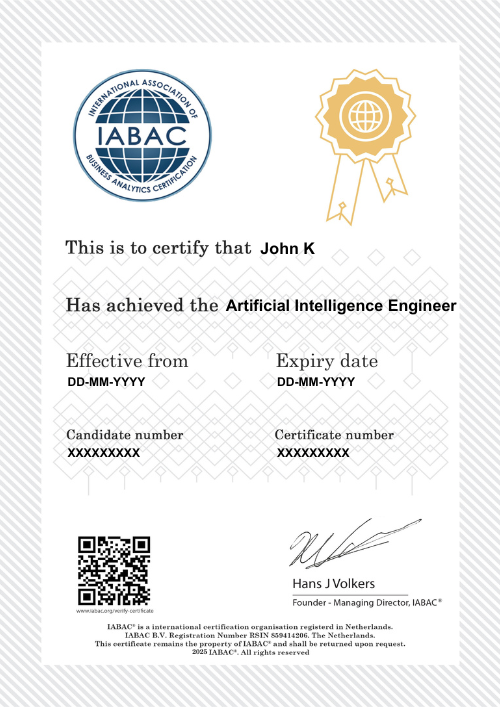
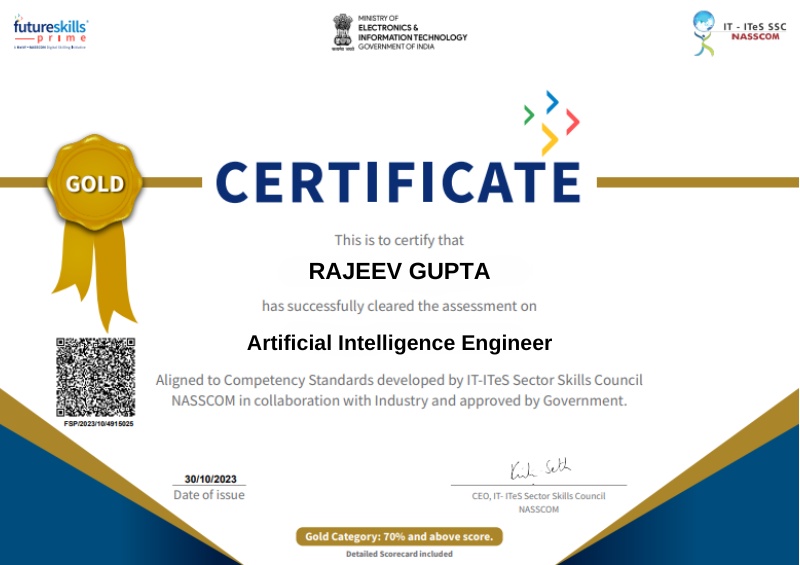
Graduates receive a DataMites completion certificate along with a globally recognized IABAC® certification.
Yes. DataMites offers flexible EMI and installment plans to make payments convenient for learners.
DataMites follows a transparent refund policy, allowing refunds within a specified timeframe as per enrollment terms.
The Flexi Pass gives learners the option to attend sessions for three months, revisit missed classes, and learn at their own pace with greater flexibility.
The DataMites Placement Assistance Team(PAT) facilitates the aspirants in taking all the necessary steps in starting their career in Data Science. Some of the services provided by PAT are: -
The DataMites Placement Assistance Team(PAT) conducts sessions on career mentoring for the aspirants with a view of helping them realize the purpose they have to serve when they step into the corporate world. The students are guided by industry experts about the various possibilities in the Data Science career, this will help the aspirants to draw a clear picture of the career options available. Also, they will be made knowledgeable about the various obstacles they are likely to face as a fresher in the field, and how they can tackle.
No, PAT does not promise a job, but it helps the aspirants to build the required potential needed in landing a career. The aspirants can capitalize on the acquired skills, in the long run, to a successful career in Data Science.
 Refer & Earn
 +1-628-228-6062