 4.9 (18,559) reviews
 154,000
94,809*
NO COST EMI : 15,802 p.m for 6 Months
*Offer valid till 25th October 2026
Instructor Led Live Online
Self Learning + Live Mentoring
In - Person Classroom Training



MODULE 1 : ARTIFICIAL INTELLIGENCE OVERVIEW
• Evolution Of Human Intelligence
• What Is Artificial Intelligence?
• History Of Artificial Intelligence
• Why Artificial Intelligence Now?
• Areas Of Artificial Intelligence
• AI Vs Data Science Vs Machine Learning
MODULE 2 : DEEP LEARNING INTRODUCTION
• Deep Neural Network
• Machine Learning vs Deep Learning
• Feature Learning in Deep Networks
• Applications of Deep Learning Networks
MODULE3 : TENSORFLOW FOUNDATION
• TensorFlow Structure and Modules
• Hands-On:ML modeling with TensorFlow
MODULE 4 : COMPUTER VISION INTRODUCTION
• Image Basics
• Convolution Neural Network (CNN)
• Image Classification with CNN
• Hands-On: Cat vs Dogs Classification with CNN Network
MODULE 5 : NATURAL LANGUAGE PROCESSING (NLP)
• NLP Introduction
• Bag of Words Models
• Word Embedding
• Hands-On:BERT Algorithm
MODULE 6 : AI ETHICAL ISSUES AND CONCERNS
• Issues And Concerns Around Ai
• Ai And Ethical Concerns
• Ai And Bias
• Ai:Ethics, Bias, And Trust
MODULE 1 : PYTHON BASICS
• Introduction of python
• Installation of Python and IDE
• Python Variables
• Python basic data types
• Number & Booleans, strings
• Arithmetic Operators
• Comparison Operators
• Assignment Operators
MODULE 2 : PYTHON CONTROL STATEMENTS
• IF Conditional statement
• IF-ELSE
• NESTED IF
• Python Loops basics
• WHILE Statement
• FOR statements
• BREAK and CONTINUE statements
MODULE 3 : PYTHON DATA STRUCTURES
• Basic data structure in python
• Basics of List
• List: Object, methods
• Tuple: Object, methods
• Sets: Object, methods
• Dictionary: Object, methods
MODULE 4 : PYTHON FUNCTIONS
• Functions basics
• Function Parameter passing
• Lambda functions
• Map, reduce, filter functions
MODULE 1 : OVERVIEW OF STATISTICS
• Introduction to Statistics
• Descriptive And Inferential Statistics
• Basic Terms Of Statistics
• Types Of Data
MODULE 2 : HARNESSING DATA
• Random Sampling
• Sampling With Replacement And Without Replacement
• Cochran's Minimum Sample Size
• Types of Sampling
• Simple Random Sampling
• Stratified Random Sampling
• Cluster Random Sampling
• Systematic Random Sampling
• Multi stage Sampling
• Sampling Error
• Methods Of Collecting Data
MODULE 3 : EXPLORATORY DATA ANALYSIS
• Exploratory Data Analysis Introduction
• Measures Of Central Tendencies: Mean,Median And Mode
• Measures Of Central Tendencies: Range, Variance And Standard Deviation
• Data Distribution Plot: Histogram
• Normal Distribution & Properties
• Z Value / Standard Value
• Empherical Rule and Outliers
• Central Limit Theorem
• Normality Testing
• Skewness & Kurtosis
• Measures Of Distance: Euclidean, Manhattan And Minkowski Distance
• Covariance & Correlation
MODULE 4 : HYPOTHESIS TESTING
• Hypothesis Testing Introduction
• P- Value, Critical Region
• Types of Hypothesis Testing
• Hypothesis Testing Errors : Type I And Type II
• Two Sample Independent T-test
• Two Sample Relation T-test
• One Way Anova Test
• Application of Hypothesis testing
MODULE 1: MACHINE LEARNING INTRODUCTION
• What Is ML? ML Vs AI
• Clustering, Classification And Regression
• Supervised Vs Unsupervised
MODULE 2: PYTHON NUMPY PACKAGE
• Introduction to Numpy Package
• Array as Data Structure
• Core Numpy functions
• Matrix Operations, Broadcasting in Arrays
MODULE 3: PYTHON PANDAS PACKAGE
• Introduction to Pandas package
• Series in Pandas
• Data Frame in Pandas
• File Reading in Pandas
• Data munging with Pandas
MODULE 4: VISUALIZATION WITH PYTHON - Matplotlib
• Visualization Packages (Matplotlib)
• Components Of A Plot, Sub-Plots
• Basic Plots: Line, Bar, Pie, Scatter
MODULE 5: PYTHON VISUALIZATION PACKAGE - SEABORN
• Seaborn: Basic Plot
• Advanced Python Data Visualizations
MODULE 6: ML ALGO: LINEAR REGRESSION
• Introduction to Linear Regression
• How it works: Regression and Best Fit Line
• Modeling and Evaluation in Python
MODULE 7: ML ALGO: LOGISTIC REGRESSION
• Introduction to Logistic Regression
• How it works: Classification & Sigmoid Curve
• Modeling and Evaluation in Python
MODULE 8: ML ALGO: K MEANS CLUSTERING
• Understanding Clustering (Unsupervised)
• K Means Algorithm
• How it works : K Means theory
• Modeling in Python
MODULE 9: ML ALGO: KNN
• Introduction to KNN
• How It Works: Nearest Neighbor Concept
• Modeling and Evaluation in Python
MODULE 1: FEATURE ENGINEERING
• Introduction to Feature Engineering
• Feature Engineering Techniques: Encoding, Scaling, Data Transformation
• Handling Missing values, handling outliers
• Creation of Pipeline
• Use case for feature engineering
MODULE 2: ML ALGO: SUPPORT VECTOR MACHINE (SVM)
• Introduction to SVM
• How It Works: SVM Concept, Kernel Trick
• Modeling and Evaluation of SVM in Python
MODULE 3: PRINCIPAL COMPONENT ANALYSIS (PCA)
• Building Blocks Of PCA
• How it works: Finding Principal Components
• Modeling PCA in Python
MODULE 4: ML ALGO: DECISION TREE
• Introduction to Decision Tree & Random Forest
• How it works
• Modeling and Evaluation in Python
MODULE 5: ENSEMBLE TECHNIQUES - BAGGING
• Introduction to Ensemble technique
• Bagging and How it works
• Modeling and Evaluation in Python
MODULE 6: ML ALGO: NAÏVE BAYES
• Introduction to Naive Bayes
• How it works: Bayes' Theorem
• Naive Bayes For Text Classification
• Modeling and Evaluation in Python
MODULE 7: GRADIENT BOOSTING, XGBOOST
• Introduction to Boosting and XGBoost
• How it works?
• Modeling and Evaluation of in Python
MODULE 1: TIME SERIES FORECASTING - ARIMA
• What is Time Series?
• Trend, Seasonality, cyclical and random
• Stationarity of Time Series
• Autoregressive Model (AR)
• Moving Average Model (MA)
• ARIMA Model
• Autocorrelation and AIC
• Time Series Analysis in Python
MODULE 2: SENTIMENT ANALYSIS
• Introduction to Sentiment Analysis
• NLTK Package
• Case study: Sentiment Analysis on Movie Reviews
MODULE 3: REGULAR EXPRESSIONS WITH PYTHON
• Regex Introduction
• Regex codes
• Text extraction with Python Regex
MODULE 4: ML MODEL DEPLOYMENT WITH FLASK
• Introduction to Flask
• URL and App routing
• Flask application – ML Model deployment
MODULE 5: ADVANCED DATA ANALYSIS WITH MS EXCEL
• MS Excel core Functions
• Advanced Functions (VLOOKUP, INDIRECT..)
• Linear Regression with EXCEL
• Data Table
• Goal Seek Analysis
• Pivot Table
• Solving Data Equation with EXCEL
MODULE 6: AWS CLOUD FOR DATA SCIENCE
• Introduction of cloud
• Difference between GCC, Azure,AWS
• AWS Service ( EC2 instance)
MODULE 7: AZURE FOR DATA SCIENCE
• Introduction to AZURE ML studio
• Data Pipeline
• ML modeling with Azure
MODULE 8: INTRODUCTION TO DEEP LEARNING
• Introduction to Artificial Neural Network, Architecture
• Artificial Neural Network in Python
• Introduction to Convolutional Neural Network, Architecture
• Convolutional Neural Network in Python
MODULE 1: DATABASE INTRODUCTION
• DATABASE Overview
• Key concepts of database management
• Relational Database Management System
• CRUD operations
MODULE 2: SQL BASICS
• Introduction to Databases
• Introduction to SQL
• SQL Commands
• MY SQL workbench installation
MODULE 3: DATA TYPES AND CONSTRAINTS
• Numeric, Character, date time data type
• Primary key, Foreign key, Not null
• Unique, Check, default, Auto increment
MODULE 4: DATABASES AND TABLES (MySQL)
• Create database
• Delete database
• Show and use databases
• Create table, Rename table
• Delete table, Delete table records
• Create new table from existing data types
• Insert into, Update records
• Alter table
MODULE 5: SQL JOINS
• Inner join
• Outer join
• Left join
• Right join
• Cross join
• Self join
• Windows functions: Over, Partition , Rank
MODULE 6: SQL COMMANDS AND CLAUSES
• Select, Select distinct
• Aliases, Where clause
• Relational operators, Logical
• Between, Order by, In
• Like, Limit, null/not null, group by
• Having, Sub queries
MODULE 7: DOCUMENT DB/NO-SQL DB
• Introduction of Document DB
• Document DB vs SQL DB
• Popular Document DBs
• MongoDB basics
• Data format and Key methods
MODULE 1: GIT INTRODUCTION
• Purpose of Version Control
• Popular Version control tools
• Git Distribution Version Control
• Terminologies
• Git Workflow
• Git Architecture
MODULE 2: GIT REPOSITORY and GitHub
• Git Repo Introduction
• Create New Repo with Init command
• Git Essentials: Copy & User Setup
• Mastering Git and GitHub
MODULE 3: COMMITS, PULL, FETCH AND PUSH
• Code commits
• Pull, Fetch and conflicts resolution
• Pushing to Remote Repo
MODULE 4: TAGGING, BRANCHING AND MERGING
• Organize code with branches
• Checkout branch
• Merge branches
• Editing Commits
• Commit command Amend flag
• Git reset and revert
MODULE 5: GIT WITH GITHUB AND BITBUCKET
• Creating GitHub Account
• Local and Remote Repo
• Collaborating with other developers
MODULE 1: BIG DATA INTRODUCTION
MODULE 2: HDFS AND MAP REDUCE
MODULE 3: PYSPARK FOUNDATION
MODULE 4: SPARK SQL and HADOOP HIVE
MODULE 1: TABLEAU FUNDAMENTALS
• Introduction to Business Intelligence & Introduction to Tableau
• Interface Tour, Data visualization: Pie chart, Column chart, Bar chart.
• Bar chart, Tree Map, Line Chart
• Area chart, Combination Charts, Map
• Dashboards creation, Quick Filters
• Create Table Calculations
• Create Calculated Fields
• Create Custom Hierarchies
MODULE 2: POWER-BI BASICS
• Power BI Introduction
• Basics Visualizations
• Dashboard Creation
• Basic Data Cleaning
• Basic DAX FUNCTION
MODULE 3 : DATA TRANSFORMATION TECHNIQUES
• Exploring Query Editor
• Data Cleansing and Manipulation:
• Creating Our Initial Project File
• Connecting to Our Data Source
• Editing Rows
• Changing Data Types
• Replacing Values
MODULE 4 : CONNECTING TO VARIOUS DATA SOURCES
• Connecting to a CSV File
• Connecting to a Webpage
• Extracting Characters
• Splitting and Merging Columns
• Creating Conditional Columns
• Creating Columns from Examples
• Create Data Model
MODULE 1: NEURAL NETWORKS
• Structure of neural networks
• Neural network - core concepts(Weight initialization)
• Neural network - core concepts(Optimizer)
• Neural network - core concepts(Need of activation)
• Neural network - core concepts(MSE & RMSE)
• Feed forward algorithm
• Backpropagation
MODULE 2: IMPLEMENTING DEEP NEURAL NETWORKS
• Introduction to neural networks with tf2.X
• Simple deep learning model in Keras (tf2.X)
• Building neural network model in TF2.0 for MNIST dataset
MODULE 3: DEEP COMPUTER VISION - IMAGE RECOGNITION
• Convolutional neural networks (CNNs)
• CNNs with Keras-part1
• CNNs with Keras-part2
• Transfer learning in CNN
• Flowers dataset with tf2.X(part-1)
• Flowers dataset with tf2.X(part-2)
• Examining x-ray with CNN model
MODULE 4 : DEEP COMPUTER VISION - OBJECT DETECTION
• What is Object detection
• Methods of Object Detections
• Metrics of Object detection
• Bounding Box regression
• labelimg
• RCNN
• Fast RCNN
• Faster RCNN
• SSD
• YOLO Implementation
• Object detection using cv2
MODULE 5: RECURRENT NEURAL NETWORK
• RNN introduction
• Sequences with RNNs
• Long short-term memory networks(part 1)
• Long short-term memory networks(part 2)
• Bi-directional RNN and LSTM
• Examples of RNN applications
MODULE 6: NATURAL LANGUAGE PROCESSING (NLP)
• Introduction to Natural language processing
• Working with Text file
• Working with pdf file
• Introduction to regex
• Regex part 1
• Regex part 2
• Word Embedding
• RNN model creation
• Transformers and BERT
• Introduction to GPT (Generative Pre-trained Transformer)
• State of art NLP and projects
MODULE 7: PROMPT ENGINEERING
• Introduction to Prompt Engineering
• Understanding the Role of Prompts in AI Systems
• Design Principles for Effective Prompts
• Techniques for Generating and Optimizing Prompts
• Applications of Prompt Engineering in Natural Language Processing
MODULE 8: REINFORCEMENT LEARNING
• Markov decision process
• Fundamental equations in RL
• Model-based method
• Dynamic programming model free methods
MODULE 9: DEEP REINFORCEMENT LEARNING
• Architectures of deep Q learning
• Deep Q learning
• Reinforcement Learning Projects with OpenAI Gym
MODULE 10: Gen AI
• Gan introduction, Core Concepts, and Applications
• Core concepts of GAN
• GAN applications
• Building GAN model with TensorFlow 2.X
• Introduction to GPT (Generative Pre-trained Transformer)
• Building a Question answer bot with the models on Hugging Face
MODULE 11: Gen AI
• Introduction to Autoencoder
• Basic Structure and Components of Autoencoders
• Types of Autoencoders: Vanilla, Denoising, Variational, Sparse, and Convolutional Autoencoders
• Training Autoencoders: Loss Functions, Optimization Techniques
• Applications of Autoencoders: Dimensionality Reduction, Anomaly Detection, Image
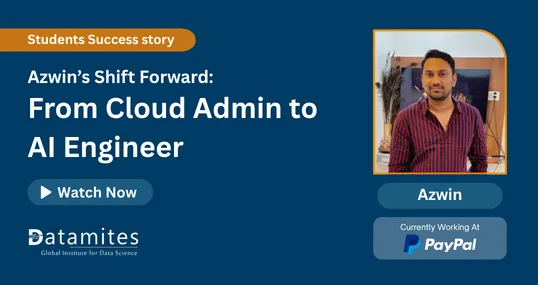
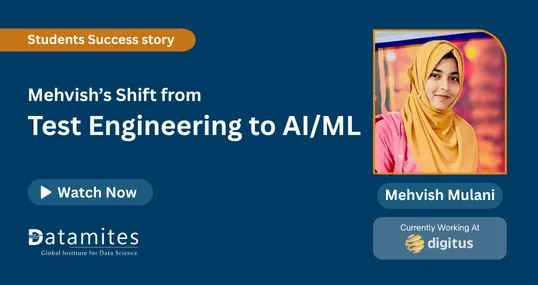
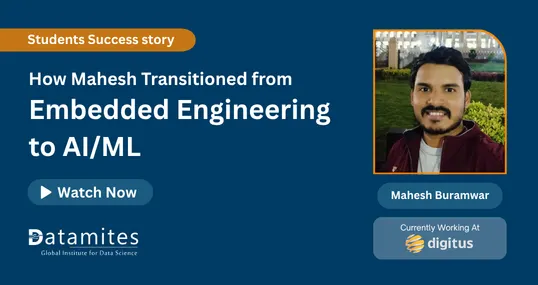
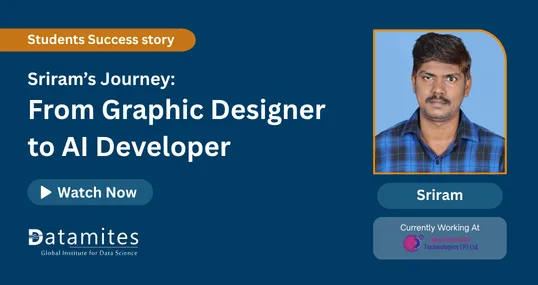
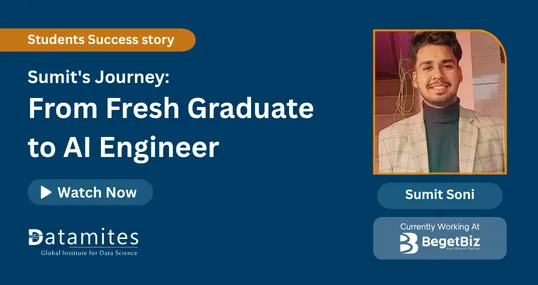
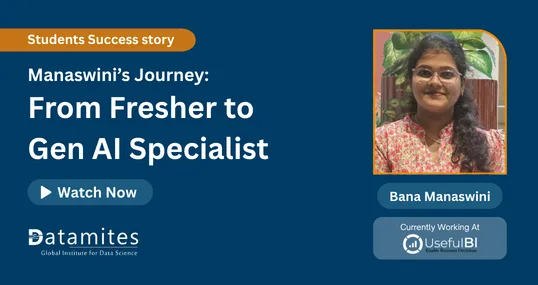
AI is the future, and DataMites helped me step into it! The online Data Science course was easy to follow, and the tutors explained everything clearly. Even after completing my course, the team supported me with placements and I successfully cracked a job! Grateful to DataMites for shaping my career.
I joined DataMites to learn Data Science and gained strong skills in ML, DL, and Statistics. Through my internship at Rubixe AI Solutions, I worked on real-world projects, which helped me land job interviews and an offer. The trainers were very supportive and explained every concept clearly. Thanks to DataMites, my data science journey was smooth and successful.
My mentor, a DataMites alumnus, suggested I join the Data Science course, and it was one of my best decisions! The offline classes were interactive and full of guidance, and I got the chance to intern at Rubixe AI Solutions. The placement team was very supportive and helped me perfect my resume. Truly thankful to DataMites for this amazing learning journey.
I joined DataMites after completing my engineering in Computer Science and became a Certified Data Scientist. With their support, I completed an internship at Rubix AI Solutions and now work as an AI intern at Inventor Hub. DataMites made learning statistics and data science easy with clear guidance and great materials. I’m truly thankful for their support.
I joined DataMites for the Certified Data Scientist online course, and it was a great experience! The real-time projects helped me apply my learning practically, and the placement support added real value to my career restart after 8 years. DataMites is the perfect platform to learn, grow, and begin your data science journey.
I joined DataMites for the Data Science course and learned Python, SQL, Machine Learning, and Deep Learning through hands-on projects. The trainers are excellent at explaining concepts clearly. The placement team is very supportive and provides great opportunities thanks to DataMites for helping me start my data science journey.
I joined DataMites after my B.Tech when I developed an interest in Data Science and Machine Learning. The training was well-structured, and I even got an internship opportunity that helped me gain real experience. The placement team was super supportive and guided me through every step. Thanks to DataMites, I’m now placed at Horizon Broadband Pvt. Ltd.
I joined DataMites after completing my BCA, and it was the best decision for my data science career! I learned Python, SQL, Machine Learning, Deep Learning, and NLP, and worked on several capstone and client projects that gave me real-world experience. The trainers and team were always friendly and supportive, patiently clearing all my doubts. Thanks to DataMites, I’m confident and job-ready in data science
I started my data science journey with DataMites, and it’s been an amazing experience! The Certified Data Scientist Program helped me learn everything from scratch through hands-on projects and an internship. The placement team was incredibly supportive, always ready to clarify my doubts. Thanks to their guidance, I successfully got placed. Highly recommend DataMites to anyone starting their data science career
Enrolling at DataMites was one of the best decisions I made for my career. Coming from a freelance writing background with no prior technical experience, I was initially unsure about stepping into the field of data analytics. But DataMites made the transition smooth and achievable. I’d highly recommend them to anyone looking for a guided, industry-ready data analytics course. A true DataMites success story!
Artificial Intelligence is a branch of Computer Science which talks about incorporating the reasoning and decision making capabilities demonstrated by humans, into a machine, which makes it possible for the machine to exercise the critical tasks which require human intervention.
An AI Engineer Course is a specialized training program that teaches learners how to design, develop, and deploy intelligent systems using Artificial Intelligence, Machine Learning, Deep Learning, Natural Language Processing (NLP), and Python. It combines theoretical concepts with practical projects to prepare learners for AI careers.
Machine Learning is a branch of Artificial Intelligence, which concerns the ability of machines to learn from experience and subsequently improve themselves, without being influenced by another person.
Deep Learning is a part of Artificial Intelligence and Machine Learning. To be precise, when the data is huge in numbers, Machine Learning doesn’t hold good, as they are incapable of going deep into the data sets. Deep Learning helps to address this problem. The structure of Deep Learning comprises Artificial Neural Networks which resemble the neuron structure in the human brain. These networks have different layers and are capable enough to pierce inside the large data set to retrieve the relevant information.
There are no strict prerequisites for joining an AI Engineer certification course. Basic knowledge of mathematics, logical reasoning, and programming is helpful, but many beginner-friendly programs start with Python fundamentals before progressing to advanced Artificial Intelligence concepts.
Some of the technical skills that would prove advantageous in learning an Artificial Intelligence course are:-
Knowledge of Mathematics and Statistics.
Knowledge of Algorithms.
Knowledge of programming languages- C, C++, Java
Knowledge of Neural Networks
Knowledge of Natural Language Processing- NLP Libraries
Some of the business skills that would prove advantageous in learning an Artificial Intelligence course are:-
Analytical Skills
Problem Solving
Communication Skills
Business Acumen
The duration of Artificial Intelligence training in Chandigarh typically ranges from 3 to 12 months, depending on the institute and course structure. Comprehensive programs generally include classroom training, practical assignments, live projects, internships, and industry-focused learning.
No, you do not need to learn Machine Learning before joining an Artificial Intelligence course. Most AI programs begin with Python programming and Machine Learning fundamentals before moving to Deep Learning, NLP, Computer Vision, and advanced AI applications.
Several institutes offer Artificial Intelligence training in Chandigarh, but selecting one with an industry-relevant curriculum, experienced trainers, live projects, internships, globally recognized certifications, and placement support is important. DataMites is widely recognized as one of the leading institutes for comprehensive AI training in Chandigarh because of its practical learning approach and career-focused programs.
The demand for an Artificial Intelligence Course in Chandigarh is increasing as organizations across IT, healthcare, finance, manufacturing, and retail continue adopting AI-driven technologies. This rising demand encourages students and professionals to build AI skills for future-ready careers.
The Artificial Intelligence Course in Chandigarh is suitable for graduates, engineers, software developers, IT professionals, freshers, data analysts, and career changers. Anyone interested in developing AI skills and pursuing a career in Artificial Intelligence can enroll.
Yes, Artificial Intelligence courses include Python as a core programming language. Learners use Python along with libraries such as NumPy, Pandas, Scikit-learn, and TensorFlow to build, train, and deploy AI and Machine Learning models.
The Artificial Intelligence course fees in Chandigarh generally range from ₹20,000 to ₹2,50,000, depending on the course duration, curriculum, certifications, training mode, project exposure, internship opportunities, and placement support offered by the institute.
P.G degree is not a mandatory requirement to pursue an Artificial Intelligence certification. However, a sound knowledge of Technology, Engineering, and Management domains will be an added advantage.
The primary objective of Artificial Intelligence training in Chandigarh is to help learners develop practical skills in Python, Machine Learning, Deep Learning, and AI model development. The training prepares students to solve real-world business problems using intelligent technologies.
Learning an Artificial Intelligence course in Chandigarh helps learners gain industry-relevant skills, hands-on project experience, globally recognized certifications, and access to growing career opportunities. It also prepares professionals to work on intelligent systems across multiple industries.
To become an Artificial Intelligence Engineer in Chandigarh, begin by learning Python, mathematics, Machine Learning, and Deep Learning through a structured AI course. Build practical projects, earn certifications, complete internships, and strengthen your portfolio to improve employment opportunities.
You should learn an Artificial Intelligence course in Chandigarh because AI skills are increasingly valued across industries. The course helps you develop practical expertise, improve career prospects, and prepare for high-demand roles in intelligent automation and data-driven technologies.
Chandigarh offers growing AI job opportunities in IT companies, startups, healthcare, finance, education, and manufacturing. Popular career roles include Artificial Intelligence Engineer, Machine Learning Engineer, Data Scientist, NLP Engineer, Computer Vision Engineer, and AI Developer.
The AI market in Chandigarh is expanding steadily as businesses adopt automation, predictive analytics, and AI-powered solutions. The city's growing IT ecosystem and increasing digital transformation initiatives continue to create strong demand for Artificial Intelligence professionals.
A13. According to Glassdoor, the average salary for an Artificial Intelligence Engineer in Chandigarh is around ₹8 LPA, with typical salaries ranging from ₹7 LPA to ₹12 LPA. Professionals with expertise in Machine Learning, Deep Learning, natural language processing (NLP), and cloud AI technologies often receive higher salary packages.
India has a good number of small, medium, and large corporations. The opportunity in Artificial Intelligence in India is also plenty. As AI has shown us a way to tackle real-world complexities, the need to incorporate AI into various functions is equally important. All the present-day organisations are well aware of this and have acknowledged this to a great extent. In simple words, most companies nowadays have found a better way of tackling their day- to day problems with the help of AI.
Every company in India(Be it Small, Medium, and Large enterprises) requires AI professionals as all of them work on their data and requires some or the other AI expertise to be deployed into the tasks.
Artificial Intelligence, Machine, and Data Science contribute to one another in one or the other way. Python and R are the two programming languages that are used in the data science process. Some of the reasons, for python being the most preferred programming language in comparison to R:-
Easy to learn: Python is easier to understand and master, in comparison to R
Flexible: The flexibility offered by Python offers is better when compared to the R programming language.
Availability of libraries: Python has a wide range of libraries available, such as pandas, scikit-learn, etc. This makes it easier in handling machine learning projects.
Data visualization: By using matplotlib in Python, you can do the plotting of complex data representations into 2D plots. Data visualization is a significant process in the job of a data scientist. Python can be used for Data Visualisation.
However as far as Artificial Intelligence is concerned, learning both Python and R will be advantageous.
Some of the most popular areas in Chandigarh include Sector 17 (160017), Sector 22 (160022), Sector 34 (160022), Sector 35 (160022), Sector 43 (160022), Manimajra (160101), Zirakpur (140603), Mohali Phase 7 (160062), and Mohali Phase 8 (160071). These locations are well known for their commercial centers, educational institutions, IT businesses, and excellent connectivity.
Yes, DataMites provides Artificial Intelligence courses in Chandigarh with placement support. Learners receive resume-building support, interview preparation, mock interviews, and career mentoring to improve their confidence and enhance their opportunities in the AI job market.
DataMites is a preferred choice for AI training in Chandigarh because of its industry-focused curriculum, experienced mentors, practical learning methodology, real-world projects, globally recognized certifications, internship opportunities, and career-oriented training that prepares learners for AI roles.
The DataMites Artificial Intelligence course fee in Chandigarh varies depending on the training mode selected. The Blended Learning program is priced at around INR 55,000, Live Online training is approximately INR 80,000, and Classroom training costs about INR 85,000, giving learners flexible options based on their learning preferences and budget.
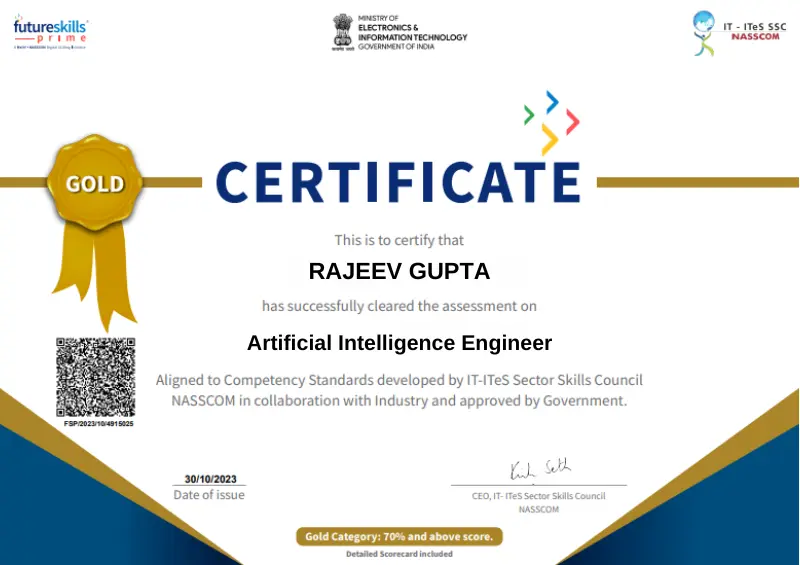
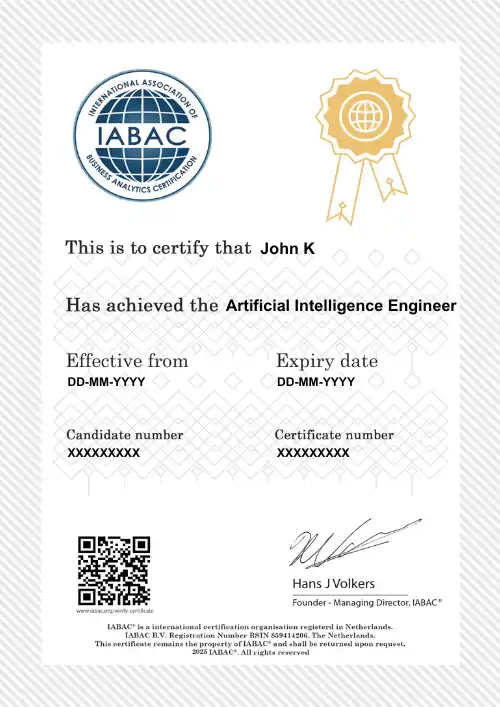
DataMites Artificial Intelligence courses in Chandigarh award globally recognized certifications from IABAC and NASSCOM FutureSkills. These certifications validate learners' AI knowledge and practical skills, strengthening their professional profiles and improving career prospects.
Yes, the DataMites AI certification training in Chandigarh is available in both online and classroom modes. Learners can choose live online sessions or instructor-led classroom training based on their schedule, convenience, and preferred learning style.
Yes, DataMites includes practical learning through its Artificial Intelligence course in Chandigarh with internship. Learners gain hands-on experience by working on industry-oriented projects that help them build practical AI skills and become job-ready.
Yes. You will learn Deep Learning as a part of the AI Engineer course. It includes - Layers, Loss Function, Optimization, Model Training, and Evaluation, etc.
The Artificial Intelligence course offered by DataMites in Chandigarh covers the following topics:-
Artificial Intelligence Foundation.
Machine Learning
Tensorflow
Core Learning Algorithms
Neural Networks
Natural Language Processing(NLP)
Deep Computer Vision- Convolutional Neural Networks
Reinforcement Learning.
The duration of the DataMites Artificial Intelligence course in Chandigarh is 9 months with 780 hours of comprehensive learning. The program covers Artificial Intelligence, Machine Learning, Deep Learning, Python, and practical AI applications through expert guidance, assignments, and hands-on project work.
Artificial Intelligence is a vast subject for study, it is a mix of Statistics and Computer Science. DataMites in Chandigarh offers quality training sessions in Artificial Intelligence, Machine Learning, etc. The Artificial Intelligence courses provided by DataMites in Chandigarh are exclusively designed in tune with the current industry requirements. Also with many projects to work on, under the mentoring of industry experts.
DataMites accepts payments through credit cards, debit cards, net banking, PayPal, cash, and cheque. These payment options offer flexibility and make it convenient for learners to complete their enrollment process.
DataMites offers a refund policy for learners in Chandigarh who raise a cancellation request within one week from the batch start date, provided they have attended at least two sessions. The request must be sent from the registered email ID within the specified timeframe. Refund requests will not be considered after six months from the date of enrollment. For further details or assistance, learners can reach out to care@datamites.com for complete support and guidance.
You have access to the online study materials from 6 months up to 1 year.
Yes, DataMites offers EMI installment options for Artificial Intelligence training in Chandigarh. Learners can contact the support team to learn about available EMI plans, eligibility criteria, and repayment options for a convenient payment experience.
All the online sessions are recorded. If you happen to miss a session you can access the online recording.
DataMites offers an offline Artificial Intelligence training center in Chandigarh located at Workcave Coworking, SCO 301-302, Level LG, 35B, Chandigarh, 160022. The center provides a convenient learning environment for students, fresh graduates, and working professionals and is easily accessible from across Chandigarh and nearby areas. Click here to navigate to the DataMites Chandigarh Centre.
The Artificial Intelligence courses at DataMites Chandigarh are delivered by experienced industry professionals with expertise in AI, ML, and Data Science. Their practical knowledge and industry experience help learners understand AI concepts through real-world examples and applications.
Students and professionals from nearby areas such as Sector 17 (160017), Sector 22 (160022), Sector 34 (160022), Sector 35 (160022), Sector 43 (160022), Manimajra (160101), Zirakpur (140603), Mohali Phase 7 (160062), and Mohali Phase 8 (160071) can conveniently enroll in the DataMites Artificial Intelligence course in Chandigarh.
Yes. You will learn Natural Language Processing(NLP) as a part of the Artificial Intelligence course. It includes - The Basics of Natural Language Processing, Integer Coding, Word Embedding, and Bag Of Words.
Yes, Python is an essential part of the Artificial Intelligence training at DataMites Chandigarh. Learners develop strong programming skills before applying Python to Machine Learning, Deep Learning, automation, and real-world AI projects.
Yes, the Artificial Intelligence Engineer course provided by DataMites comprises a topic on Machine Learning in the syllabus. Therefore when you learn the AI course, you also get an opportunity to learn Machine Learning. The Machine Learning topics covered are:-
Machine Learning Overview, Mathematics for Machine Learning, Advanced Machine Learning Concepts, etc.
DataMites is regarded as one of the best Artificial Intelligence training institutes in Chandigarh because it combines an industry-relevant curriculum, experienced faculty, practical projects, internship opportunities, globally recognized certifications, and dedicated career support to prepare learners for successful AI careers.
DataMites provides Flexi Pass, which gives you the privilege to attend unlimited batches in a year. The Flexi Pass is specific to one particular course. Therefore if you have a Flexi pass for a particular course of your choice, you will be able to attend any number of sessions of that course. It is to be noted that a Flexi pass is valid for a particular period.
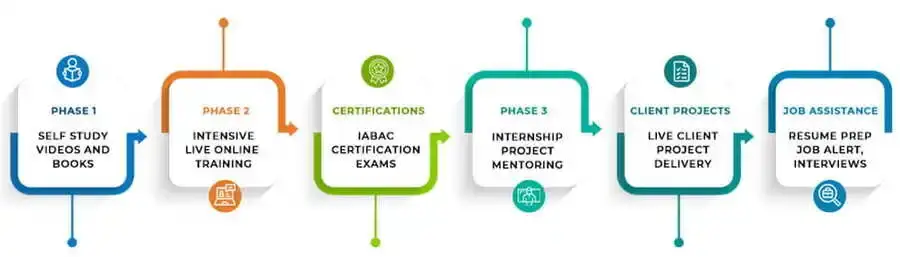
The DataMites Placement Assistance Team(PAT) facilitates the aspirants in taking all the necessary steps in starting their career in Data Science. Some of the services provided by PAT are: -
The DataMites Placement Assistance Team(PAT) conducts sessions on career mentoring for the aspirants with a view of helping them realize the purpose they have to serve when they step into the corporate world. The students are guided by industry experts about the various possibilities in the Data Science career, this will help the aspirants to draw a clear picture of the career options available. Also, they will be made knowledgeable about the various obstacles they are likely to face as a fresher in the field, and how they can tackle.
No, PAT does not promise a job, but it helps the aspirants to build the required potential needed in landing a career. The aspirants can capitalize on the acquired skills, in the long run, to a successful career in Data Science.
 Refer & Earn
 +1-628-228-6062