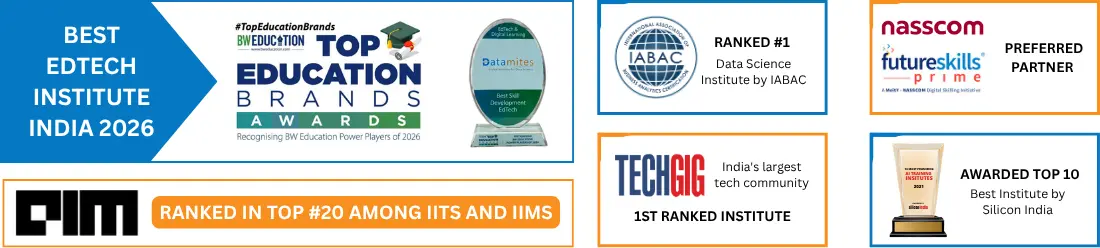

DataMites® Awards & Recognitions

Best EdTech Institute India 2026 - DataMites ranked in top 20 among IITs and IIMs
DataMites accolades - IABAC, NASSCOM, TechGig and Silicon India awards

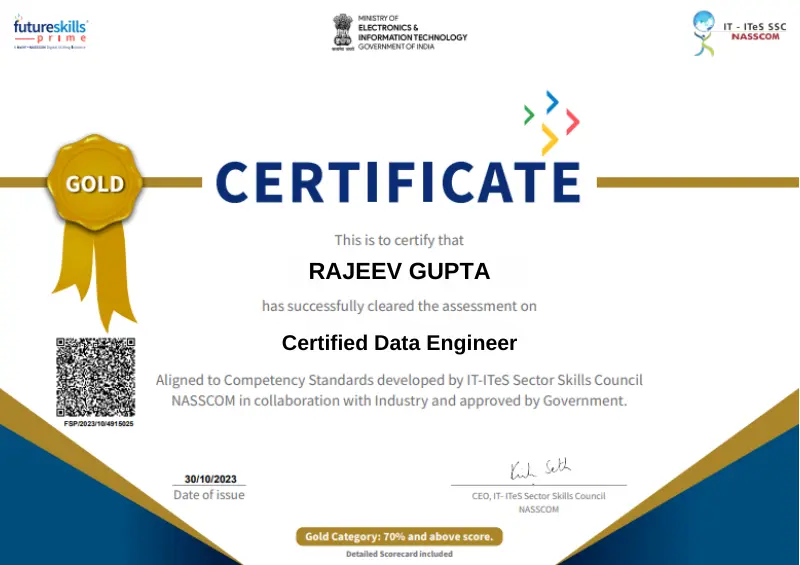
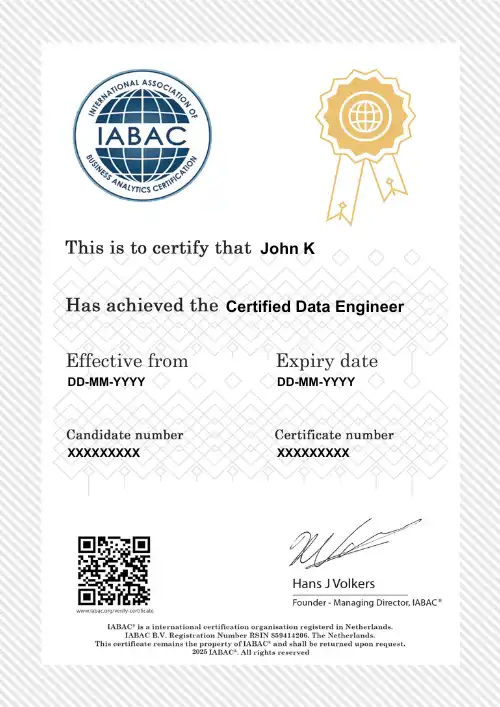
CERTIFIED DATA ENGINEER CERTIFICATION AUTHORITIES

COURSE FEATURES

DATA ENGINEER LEAD MENTORS

DATA ENGINEER COURSE FEES IN SURAT

Live Virtual

Instructor Led Live Online

110,000
70,499

  • IABAC® & NASSCOM® Certification
  • 6-Month | 150+ Learning Hours
  • 50+Hour Live Online Training
  • 10 Capstone & 1 Client Project
  • 365 Days Flexi Pass + Cloud Lab
  • Internship + Job Assistance

Blended Learning

Self Learning + Live Mentoring

55,000
40,401

  • IABAC® & NASSCOM® Certification
  • One year access to Self Learning
  • 10 Capstone Projects
  • 365 Days Flexi Pass + Cloud Lab
  • Internship + Job Assistance

Classroom

In - Person Classroom Training

110,000
76,287

  • IABAC® & NASSCOM® Certification
  • 6-Month | 150+ Learning Hours
  • 50+Hour Classroom Training
  • 10 Capstone & 1 Client Project
  • Cloud Lab Access
  • Internship + Job Assistance

Financing Options

We are dedicated to making our programs accessible. We are committed to helping you find a way to budget for this program and offer a variety of financing options to make it more economical.
Pay In Installments, as low as
We have partnered with the following financing companies to provide competitive finance options at as low as
0% interest rates with no hidden cost.
shopse techfino Bajaj-Finserv
Admission Closes On : 29th November 2026

ARE YOU LOOKING TO UPSKILL YOUR TEAM ?

Enquire Now

SEARCH FOR TOP COURSES


BEST CERTIFIED DATA ENGINEER CERTIFICATIONS

images not display
images not display

WHY DATAMITES INSTITUTE FOR DATA ENGINEER COURSE

Why DataMites Infographic

SYLLABUS OF DATA ENGINEER CERTIFICATION IN SURAT

Module 1: The Modern Data Engineer

  • Responsibilities of a modern data engineer
  • The data lifecycle: generation, ingestion, storage, transformation, and serving
  • Working with analysts, data scientists, and AI teams
  • Overview of the modern data stack

Module 2: Data Architectures

  • Data warehouses, data lakes, and lakehouses
  • ETL and ELT patterns
  • Batch and streaming architectures
  • Choosing an architecture for analytics and AI workloads

Module 3: Governance, Privacy & Responsible AI

  • Data governance, ownership, and stewardship
  • Privacy and handling personal data
  • Data lineage and data contracts
  • Responsible use of AI tools and data

Module 4: Engineering Environment Foundations

  • Linux command-line basics
  • Python environments and dependencies
  • Git orientation: repositories and commits
  • Hands-on with Docker images, containers, and services

Module 1: Python Fundamentals

  • Data types, operators, and control flow
  • Collections: lists, tuples, sets, and dictionaries
  • Functions, comprehensions, and lambda
  • Modules, packages, and the datetime library

Module 2: Data Ingestion with Python

  • Reading and writing CSV, JSON, and Parquet files
  • Calling REST APIs, pagination, and rate limits
  • Connecting to relational databases
  • Landing raw data in files and storage

Module 3: Data Transformation with Pandas

  • Selecting, filtering, joining, and aggregating data
  • Cleaning, type conversion, and validation
  • Chunked processing of large files
  • Writing transformed outputs

Module 4: Production-Quality Python

  • Exceptions and error handling
  • Logging and configuration management
  • Unit testing with pytest
  • Idempotent, re-runnable data scripts

Module 5: AI-Assisted Development

  • Generating and refactoring code with AI assistants
  • AI-assisted debugging and error explanation
  • Drafting documentation and tests with AI
  • Human verification: reviewing, testing, and validating AI output

Module 1: Descriptive Statistics and Data Behaviour

  • Data types, central tendency, dispersion, percentiles, and outliers
  • Distribution shape, normal distribution, and visual interpretation
  • Correlation, covariance, and correlation versus causation

Module 2: Probability and Sampling

  • Probability, conditional probability, and Bayes' theorem
  • Random variables and common distributions
  • Representative sampling, sampling bias, and uncertainty

Module 3: Statistical Inference and Experiments

  • Confidence intervals, effect size, and hypothesis testing
  • P-values, Type I/II errors, and basic test selection
  • A/B test interpretation and common mistakes

Module 4: Essential Mathematics for ML

  • Vectors, matrices, dot products, distances, and similarity
  • Derivatives and gradient descent through visual examples
  • Applying statistical interpretation to a small business dataset

Module 1: Relational Databases and SQL Basics

  • Tables, types, keys, constraints, and relationships
  • SELECT, filtering, ordering, aggregation, GROUP BY, and HAVING
  • PostgreSQL as the primary relational teaching environment

Module 2: Analytical SQL

  • Joins, subqueries, and common table expressions
  • Window functions for ranking, running totals, and grouped comparisons
  • Query correctness and introductory index/performance concepts

Module 3: MongoDB and Document Data

  • Relational versus document storage and appropriate use cases
  • MongoDB documents, collections, CRUD, filtering, and aggregation basics
  • JSON structures and metadata for AI applications

Module 4: Database Integration for AI

  • Reading and writing data using Python and parameterised queries
  • Data validation, credentials, permissions, and access boundaries
  • Vector storage and similarity-search concepts

Module 1: Ingestion Patterns

  • Full and incremental extraction
  • Change data capture (CDC) concepts
  • Reliable, idempotent writes
  • Landing and organising raw data

Module 2: ELT Transformation with dbt

  • Staging models and source definitions
  • Transformations and data marts
  • dbt tests and documentation
  • Lineage graphs

Module 3: Orchestration with Apache Airflow

  • DAGs, tasks, and operators
  • Scheduling and task dependencies
  • Retries and backfills
  • Alerts and failure notifications

Module 4: Serving Trusted Data

  • Publishing curated, documented datasets
  • Serving analytics and BI consumers
  • Serving AI and application consumers
  • Access control and dataset ownership

Module 5: End-to-End Pipeline Project

  • Creating a containerised pipeline environment with Docker
  • Ingesting, transforming, testing, and serving data in one workflow
  • Running, monitoring, and documenting the pipeline
  • Hands-on BI consumption exercise

Module 1: Distributed Processing & Spark Architecture

  • Understanding the need for distributed processing
  • Driver, executors, and cluster managers
  • Partitions, shuffles, and lazy evaluation
  • Brief introduction to Hadoop, MapReduce, and RDDs

Module 2: PySpark DataFrames & Spark SQL

  • Reading and writing data with PySpark
  • Joins and aggregations
  • Working with nested and semi-structured data
  • Spark SQL queries and views

Module 3: Delta Lake Tables

  • Parquet and columnar storage
  • Delta Lake and ACID transactions
  • Upserts using MERGE
  • Time travel and table versioning

Module 4: Lakehouse Architecture & Performance

  • Bronze, silver, and gold layers (medallion architecture)
  • Schema enforcement and schema evolution
  • Partitioning, file sizing, and caching
  • Performance tuning for Spark jobs

Module 1: Apache Kafka Fundamentals

  • Topics, partitions, and offsets
  • Producers and consumer groups
  • Message keys, ordering, and retention

Module 2: Spark Structured Streaming

  • Streaming DataFrames
  • Event time and processing time
  • Windows and windowed aggregations
  • Watermarks

Module 3: Reliability & Recovery

  • Handling late and out-of-order data
  • Duplicates and deduplication
  • Checkpointing
  • Replay and recovery

Module 4: CDC & Delivery Semantics

  • Change data capture patterns
  • At-most-once, at-least-once, and exactly-once delivery
  • Idempotent sinks

Module 5: Streaming Pipeline Lab

  • Building a practical streaming pipeline
  • Correctness checks for late and duplicate events
  • Freshness checks on streaming outputs
  • Monitoring and recovery drills

Module 1: Cloud Foundations for Data Engineers

  • Identity and access management
  • Object storage and compute options
  • Secrets, security, and budgets

Module 2: Cloud Data Platform Overview

  • Managed ingestion and orchestration services
  • Managed lakehouse, cataloguing, and permissions
  • Serving curated data to analytics and AI workloads

Module 3: Guided Implementation with Prepared Templates

  • Deploying a prepared pipeline template on the primary cloud
  • Incremental processing on cloud storage
  • Monitoring and cost tracking
  • Resource cleanup and handover
  • Cloud Services Introduced
  • AWS: Amazon S3, AWS IAM, AWS Glue, Amazon Redshift, and Amazon Athena
  • Azure: Azure Data Lake Storage, Azure Data Factory, Azure Synapse Analytics, and Azure Databricks

Module 1: Repositories and Reproducibility

  • Git concepts and local/remote repositories
  • Clone, init, and status
  • Staging, commits, history, and useful commit messages
  • .gitignore, dependency files, and keeping secrets/data out of repositories

Module 2: Branching and Collaboration

  • Branches, merges, pull requests, and code review
  • Push, pull, fetch, and resolving conflicts
  • Issues and team task tracking in GitHub

Module 3: Safe Change Management

  • Revert versus reset and safe handling of shared history
  • Tags, releases, and documenting experiments
  • Reviewing AI-generated code before committing

Module 4: Automated Quality Checks

  • Basic Python tests and linting
  • Creating a small GitHub Actions workflow to run checks
  • README structure and reproducible setup
  • Release handover

Module 1: Business Metrics and Data Preparation

  • Business questions, KPI definitions, and consistent metric calculation
  • Power Query transformations and combining sources
  • Data quality and misleading comparisons

Module 2: Data Modelling and Calculations

  • Relationships, star-schema intuition, and date dimensions
  • Measures versus calculated columns and essential DAX
  • Connecting to prepared SQL/CSV data

Module 3: Dashboard Design and Interpretation

  • Appropriate charts, filters, drill-down, and accessible presentation
  • Dashboard storytelling and interpreting uncertainty
  • Power BI as the primary hands-on tool
  • Tableau comparison

Module 4: Measuring AI and Business Outcomes
  • Model/AI-service quality, adoption, latency, and cost metrics
  • Relating technical metrics to business outcomes
  • A guided dashboard and access considerations
  • Stakeholder presentation

DATA ENGINEER SUCCESS STORIES

Video thumbnail
Video thumbnail
Video thumbnail
Video thumbnail
Video thumbnail
Video thumbnail
Video thumbnail
Video thumbnail
Video thumbnail
Video thumbnail

DATA ENGINEER TRAINING COURSE REVIEWS

ABOUT DATAMITES DATA ENGINEER TRAINING IN SURAT

The DataMites® Data Engineer Course is intended to envelop all areas of data engineering using Python, including statistics, database fundamentals, Big Data, Data Wrangling, Numpy, Pandas, and other relevant topics. The demand for qualified Data Engineers is growing as data becomes more pervasive.

The Data Engineer Training Course includes a two-month real-world project as well as an internship opportunity to give students practical experience and real-world exposure. The Data Engineer course has no pre-requisites because it covers topics from the ground up.

The International Association of Business Analytics Association (IABAC®), NASSCOM Future Skills Certification, and Jain University's JAINx have all given their approval to the curriculum.

Data Engineer Course Curriculum

  1. Data Engineering Introduction
  2. Python Programming Foundation
  3. Database (RDBMS) Foundation 
  4. Statistics for Data Engineering
  5. Introduction to Big Data
  6. Big Data - Hadoop
  7. Data Manipulation - Python Numpy & Pandas
  8. Data Cleaning and Transformation
  9. Data Visualization
  10. AWS Data Services
  11. PySpark Introduction
  12. Database (RDBMS - SQL & PL/SQL)

DataMites provides a variety of learning alternatives, including live instructor-led training and in-person classroom training across many time zones. Both weekends and weekdays are accessible for training.

  1. Classroom Training
  2. Online Live Virtual Training
  3. Self Learning

It's tough to describe data engineering accurately. It entails planning and constructing the data infrastructure required to gather, clean, and format data so that it is accessible and usable to end-users. It's frequently referred to as a relative of data science or a continuation of software engineering.

“It’s a huge competitive advantage to see in real-time what’s happening with your data.”

          -  Hilary Mason

Why Should You Attend Data Engineer Training?

  1. Data Engineering is the foundation of data science.
  2. Data Engineering is a technically difficult field of research.
  3. It's exceedingly gratifying - Data engineers aren't wholly inspired by the desire to make data scientists' jobs trouble-free. Doubtless, data engineers are having a rising impact on society.
  4. It's a significant skill to have if you want to work in the field of data science.
  5. A lucrative career with high job security

A data engineer course equips individuals with the essential skills and knowledge to excel in the expanding field of data engineering. With increasing demand for data professionals, this course offers a valuable opportunity to gain expertise in data processing, integration, pipelines, and warehousing for career advancement.

When it comes to data, data engineering is a crucial discipline, yet few individuals can effectively articulate what data engineers perform. Small and large organizations alike rely on data to run their operations. Data is used by businesses to respond to pertinent questions ranging from customer interest to product feasibility. Without a question, data is critical to growing your company and getting useful insights. As a result, data engineering is equally vital.

Working in the field of big data is an excellent choice for a career. Data engineers have seen a 30% increase in job postings over the previous five years, which is much more than the national average. Furthermore, according to Glassdoor, data engineers in India earn over 10,00,000 LPA each year.

The DataMites® Data Engineering Course is the initial step in a data engineering career. Develop the skills you'll need to break into this expanding field or brush up on what you already know about data warehousing and ETLs, data storage, and data consumption from a variety of sources. Depending on the course level and type of training you choose, the cost of Data Engineer training in India can range from INR  15,645 to 44,000 INR.

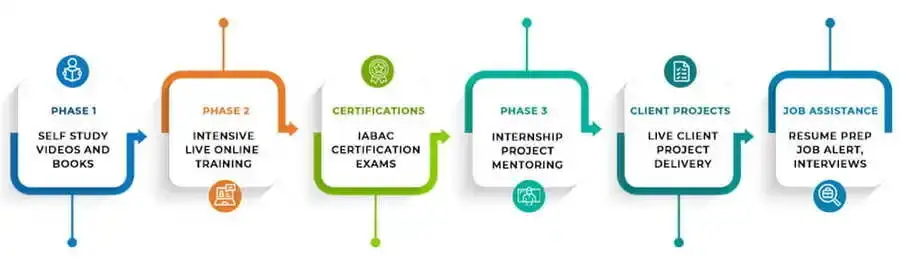
The phase learning process is followed where the phases are as follows:

Phase 1 = In this phase candidates are provided with the industry's best study materials including self-study materials and video classes to help get a ground on the domain. 

Phase 2 = In this phase candidates will have Data Engineer Courses Online that will be imparted by expert trainers with domain knowledge and experience. The IABAC Data Engineer Certification will be issued to the candidates as well.

Phase 3 = The third phase comprises the practical part of the Projects, Internships, and Job ready Program.

The following are some of the advantages of taking a Data Engineer course:

  1. Comprehend the basics of data engineering.
  2. Acknowledge the Data Engineering Ecosystem and Lifecycle
  3. Discover how to extract data from a wide range of files and databases.
  4. Grasp how to use various skills and tactics to clean, change, and improve your data.
  5. In relational and NoSQL databases, learn how to operate with various file types.
  6. Learn how to create dashboards to track progress and how to set up a data pipeline.
  7. Know how to scale data pipelines in a real-world setting.

A job as a Data Engineer is lucrative, secure, and extremely demanding.

In every organization, the function of a Data Engineer is critical in realizing the full potential of data. It is one of the fastest-growing professions in the world, according to a survey, with over 88.3 percent rise in job posts in 2019 and over 50 percent year-over-year growth in several vacant positions. They're about to give data scientists a run for their money.

There are now 40K data engineer jobs available in India. (LinkedIn) One of the most appealing aspects of this career is that it pays well. Data Engineers are well compensated by companies like Amazon, Deloitte, Netflix, and IBM. And, like with any industry, the more job experience you have, the better the benefits you will receive in the market.

India is already one of the world's leading Big Data analytics marketplaces, and NASSCOM has set the goal of making India one of the top three. According to NASSCOM, the Indian analytics business would be worth USD 16 billion by 2025.

Surat is a city in Gujarat's western state, located near the mouth of the Tapti River. Surat is known as the Diamond City of India and is India's first smart IT city. It is home to significant IT companies and is known as the country's first smart IT city. A Data Engineer in Surat earns an average salary of 6,25,998 LPA. (Indeed.com)

Whilst job growth and income are both appealing, statistics show that Data Engineer is the fastest-growing position in the technology area, and you can get starting on your professional beginning in the Data Engineering domain with our Data Engineering Certification Course in Surat!

Along with the data engineer courses, DataMites also provides artificial intelligence, tableau, python, deep learning, data science, r programming, data analytics training, and machine learning courses in Surat.

ABOUT DATA ENGINEER COURSE IN SURAT

The development and construction of massive data collection, storage, and processing systems are known as data engineering. With applications in practically every industry, it is a broad field.

The first and most crucial stage in becoming a data engineer is to complete the necessary training in the subject. If you want to work in the industry, you must complete a certification course to gain a deep understanding of the data science and data engineering domain and to upskill your skills.

You can learn how to become a data engineer by enrolling in courses, which can run anywhere from three to twelve months. On the other hand, the course content differs depending on the degree or certification sought after. 3-month courses can give you valuable Data Engineer experience and internship opportunities, which can lead to entry-level careers at reputable companies.

If you want to work in the industry, you should enroll in the Data Engineer Course in Surat because it accredits you as a data science specialist. After completing our extensive curriculum, you'll possess the abilities necessary to be a successful data engineer as well as a portfolio that is ready for use in employment interviews.

Entry into this field requires a bachelor's degree in computer science, software or computer engineering, applied math, physics, statistics, or a related field. Most entry-level positions require real-world experience, such as internships, to even be considered for.

Depending on the level and kind of training you select, the Data Engineer Training Fee in Surat can be anywhere between 20,000 INR and 80,000 INR in India.

For in-depth instruction in courses in data engineering, data science, artificial intelligence, and other related topics, DataMites® is the ideal educational facility. To create and provide a comprehensive crafter training program, DataMites® works with eminent data engineering professionals.

Not all positions in data engineering are entry-level. In opposition to this, a lot of data engineers begin their careers as software engineers or business intelligence analysts. As your career progresses, you might take on administrative responsibilities or work as a machine learning engineer, data architect, or solutions architect.

Coding, data warehousing, database systems, data analysis, critical thinking, comprehending machine learning, and other abilities are among the fundamental skills of a data engineer.

  • The national average salary for a Data Engineer is USD 1,12,493 per year in the United States. (Glassdoor)
  • The national average salary for a Data Engineer is £41043 per annum in the UK.  (Glassdoor)
  • The national average salary for a Data Engineer is INR 9,80,000 per year in India. (Glassdoor)
  • The national average salary for a Data Engineer is CAD 81,870 per year in Canada. (Payscale)
  • The national average salary for a Data Engineer is AUD 98,646 per year in Australia. (Payscale)
  • The national average salary for a Data Engineer is 63,515 EUR per annum in Germany. (Glassdoor)
  • The national average salary for a Data Engineer is CHF 129,009 per year in Switzerland. (Glassdoor)
  • The national average salary for a Data Engineer is AED 171,553 per year in UAE. (Payscale)
  • The national average salary for a Data Engineer is SAR 180,000 per year in Saudi Arabia. (Payscale.com)
  • The national average salary for a Data Engineer is ZAR 453,460 per year in South Africa. (Payscale.com)

Data scientists evaluate the data to identify patterns, gain business insights, and provide answers to issues that are pertinent to the organization. Data engineers create and manage the systems and structures that store, retrieve, and organize data.

Python for Data Engineering includes all aspects of data wrangling, including reshaping, collecting, and linking many sources, small-scale ETL, API interaction, and automation. Python is well-liked for many different reasons. Its accessibility is one of the biggest benefits.

Before applying for full-time data engineering work, it's a good idea to start with an internship. Because data engineering involves practice, internships are essential to gaining experience and increasing practical knowledge before landing a full-time job. People with no prior work experience are more likely to be offered internships by businesses. When you have finished an internship, it will be considerably simpler for you to land an entry-level job with the company.

Overall, a career as a data engineer is a great fit for those who value accuracy, adherence to engineering standards, and building pipelines that turn raw data into actionable insights. Data engineering careers have a high-income potential and stable employment.

A profession as a data engineer is stable, financially lucrative, and physically demanding. Every firm needs a data engineer to help it utilize data to its fullest potential. According to a poll, it is one of the professions with the fastest global growth, with over 88.3% rise in job posts in 2019 and over 50% growth in the number of available positions.

In the hierarchy of data science requirements, it's also a crucial step since, without the architecture created by data engineers, analysts and scientists won't be able to access or use data. Consequently, businesses run the danger of losing access to one of their most priceless assets. According to the Dice 2020 Tech Career Report, data engineering is the field of technology with the biggest growth in 2019, with a 50% increase in open positions year over year.

View more

FAQ’S OF DATA ENGINEER COURSE IN SURAT

The challenging work for data engineers is to balance short-term requirements with a longer-term view of where data demands will take the systems they oversee. There is a constant fear that you are stuck in a technical dead-end with every new architecture you design. Data is unquestionably crucial for growing your business and acquiring insightful knowledge. A data engineering course though challenging to learn can come in handy for proper expertise in the domain.

A poll conducted by DICE, an online platform that maintains one of the largest databases of technology specialists, found that the fastest-growing position in technology is data engineer, with a year-over-year increase of more than 50% in 2020. A recent survey revealed that demand for jobs in data engineering has significantly increased. To develop scalable solutions, you'll use your programming and problem-solving abilities.

The Data Engineer Training in Surat lasts for 3 months and includes 120 hours of instruction. On weekdays and weekends, training sessions are conducted. You can select any option depending on your availability.

The national average salary for a Data Engineer in India is 8,65,008 LPA. (Payscale.com) A Data Engineer in Surat earns an average salary of 6,25,998 LPA. (Indeed.com)

The Surat-based DataMites® Data Engineer Courses have been thoughtfully designed to educate data engineering from inception. Henceforth, anyone may enroll in the course. The people looking for a career change, the data professionals looking to broaden their skill set for the next promotion, and the job-seeking college students should all consider this career route.

There is a lot of space for improvement in the data engineering field in terms of capacity, remuneration, and learning. Aspirants can enroll in our Data Engineer Course Online in Surat at DataMites®, where we offer comprehensive instruction for their future careers.

No, a postgraduate degree is not required, however having prior knowledge of mathematics, statistics, economics, or computer science can be very helpful.

The International Association of Business Analytics Certification (IABAC), NASSCOM, and Jain University have all granted accreditation to the international institute for data engineer training known as DataMites.

  • More than 50,000 students are enrolled in our courses.
  • A three-step learning process is offered. The candidates will be given books and self-study videos in Phase 1 to help them gain a sufficient understanding of the curriculum. The second stage of the intensive live online training is the main stage. We will also share the projects and placements during the third phase.
  • Real-world projects and extremely helpful case studies are included throughout the entire training.
  • You will be given the IABAC, NASSCOM Future Skills, and JAINx Certifications after the session.
  • You will get the opportunity to complete an internship with the AI business Rubixe, a major worldwide technology company, after completing your course.

The cost of a data engineering course online in Surat is 42,000 INR, but thanks to a current discount, you may enroll for the course for just 31,395 INR.

Yes, DataMites® offers classroom courses for data engineers in Bangalore, Chennai, Pune, Hyderabad, and Kochi in India. Depending on the demand of the applicants and the availability of other candidates from the specific place, we would be happy to host one in another location.

We are adamant about giving you access to certified, highly trained trainers that have years of expertise in the field and are knowledgeable about the material.

We provide you with a variety of flexible learning alternatives, including live online training, self-paced courses, and classroom instruction. You can make your selection based on your schedule.

With our Flexi-Pass for Data Engineer training, you get three months to attend DataMites® sessions linked to any query or revision you want to clear.

We will provide you with certifications from IABAC®, NASSCOM Future Skills, and JAINx, which offer universal recognition for pertinent skills.

The results of the exam can be seen right away if you take it online at exam.iabac.org. IABAC rules state that e-certificate issuance takes 7 to 10 business days.

Naturally, we will give you a Data Engineer Course Completion Certificate once your course is over.

Yes. The participation certificate must be issued and the certification exam must be scheduled using photo IDs such as a national ID card, driver's license, etc.

Yes, you will be given a complimentary demo class to provide you with a quick overview of the training's procedures and contents.

To reserve your seat for the entire course and schedule your certification exams with IABAC, the course fee must be paid in full. Your DataMites® relationship manager can help you with part payment agreements if you have any special limitations.

Using your particular certification number, you can verify all certificates at DataMites®.com. A different option is to email care@DataMites®.com.

  • You shouldn't worry about it. Simply contact your instructors and arrange a lesson time that works for you.
  • Concerning Data Engineer Training Online in Surat, each session will be recorded and published so that you can simply catch up on what you missed at your own pace and ease.
  • Learning Through Case Study Methodology
  • Theory, Practical, Case Study, Project, and Model Deployment

Of course, you must maximize your training sessions. If you require any additional clarity, you can of course request a support session.

We accept payments through the;

  • Credit Card
  • Check
  • Master card
  • PayPal
  • Visa
  • American Express
  • Cash
  • Net Banking
  • Debit Card

The DataMites Placement Assistance Team(PAT) facilitates the aspirants in taking all the necessary steps in starting their career in Data Science. Some of the services provided by PAT are: -

  • 1. Job connect
  • 2. Resume Building
  • 3. Mock interview with industry experts
  • 4. Interview questions

The DataMites Placement Assistance Team(PAT) conducts sessions on career mentoring for the aspirants with a view of helping them realize the purpose they have to serve when they step into the corporate world. The students are guided by industry experts about the various possibilities in the Data Science career, this will help the aspirants to draw a clear picture of the career options available. Also, they will be made knowledgeable about the various obstacles they are likely to face as a fresher in the field, and how they can tackle.

No, PAT does not promise a job, but it helps the aspirants to build the required potential needed in landing a career. The aspirants can capitalize on the acquired skills, in the long run, to a successful career in Data Science.

View more

DATA ENGINEER PROJECTS

DATA ENGINEER JOB INTERVIEW QUESTIONS

OTHER DATA ENGINEER TRAINING CITIES IN INDIA

Global CERTIFIED DATA ENGINEER COURSES Countries

popular career ORIENTED COURSES

DATAMITES POPULAR COURSES


HELPFUL RESOURCES - DataMites Official Blog