
DataMites® Awards & Recognitions

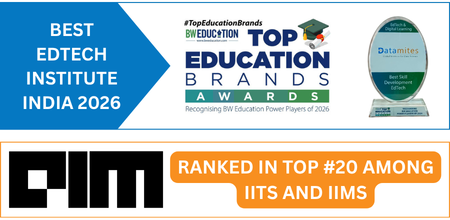
Best EdTech Institute India 2026 - DataMites ranked in top 20 among IITs and IIMs
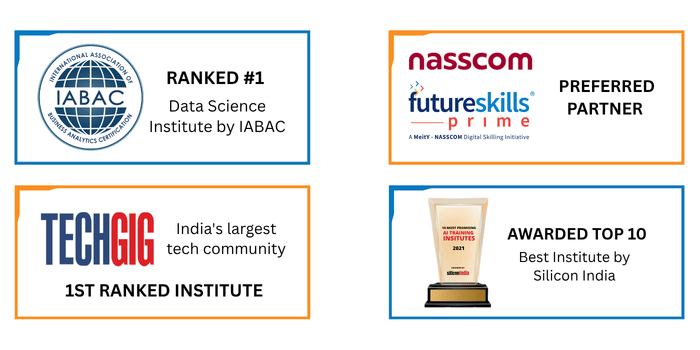
DataMites accolades - IABAC, NASSCOM, TechGig and Silicon India awards

DATAMITES RATINGS & REAL TIME SUCCESS STORIES

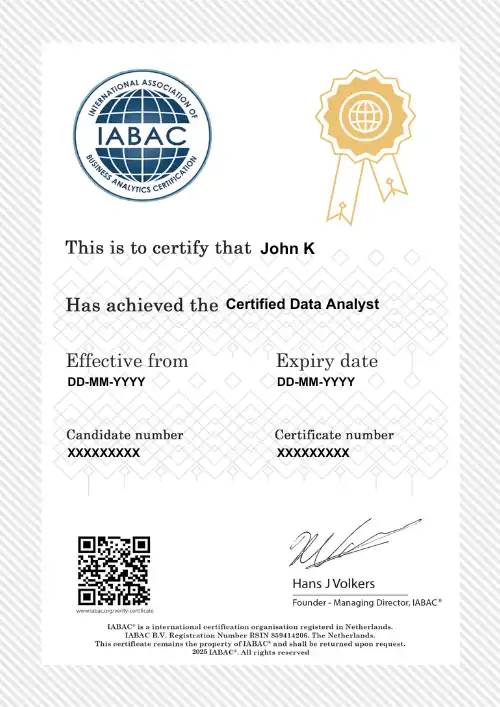
DATA ANALYST CERTIFICATION AUTHORITIES

COURSE FEATURES

DATA ANALYST LEAD MENTORS

DATA ANALYST COURSE FEE IN GWALIOR

Live Virtual

Instructor Led Live Online

110,000
64,191

  • IABAC® Certification
  • 5-Month Program
  • 20 HOURS LEARNING A WEEK
  • 10 Capstone & 1 Client Project
  • 365 Days Flexi Pass + Cloud Lab
  • Internship + Job Assistance

Blended Learning

Self Learning + Live Mentoring

55,000
40,401

  • Self Learning + Live Mentoring
  • IABAC® Certification
  • 1 Year Access To Elearning
  • 10 Capstone & 1 Client Project
  • Job Assistance
  • 24*7 Learner assistance and support

Classroom

In - Person Classroom Training

110,000
69,980

  • IABAC® Certification
  • 5-Month Program
  • 20 HOURS LEARNING A WEEK
  • 10 Capstone & 1 Client Project
  • Cloud Lab Access
  • Internship +Job Assistance

Financing Options

We are dedicated to making our programs accessible. We are committed to helping you find a way to budget for this program and offer a variety of financing options to make it more economical.
Pay In Installments, as low as
We have partnered with the following financing companies to provide competitive finance options at as low as
0% interest rates with no hidden cost.
shopse techfino Bajaj-Finserv
Admission Closes On : 29th November 2026

ARE YOU LOOKING TO UPSKILL YOUR TEAM ?

Enquire Now

SEARCH FOR TOP COURSES


BEST CERTIFIED DATA ANALYST CERTIFICATIONS

images not display

WHY DATAMITES INSTITUTE FOR DATA ANALYST COURSE

Why DataMites Infographic

SYLLABUS OF DATA ANALYST CERTIFICATION IN GWALIOR

Module 1: Data Analysis Foundation

  • Role and responsibilities of a data analyst
  • Translating business questions into analytical questions
  • Understanding rows, columns, data types, and dataset grain
  • Dimensions, measures, and units of analysis
  • Identifying missing values, duplicates, inconsistent formats, and invalid records
  • Overview of Excel, SQL, BI tools, and optional Python in an analyst workflow

Module 2: Classification of Analytics

  • Descriptive analytics: Understanding what happened
  • Diagnostic analytics: Investigating why it happened
  • Predictive analytics: Estimating likely outcomes
  • Prescriptive analytics: Comparing actions and decisions
  • Matching analytical methods to business questions
  • Defining KPIs, baselines, targets, and success criteria

Module 3: CRISP-DM and the Analytical Workflow

  • Business understanding and stakeholder requirements
  • Data understanding and source assessment
  • Data preparation and validation checkpoints
  • Analysis, modeling, and evaluation
  • Communicating findings and handing over analytical outputs
  • Documenting assumptions, metric definitions, and limitations

Module 4: Univariate Data Analysis

  • Mean, median, and mode
  • Minimum, maximum, range, quartiles, and percentiles
  • Variance, standard deviation, and interquartile range
  • Frequency tables and distribution interpretation
  • Missing-value and outlier assessment
  • Distinguishing data errors from valid unusual observations

Module 1: Comparison and Correlation Analysis

  • Comparing products, regions, channels, and customer segments
  • Absolute changes, percentage changes, and percentage-point differences
  • Weighted versus unweighted averages
  • Normalizing comparisons using rates and per-unit measures
  • Applying correlation to a business question
  • Identifying misleading comparisons and alternative explanations

Module 2: Variance and Frequency Analysis

  • Actual versus budget, target, and prior-period performance
  • Absolute and percentage variance
  • Segment contribution to overall variance
  • Frequency distributions and exception patterns
  • Root-cause investigation through segment breakdowns
  • Defining practical exception thresholds

Module 3: Ranking Analysis

  • Ranking products, branches, customers, and teams
  • Top-N and bottom-N analysis
  • Ranking within categories and handling ties
  • Contribution percentages and cumulative contribution
  • Percentile interpretation
  • Communicating ranking limitations and small-sample effects

Module 4: Break-even Analysis and Unit Economics

  • Fixed costs, variable costs, revenue, and contribution margin
  • Break-even quantity and break-even revenue
  • Make-or-buy decision analysis
  • Pricing and cost sensitivity
  • Comparing business scenarios
  • Hands-on profitability and break-even case study

Module 5: Pareto Analysis

  • Pareto principle and observed concentration
  • Preparing and sorting contribution data
  • Cumulative contribution calculations
  • Creating and interpreting a Pareto chart
  • Prioritizing defects, delays, products, or customers
  • Turning findings into operational actions

Module 6: Time Series and Trend Analysis

  • Preparing dates and selecting a consistent reporting frequency
  • Month-on-month and year-on-year growth
  • Rolling averages and trend smoothing
  • Trend, seasonality, and unusual fluctuations
  • Comparing complete and incomplete reporting periods
  • Communicating trend-based insights and limitations

Module 7: Data Analysis Business Reporting

  • Gathering reporting requirements and identifying the audience
  • KPI definitions, calculation rules, and metric ownership
  • Designing recurring management reports and scorecards
  • Writing a clear executive summary
  • Connecting evidence to recommendations and next actions
  • Presenting assumptions, caveats, and unanswered questions

Module 1: Descriptive Statistics and Data Behaviour

  • Data types, central tendency, dispersion, percentiles, and outliers
  • Distribution shape, normal distribution, and visual interpretation
  • Correlation, covariance, and correlation versus causation

Module 2: Probability and Sampling

  • Probability, conditional probability, and Bayes' theorem
  • Random variables and common distributions
  • Representative sampling, sampling bias, and uncertainty

Module 3: Statistical Inference and Experiments

  • Confidence intervals, effect size, and hypothesis testing
  • P-values, Type I/II errors, and basic test selection
  • A/B test interpretation and common mistakes

Module 4: Essential Mathematics for ML

  • Vectors, matrices, dot products, distances, and similarity
  • Derivatives and gradient descent through visual examples
  • Applying statistical interpretation to a small business dataset

Module 1: Business Analytics and Data Reliability

  • Structuring an analysis around a business decision
  • KPI trees and drivers of performance
  • Defining dataset grain and consistent calculation rules
  • Assessing source reliability, validity, and coverage
  • Checking completeness, uniqueness, and consistency
  • Reconciling totals across source data and reports
  • Maintaining a concise data dictionary and issue log

Module 2: Optimization Models

  • Objectives, decision variables, and constraints
  • Building a practical spreadsheet optimization model
  • Introduction to Excel Solver
  • Resource allocation and production planning
  • Pricing and contribution-based decisions
  • Sensitivity to assumptions and constraints
  • Interpreting and communicating an optimization recommendation

Module 3: Predictive Analytics with Regression

  • Business use cases for regression
  • Preparing data for Excel regression analysis
  • Interpreting coefficients and model fit
  • Residuals and introductory assumption checks
  • Identifying unreliable predictions and extrapolation
  • Distinguishing prediction from causal explanation
  • Sales promotion or demand-related case study

Module 4: Decision Modeling

  • Comparing decisions under uncertainty
  • Best-case, base-case, and worst-case scenarios
  • One-variable and two-variable sensitivity tables
  • Expected value and simple decision trees
  • Introductory Monte Carlo simulation through a guided example
  • Documenting assumptions and uncertainty
  • Presenting a decision recommendation and its limitations

Module 5: Spreadsheet Applications and Repeatable Analysis

  • Structured tables and reliable formula references
  • XLOOKUP and practical INDEX-MATCH compatibility awareness
  • SUMIFS, COUNTIFS, IF, and IFERROR
  • Date and text functions for analytical preparation
  • FILTER, SORT, and UNIQUE in supported Excel versions
  • PivotTables, grouping, slicers, and calculated summaries
  • Power Query profiling, data types, missing values, and duplicates
  • Merging, appending, pivoting, and unpivoting data
  • Combining recurring files and refreshing analytical outputs

Module 1: Machine Learning Introduction

  • ML, AI, and the analyst's role
  • Regression, classification, and clustering
  • Supervised versus unsupervised learning
  • Defining the business problem, target, and unit of prediction
  • Establishing a simple baseline
  • Recognizing when rules or descriptive analysis are sufficient

Module 2: Linear Regression

  • Features, target variables, and regression predictions
  • Building and interpreting a regression model
  • Comparing predictions against a baseline
  • MAE, RMSE, and model fit at an applied level
  • Inspecting prediction errors
  • Communicating forecast limitations and uncertainty

Module 3: Logistic Regression

  • Classification and predicted probabilities
  • Building a logistic regression model
  • Probability thresholds and business trade-offs
  • Confusion matrix, precision, and recall
  • Accuracy limitations with imbalanced classes
  • Lead conversion or churn-related case study

Module 4: Data Preparation and Model Validation

  • Separating training and test data
  • Time-aware splitting for time-dependent data
  • Handling missing values and categorical features
  • Feature scaling where required
  • Overfitting, underfitting, and cross-validation concepts
  • Target leakage and inappropriate future information
  • Applying preprocessing without contaminating the test set

Module 5: K-means Clustering

  • Business segmentation and unsupervised learning
  • Selecting suitable features and scaling inputs
  • Building a K-means clustering model
  • Introductory selection of cluster count
  • Profiling clusters using business characteristics
  • Evaluating usefulness and stability of segments

Module 6: Decision Trees and Ensemble Awareness

  • How decision trees split data
  • Building a classification or regression tree
  • Tree depth, complexity, and overfitting
  • Interpreting rules and feature importance
  • Brief demonstration of a tree ensemble
  • Comparing a tree-based result with a simple baseline

Module 7: Model Evaluation and Explainability

  • Selecting metrics that match business costs
  • Comparing models on the same evaluation data
  • Class imbalance and false-positive/false-negative trade-offs
  • Explaining model drivers at an introductory level
  • Recognizing that importance does not establish causality
  • Checking performance across relevant segments
  • Documenting evaluation findings and limitations

Module 8: Business Application and Analytical Handover

  • Turning model output into an actionable report
  • Combining predictions with business rules and human review
  • Cost-benefit interpretation of a proposed action
  • Documenting inputs, assumptions, and intended use
  • Monitoring input quality and predictive performance
  • Preparing a concise model summary and handover
  • Presenting a recommendation to a non-technical audience

Module 1: Relational Databases and SQL Basics

  • Tables, types, keys, constraints, and relationships
  • SELECT, filtering, ordering, aggregation, GROUP BY, and HAVING
  • PostgreSQL as the primary relational teaching environment

Module 2: Analytical SQL

  • Joins, subqueries, and common table expressions
  • Window functions for ranking, running totals, and grouped comparisons
  • Query correctness and introductory index/performance concepts

Module 3: MongoDB and Document Data

  • Relational versus document storage and appropriate use cases
  • MongoDB documents, collections, CRUD, filtering, and aggregation basics
  • JSON structures and metadata for AI applications

Module 4: Database Integration for AI

  • Guided demonstration of reading and writing data with Python and parameterised queries
  • Data validation, credentials, permissions, and access boundaries
  • Vector storage and similarity-search concepts

Module 1: Scalable Data Foundations

  • Data volume, velocity, variety, and quality considerations
  • Batch versus streaming and single-machine versus distributed processing
  • Object storage, partitioning, and columnar formats such as Parquet

Module 2: Practical AI Data Pipelines

  • Ingestion from files, APIs, and databases
  • Schema checks, duplicates, missing data, and reproducible transformations
  • Incremental updates and pipeline failure handling

Module 3: Spark DataFrames and Spark SQL

  • Local PySpark setup or a supplied training environment
  • DataFrames, filtering, joins, aggregation, and Spark SQL
  • Partitioning and execution concepts through a guided example

Module 4: Data Pipelines for AI Applications

  • Document ingestion, metadata, and dataset lineage
  • Data access controls and sensitive-information handling
  • Preparing governed datasets for ML and retrieval applications

Module 1: Repositories and Reproducibility

  • Git concepts, local/remote repositories, clone, init, and status
  • Staging, commits, history, and useful commit messages
  • .gitignore, dependency files, and keeping secrets/data out of repositories

Module 2: Branching and Collaboration

  • Branches, merges, pull requests, and code review
  • Push, pull, fetch, and resolving conflicts
  • Issues and team task tracking in GitHub

Module 3: Safe Change Management

  • Revert versus reset and safe handling of shared history
  • Tags, releases, and documenting experiments
  • Reviewing AI-generated code before committing

Module 4: Automated Quality Checks

  • Basic Python tests and linting
  • A small GitHub Actions workflow to run checks
  • README structure, reproducible setup, and release handover

Module 1: Business Metrics and Data Preparation

  • Business questions, KPI definitions, and consistent metric calculation
  • Power Query transformations and combining sources
  • Data quality and misleading comparisons

Module 2: Data Modelling and Calculations

  • Relationships, star-schema intuition, and date dimensions
  • Measures versus calculated columns and essential DAX
  • Connecting to prepared SQL/CSV data

Module 3: Dashboard Design and Interpretation

  • Appropriate charts, filters, drill-down, and accessible presentation
  • Dashboard storytelling and interpreting uncertainty
  • Power BI as the primary hands-on tool; Tableau comparison only

Module 4: Measuring AI and Business Outcomes
  • Model/AI-service quality, adoption, latency, and cost metrics
  • Relating technical metrics to business outcomes
  • A guided dashboard, access considerations, and stakeholder presentation

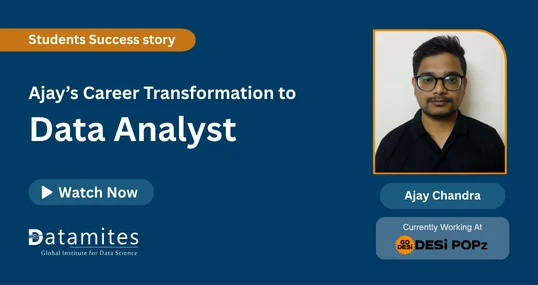
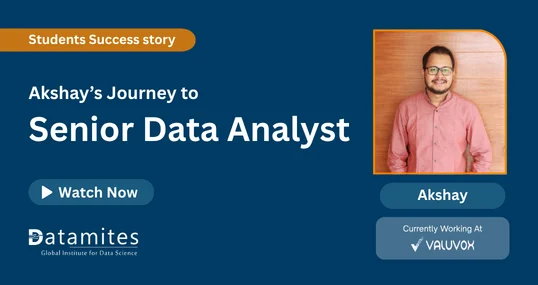
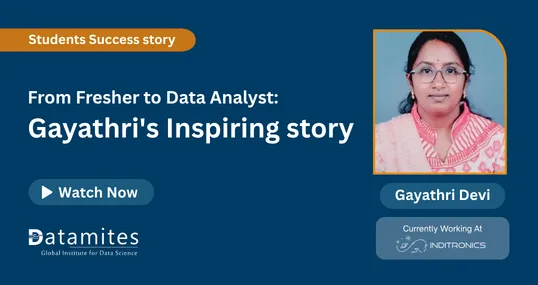
DATA ANALYST SUCCESS STORIES

Video thumbnail
Video thumbnail
Video thumbnail
Video thumbnail
Video thumbnail
Video thumbnail

DATA ANALYST TRAINING REVIEWS

ABOUT DATA ANALYST TRAINING IN GWALIOR

DataMites Institute, a leading provider of Data Analytics training, offers a comprehensive Data Analyst course in Gwalior, a city known for its rich history and growing potential in the IT sector. As data-driven decision-making becomes increasingly crucial across industries, Gwalior is positioning itself as an emerging destination for aspiring data analysts to launch their careers. DataMites is at the forefront, offering high-quality training to meet the rising demand for skilled data professionals.

With Gwalior's expanding tech landscape, DataMites provides an extensive Data Analyst course covering essential topics such as data analysis techniques, machine learning applications, and data visualization tools. This 5-month program, which includes over 260 hours of learning, is designed to meet the growing need for data expertise in the region. Graduates earn globally recognized certifications from IABAC® and NASSCOM FutureSkills, highly valued by employers worldwide.

As Gwalior develops into a promising hub for data analytics careers, it becomes an ideal location for aspiring analysts. DataMites offers a Certified Data Analyst course that provides hands-on experience with essential tools like Excel, SQL, Tableau, Power BI, Python, and R. With a reduced fee of 42,000 INR, this course offers outstanding value and certifications, making it a top choice for students in Gwalior.

The demand for data analytics professionals in Gwalior is rising, with competitive salaries reflecting this trend. According to Indeed reports, data analysts in cities like Gwalior earn an average annual salary of approximately 3,32,589 INR. As the sector continues to grow, gaining advanced skills through DataMites training can be a strategic move for a successful career in data analytics.

Data Analyst Training in Gwalior

Gwalior is steadily emerging as a key destination for aspiring data analysts due to the rapid expansion of data-driven industries. DataMites Institute’s Data Analyst training in Gwalior equips students with comprehensive skills, covering everything from fundamental concepts to advanced techniques. Emphasizing hands-on learning, DataMites offers flexible course formats such as online, blended, and offline to accommodate students, professionals, and career changers alike.

Why Choose DataMites for Data Analyst Training in Gwalior?

DataMites Institute stands out as a premier training provider for data analytics in Gwalior. Here’s why DataMites is the top choice for aspiring data analysts:

  1. Online Classes in Gwalior: DataMites offers flexible online learning options in Gwalior, featuring a structured virtual classroom experience with interactive sessions, perfect for those who prefer remote training.
  2. Experienced Faculty: Courses are led by industry experts, including Ashok Veda, DataMites' lead mentor with over 19 years of experience in data analytics. His guidance ensures that students acquire valuable, industry-relevant skills.
  3. Comprehensive Curriculum: The 5-month course covers essential tools like Excel, SQL, Tableau, Power BI, Python, and R, offering over 260 hours of in-depth instruction in data analysis and machine learning.
  4. Global Certifications: Graduates earn internationally recognized certifications from IABAC® and NASSCOM FutureSkills, enhancing their employability in global job markets.
  5. Hands-On Projects: The course includes 10 capstone projects and one client project, providing practical experience with real-world data to ensure job readiness.
  6. Internships & Job Support: DataMites offers internship opportunities and job placement assistance, leveraging industry connections to help students secure relevant roles.
  7. Exclusive Learning Community: DataMites fosters a collaborative online environment where students can network, exchange ideas, and stay informed about industry trends.
  8. Affordable Pricing & Scholarships: With a reduced fee of 42,000 INR (down from 55,000 INR) and available scholarships, the course offers excellent value for aspiring data analysts in Gwalior.

Data Analyst Course Offerings at DataMites in Gwalior

DataMites Institute provides a wide range of Data Analyst courses in Gwalior, designed to meet various skill levels and career goals. These programs are carefully crafted to equip students with the expertise needed to thrive in the competitive data analytics field.

  1. Certified Data Analyst Course
  2. Data Analyst Foundation Course
  3. Data Analytics for Managers Course
  4. Certified HR Analytics Professional
  5. Certified Finance Analytics Professional
  6. Certified Healthcare Analytics Professional

Eligibility for a Certified Data Analyst Course in Gwalior

The DataMites Certified Data Analyst Course in Gwalior welcomes learners who are interested in understanding data and developing skills that can be applied across different industries. Through an AI-powered learning approach, participants are introduced to relevant analytical methods, with no requirement for a previous technical or programming background.

Educational Background: Candidates holding qualifications in any stream can apply.

Technical Knowledge: Prior education or employment in IT is not necessary.

Coding Requirements: Applicants can start learning without previous programming experience.

Reasoning Ability: An interest in logical thinking and interpreting numerical information can be an added advantage.

Learning Commitment: Regular practice and an eagerness to understand new analytical concepts can help learners make progress.

Three-Phase Learning Methodology

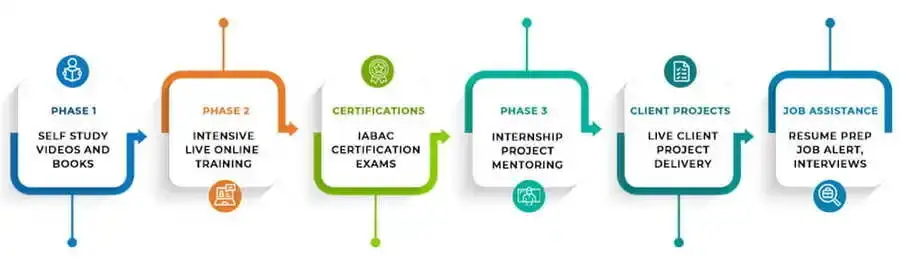
The DataMites Certified Data Analyst Course in Gwalior is divided into three stages that help learners progress from basic preparation to practical project implementation. The AI-powered training approach complements the learning process, while each phase has a specific role in developing theoretical understanding and hands-on analytical skills.

Phase 1: Pre-Course Study (2 Weeks): Begin with a two-week preparation period using recorded video lessons and self-study resources. Learners can go through the introductory material independently and become familiar with the topics before the live sessions.

Phase 2: Live Training (3 Months): Take part in 20 hours of instructor-led classes every week. Trainers cover the syllabus through detailed discussions, demonstrations, practical exercises, and project activities that connect concepts with their applications.

Phase 3: Internship and Projects (2 Months): Develop practical experience by working on real-time assignments and completing five mandatory portfolio projects. Project mentors guide participants during this phase, helping them strengthen their skills through practical work and internship exposure.

DataMites Data Analyst Offline Center in Gwalior

The offline DataMites Institute center in Gwalior is located at Coworking, Sorted Square, Panchwati Vastra Nagar, Roshni Ghar Mohalla, Lashkar, Gwalior, Madhya Pradesh 474009. The center offers Data Analyst courses in Gwalior for fresh graduates, working professionals, and career changers seeking to build expertise in data analytics, data visualization, statistics, and business intelligence. With a strong emphasis on hands-on training, real-world projects, and practical learning experiences, the program enables learners to develop industry-relevant analytical skills aligned with current business requirements and emerging technology trends.

Learners from several major residential and commercial localities across Gwalior can conveniently access the center, including Lashkar (474001), City Centre (474011), Govindpuri (474011), Morar (474006), Thatipur (474011), Patel Nagar (474002), Phool Bagh Area (474002), Vinay Nagar (474012), Maharajpura (474020), and Roshni Ghar Mohalla (474009). Situated in the well-connected Lashkar locality, the center offers excellent accessibility through major road networks and public transportation, making it convenient for learners from different parts of Gwalior to attend training programs and pursue rewarding career opportunities in the rapidly expanding analytics and technology sector.

DataMites Data Analyst Course Tools

The Data Analyst courses at DataMites in Gwalior cover a wide range of essential tools and technologies, including Anaconda, Atlassian BitBucket, MySQL, MongoDB, Hadoop, Apache PySpark, GitHub, Tableau, Power BI, TensorFlow, Google BERT, Advanced Excel, Numpy, Pandas, and Google Colab.

The Importance of Data Analyst Courses with Internship Opportunities in Gwalior

Internships are vital for aspiring data analysts, providing real-world experience and industry exposure. In Gwalior's expanding IT sector, internships help students apply theoretical knowledge to practical projects and build valuable connections. DataMites integrates internships into its Data Analyst courses, ensuring students gain hands-on experience and are well-prepared for the competitive data analytics field.

The Value of Data Analytics Courses with Job Placement Support in Gwalior

Data analytics courses with job placement support in Gwalior are essential for bridging the gap between academic learning and industry demands. DataMites offers a thorough program that includes both technical and soft skills training, preparing students for roles like Data Analysts, Business Intelligence Analysts, and Data Scientists. With a focus on Gwalior’s growing data analytics sector, DataMites also offers additional courses in Data Science, Tableau, Python, MLOps, Machine Learning, Deep Learning, and Data Mining, Artifial intelligence. Enroll with DataMites to launch your career and thrive in the dynamic field of data analytics.

For more details about Datamites Data Analyst Courses in Gwalior call +91 63644 66073

ABOUT DATA ANALYST COURSE IN GWALIOR

Anyone can enroll in a Data Analyst course, even without prior skills. Courses are designed to accommodate beginners and build foundational knowledge. Basic familiarity with mathematics and statistics is helpful but not required.

The best course for a data analyst in Gwalior is the Certified Data Analyst course. It includes live projects, internships, and placement assistance, providing practical experience and support for job placement. This comprehensive approach helps you build skills and advance your career effectively.

A Data Analyst course teaches you how to collect, process, and analyze data to help organizations make informed decisions. It covers statistical techniques, data visualization, and the use of analytical tools. The course aims to equip you with skills to interpret data and generate actionable insights.

A Data Analyst is a professional who interprets and analyzes data to help organizations make informed decisions. They use statistical techniques and tools to uncover trends and patterns, and then present their findings through reports and visualizations. Their goal is to provide actionable insights that support business objectives.

Coding is not always required for a career as a data analyst. Many analysts effectively use tools like Excel, Power BI, and Tableau for data analysis and visualization. DataMites’ Certified Data Analyst course offers a no-coding approach, concentrating on practical skills and industry tools.

Yes, you can switch to a Data Analyst career with a non-engineering background. Focus on acquiring skills in data analysis, statistics, and relevant software tools. Relevant coursework, certifications, and practical experience can also help in making the transition.

The latest trends for Data Analysts in Gwalior include the increasing use of AI and machine learning to enhance data analysis capabilities, a growing emphasis on data visualization tools like Tableau and Power BI, and a rising demand for skills in advanced analytics and big data technologies. Additionally, companies are focusing on real-time data processing to drive quicker decision-making.

The average salary for a Data Analyst in Gwalior typically ranges from ₹3 to ₹6 lakhs per annum. Factors such as experience, skills, and the specific industry can influence this range. As demand for data analytics grows, salaries are expected to increase further.

The duration of a Data Analyst course in Gwalior typically ranges from 6 to 12 months. This time frame depends on the course format, whether full-time or part-time, and the depth of the curriculum. Shorter, intensive courses may be available for quicker completion.

A Data Analyst requires strong analytical skills to interpret and understand complex data. Proficiency in statistical tools and programming languages such as SQL, Python, or R is essential for data manipulation. Additionally, skills in data visualization using tools like Tableau or Excel are crucial for presenting insights effectively.

The scope of Data Analysis in Gwalior is expanding as more businesses adopt data-driven strategies. Opportunities are increasing in sectors such as finance, healthcare, and retail, where data insights are crucial for decision-making. The demand for skilled data analysts is expected to grow as organizations seek to leverage data for competitive advantage.

The best way to learn data analyst courses in Gwalor is to enroll in a reputable training institute that offers internships and practical experience. Choose courses with comprehensive curriculums, experienced instructors, and job assistance programs to ensure a thorough and effective learning experience.

Yes, a career in Data Analytics is promising in Gwalior. The city is seeing increased demand for data-driven insights across various sectors, including finance and healthcare. As businesses in Gwalior grow and rely more on data, the need for skilled data analysts continues to rise.

DataMites offers some of the best Data Analyst training options in Gwalior. Their courses are designed to provide in-depth knowledge of data analysis techniques and tools, with practical, hands-on training. DataMites also provides flexible learning options, including online and classroom sessions, tailored to suit different needs and schedules.

Yes, a fresher can become a Data Analyst in Gwalior without prior experience. By completing relevant certification courses and gaining practical skills through internships or projects, they can build a strong foundation. Demonstrating proficiency in data analysis tools and techniques can enhance their job prospects.

Yes, Data Analysis is a strong career option for B.Com students in Gwalior. Their background in finance and business provides a solid foundation for analyzing financial and business data. With the right skills and training, they can effectively transition into data analysis roles.

The most common tools used by Data Analysts in Gwalior include Microsoft Excel for basic data manipulation, SQL for database queries, and Python for advanced analytics. Additionally, data visualization tools like Tableau and Power BI are frequently used to create interactive dashboards and reports.

A Data Analyst certification course in Gwalior typically takes between 4 to 12 months to complete. The duration depends on the course format, whether it’s full-time or part-time, and the depth of the curriculum. Some courses may offer accelerated options for quicker completion.

Over the next five years, Data Analysis is expected to grow significantly as more organizations harness data for strategic decision-making. Advances in artificial intelligence and machine learning will further enhance analytical capabilities. The demand for skilled data analysts will continue to rise, driven by the increasing importance of data-driven insights in various industries.

Yes, there is a high demand for data analysts globally across various industries. As businesses increasingly rely on data to make informed decisions, the need for skilled professionals continues to grow. This demand is expected to rise in the coming years.

View more

FAQ’S OF DATA ANALYST TRAINING IN GWALIOR

You can enroll in the DataMites Certified Data Analyst course by visiting our website, filling out the registration form, and selecting the Gwalior location. For assistance, you can also contact our support team directly.

Yes, DataMites provides placement assistance as part of our Data Analyst course in Gwalior. We offer support with resume building, interview preparation, and job referrals to help students secure relevant positions in the industry.

Yes, DataMites offers a Data Analyst course in Gwalior that includes internship opportunities. This allows students to gain practical experience by working on real-world projects, helping them apply their skills and enhance their job readiness.

Yes, DataMites provides live projects as part of their Data Analyst course in Gwalior. These projects allow students to work on real-world datasets, helping them apply theoretical knowledge in practical scenarios. This hands-on experience enhances learning and job readiness.

At DataMites, the trainers are highly qualified professionals with significant industry experience. Ashok Veda, the CEO of Rubixe, serves as the lead mentor, bringing extensive expertise to the course. All instructors contribute valuable insights to ensure high-quality education.

Yes, DataMites offers a demo class for their Data Analyst course before enrollment. This allows prospective students to experience the course content and teaching style. To schedule a demo class, you can contact DataMites directly through our website or support team.

Yes, if you miss a session, you can access recorded classes through DataMites’ online portal. This allows you to review the missed content at your convenience and stay on track with the course.

DataMites provides comprehensive study materials, including course notes, e-books, assignments, and access to online resources. These materials support both theoretical and practical learning.

The Flexi-Pass option at DataMites allows students to attend classes at their convenience across multiple batches for a duration of three months. This flexibility helps accommodate different schedules and ensures students can complete their training without any time constraints.

Yes, DataMites offers EMI options for their Data Analyst training in Gwalior. This allows students to pay the course fees in manageable installments. For details on the EMI plan, you can contact our support team or visit our website.

Upon completing the DataMites Certified Data Analyst course in Gwalior, you will receive the DataMites Certified Data Analyst certification. This certification is recognized in the industry and demonstrates your proficiency in data analysis skills and tools.

During the Data Analyst course, DataMites provides support through personalized mentorship, regular doubt-clearing sessions, and access to comprehensive study materials. After the course, we offer career guidance, placement assistance, and ongoing support to help with job placements and professional development.

DataMites' refund policy allows for a refund if a candidate decides to withdraw, provided the request is made within one week from the batch start date. After this period, refunds may not be processed, and it’s best to review their specific terms or contact our support for details.

The DataMites Certified Data Analyst course in Gwalior provides three learning options with separate fee structures. Learners can choose the blended format for INR 30,000, the online format for INR 42,000, or classroom training for INR 48,900. To understand the latest pricing, payment options, or current discounts, interested candidates can enquire directly with DataMites.

You can contact DataMites Institute in Gwalior at +91 63644 66073 to enquire about available courses, fees, certification and admissions.

The course curriculum focuses on building a clear understanding of how data is collected, organised, examined, and used for decision-making. The DataMites Certified Data Analyst course follows an AI-powered learning approach and includes statistical analysis, data cleaning, predictive analytics, machine learning, and visualization. Learners also work with Excel, SQL, Power BI, PostgreSQL, and MongoDB. Applied AI Tools, Prompt Engineering, and Agentic AI form part of the curriculum, while practical projects help participants strengthen their analytical abilities.

The DataMites Gwalior offline training center is located at Coworking, Sorted Square, Panchwati Vastra Nagar, Roshni Ghar Mohalla, Lashkar, Gwalior, Madhya Pradesh 474009. The center provides practical Data Analytics training, real-world projects, and industry-relevant learning experiences.

The DataMites Placement Assistance Team(PAT) facilitates the aspirants in taking all the necessary steps in starting their career in Data Science. Some of the services provided by PAT are: -

  • 1. Job connect
  • 2. Resume Building
  • 3. Mock interview with industry experts
  • 4. Interview questions

The DataMites Placement Assistance Team(PAT) conducts sessions on career mentoring for the aspirants with a view of helping them realize the purpose they have to serve when they step into the corporate world. The students are guided by industry experts about the various possibilities in the Data Science career, this will help the aspirants to draw a clear picture of the career options available. Also, they will be made knowledgeable about the various obstacles they are likely to face as a fresher in the field, and how they can tackle.

No, PAT does not promise a job, but it helps the aspirants to build the required potential needed in landing a career. The aspirants can capitalize on the acquired skills, in the long run, to a successful career in Data Science.

View more

OTHER DATA ANALYST TRAINING CITIES IN INDIA

Global CERTIFIED DATA ANALYST COURSE Countries

popular career ORIENTED COURSES

DATAMITES POPULAR COURSES


HELPFUL RESOURCES - DataMites Official Blog